
Comparative Effects of Culture Sites on Agar Yield and Quality Parameters of Gracilaria edulis in La Union, Philippines
Article Sidebar
Main Article Content
Abstract
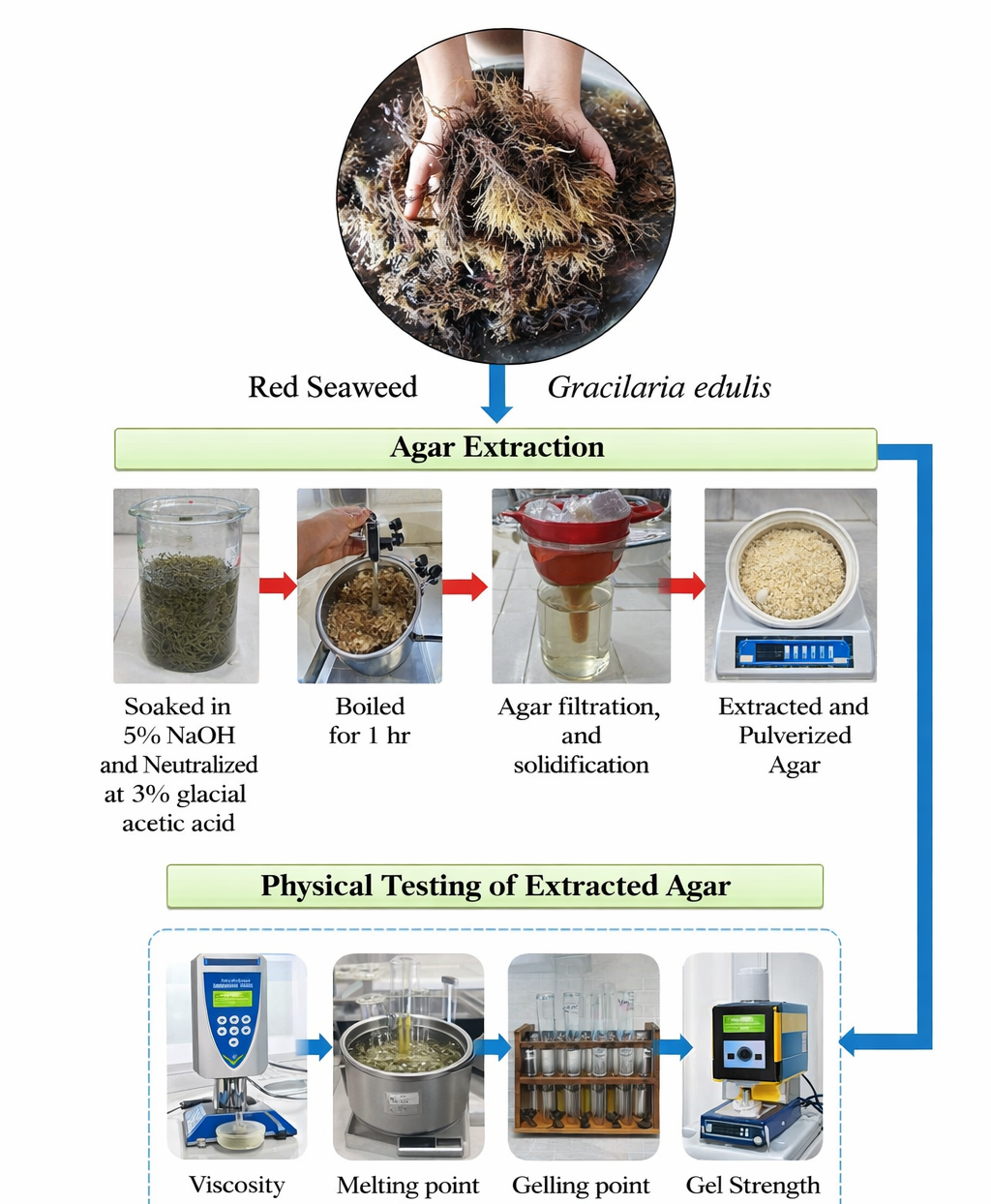
The agar potential of Gracilaria edulis cultured at two coastal sites in La Union, Philippines, was evaluated to determine site-dependent differences in yield and quality. Significant variations (p < 0.05) were observed between Balaoan and Rosario. While Rosario produced greater biomass, Balaoan yielded significantly higher agar. Proximate composition also differed, with Balaoan exhibiting higher protein and carbohydrate contents. Concentrations of inorganic arsenic (i-As), cadmium (Cd), and lead (Pb) were within the permissible limits set by the Department of Environment and Natural Resources for SB-class waters, indicating environmental safety at both sites. Agar quality parameters showed contrasting trends. Rosario samples demonstrated significantly higher viscosity, gel strength, and 3,6-anhydrogalactose content, suggesting superior gel-forming properties. In contrast, Balaoan agar exhibited higher melting and gelling temperatures, as well as higher sulfate levels. These results confirm that culture site significantly influences agar yield and physicochemical properties of G. edulis. The findings provide important insights for optimizing site selection to enhance both productivity and functional quality in commercial agar production.
Article Details

This work is licensed under a Creative Commons Attribution-NonCommercial-NoDerivatives 4.0 International License.
References
Endoma LF Jr, Monsale DR, Borlongan IAG, Gaya HCG, Santacera PAS, Yap EES. Short term tank culture of Gracilariopsis heteroclada at high salinities improves agar quality. Bot Mar. 2024;67(6):645–654.
Li Z, Tu M, Qin F, Shui G, Xu D, Zang X. Identification of indicator genes for agar accumulation in Gracilariopsis lemaneiformis (Rhodophyta). Int J Mol Sci. 2024;25(9):4606.
Mohibbullah M, Talha MA, Baten MA, Newaz AW, Choi JS. Yield optimization, physicochemical characterizations, and antioxidant properties of food grade agar from Gracilaria tenuistipitata of Cox’s Bazar coast, Bangladesh. Food Sci Nutr. 2023;11(6):2852–2863.
American Public Health Association, American Water Works Association, Water Environment Federation. Standard methods for the examination of water and wastewater (23rd ed.). 2017.
Belattmania Z, Bhaby S, Nadri A, Khaya K, Bentiss F, Jama C, Reani A, Vasconcelos V, Sabour B. Gracilaria gracilis (Gracilariales, Rhodophyta) from Dakhla (Southern Moroccan Atlantic Coast) as source of agar: Content, chemical characteristics, and gelling properties. Mar Drugs. 2021;19(12):672.
Li X, Yao W, Hu C, Lin C, You L, Mao J. Comparative analysis of Gracilaria chouae polysaccharides derived from different geographical regions: Focusing on their chemical composition, rheological properties, and gel characteristics. Gels. 2024;10(7):454.
Behera DP, Ingle KN, Mathew DE, Elze DM, Dhimmar A, Sahastrabudhe H, Sahu SK. Epiphytism, diseases and grazing in seaweed aquaculture: A comprehensive review. Rev Aquac. 2022;14(3):1345–1370.
Cheong AYL, Annammala KV, Yong EL, Zhou Y, Nichols RS, Martin P. Distribution of nutrients and dissolved organic matter in a eutrophic equatorial estuary: The Johor River and the East Johor Strait. Biogeosciences. 2024;21(12):2955–2971.
Dugdale RC, Parker AE, Wilkerson FP. Patterns in anthropogenic nitrogen and water quality leading to phytoplankton blooms in urban estuaries. J Mar Sci Eng. 2024;12(11):2029.
He S, Gordon S, Maiti K. Carbonate and nutrient dynamics in the Mississippi River influenced eutrophic estuary. Estuaries Coast. 2025;48:63.
Luu Viet Dung N, Tue NT, Quy TD, Nhuan MT. Ammonium, nitrate, and phosphate in coastal waters of the Red River Biosphere Reserve, Vietnam. Environ Nat Resour J. 2025;23(1):1.
Endoma LF, Monsale DR, Borlongan IAG, Gaya HCG, Santacera PAS, Yap EES. Short term tank culture of Gracilariopsis heteroclada at high salinities improves agar quality. Bot Mar. 2024;67(6):645–654.
Mohibbullah M, Talha MA, Baten MA, Newaz AW, Choi JS. Yield optimization, physicochemical characterizations, and antioxidant properties of food grade agar from Gracilaria tenuistipitata of Cox’s Bazar coast, Bangladesh. Food Sci Nutr. 2023; 11(6): 2852–2863.
Kapranov SV, Toichkin AM, Belous OS, Gureeva EV, Barinova SS, Ryabushko VI. Heavy metals and arsenic in macrophytes, sediments and seawater from the coastal area of Northern and Central Vietnam. Mar Pollut Bull. 2025;213:117672.
Gao W, Qu B, Yuan H, Song J, Li W. Heavy metal mobility in contaminated sediments under seawater acidification. Mar Pollut Bull. 2023;192:115062.
Salido M, Soto M, Bilbao J, Quintano E, Etxebarria N, Arana I, et al. Comparative analyses and characterization of eight seaweed species from the southeastern Bay of Biscay for potential biotechnological applications. J Appl Phycol. 2025;37(4):2845–2858.
Rivas J, Piñón J, Becerra J. Heavy metal depuration steps for Gracilaria chilensis in outdoor culture systems. Molecules. 2022;27(20): 6832.
Sakthivel R, Pandima Devi K. Evaluation of physicochemical properties, proximate and nutritional composition of Gracilaria edulis collected from Palk Bay. Food Chem. 2015;174:68–74.
Yücetepe A, Kırkın C, Mertdinç Z, Ayar EN, Soylukan C, Dikici E, Okudan EŞ. Chemical composition and nutrient profiles of nine red macroalgae species. Food Prod Process Nutr. 2024;6(1):84.
Rosemary T, Arulkumar A, Paramasivam S, Mondragon Portocarrero A, Miranda JM. Biochemical, micronutrient and physicochemical properties of the dried red seaweeds Gracilaria edulis and Gracilaria corticata. Molecules. 2019;24(12):2225.
Zhang T, Guo Q, Xin Y, Liu Y. Comprehensive review in moisture retention mechanism of polysaccharides from algae, plants, bacteria and fungus. Arab J Chem. 2022;15(10):104163.
Alfinaikh RS, Alamry KA, Hussein MA. Sustainable and biocompatible hybrid materials-based sulfated polysaccharides for biomedical applications: a review. RSC Adv. 2025;15(6):4708–4767.
Wang Q, Xie H, Liu J. Effects of nitrogen source and concentration on the growth and biochemical composition of the red seaweed Grateloupia turuturu (Halymeniaceae, Rhodophyta). Sustainability. 2023;15(5):4210.
Mendes M, Costa JM, Caetano NS, Trovão D. Red seaweed (Rhodophyta) phycocolloids: A road from biopolymer structure to environmental influence on production and quality. Mar Drugs. 2024;22(10):432.
Yücetepe A, Kırkın C, Mertdinç Z, Ayar EN, Soylukan C, Dikici E, Okudan EŞ. Chemical composition and nutrient profiles of nine red macroalgae species. Food Prod Process Nutr. 2024;6:84.
De Alwis PS, Wijesekara I. Gel properties of agar from two Gracilaria species in Sri Lanka and development of food jellies. Ruhuna J Sci. 2022;13(1):1–13.
Alam M, Majid I, Kaur S, Dar BN, Nanda V. An updated review on exploring hydrocolloids application in food matrix: Current insights into fruit, bakery, meat, and dairy based products. J Texture Stud. 2025;56(2):e70020.
Nussinovitch A. Hydrocolloid applications in foods: Review and recent advances. Food Hydrocoll. 2020;108:106047.
Praiboon J, Chirapart A, Akakabe Y, Bhumibhamon O. Gel properties and chemical characteristics of agar from wild and cultivated Gracilaria spp. in Thailand. J Appl Phycol. 2020;32:3667–3678.
Diop CIK, Beltran S, Jaime I, Sanz M‑T. Adjustable gel texture of recovered crude agar induced by processing conditions. Foods. 2022;11(14):2081.
