
Use of water hyacinth-based compost to improve the growth and biochemical properties of lettuce (Lactuca sativa var. crispa L.)
Article Sidebar
Main Article Content
Abstract
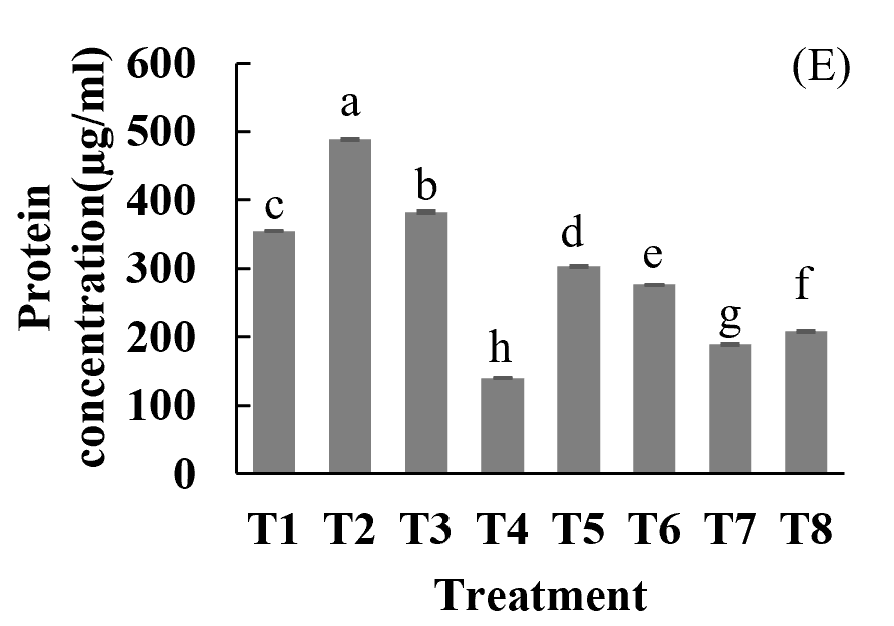
Water hyacinth (Eichhornia crassipes) is an invasive aquatic weed that spreads rapidly and poses serious ecological threats to freshwater ecosystems. Converting this biomass into compost offers a sustainable solution for weed management and soil fertility improvement. This study evaluated the effects of water hyacinth-based (WH-based) compost on the growth and biochemical properties of lettuce (Lactuca sativa var. crispa L.). Lettuce plants were cultivated for 45 days in a planting medium composed of 70% (v/v) topsoil and 30% (v/v) coconut coir, amended with 0%, 10%, 30%, 50%, 70%, and 90% (v/v) of WH-based compost. Two commercial soil media without compost served as controls. Growth and biochemical parameters were analyzed using one-way ANOVA, and means were compared with Tukey’s HSD test at p < 0.05. The 10% compost treatment produced the highest growth parameters, with a plant length of 27.33 ± 1.53 cm, a root length of 18.33 ± 1.53 cm, a leaf number of 26.83 ± 0.76, a bush width of 28.00 ± 1.00 mm, a plant thickness of 19.23 ± 0.73 mm, a leaf weight of 98.29 ± 1.00 g, and a dry weight of 4.93 ± 0.03 g. Additionally, 10% compost significantly increased protein, carbohydrate, and reducing sugar contents. Overall, WH-based compost at appropriate ratios can effectively enhance lettuce growth and biochemical quality while providing an eco-friendly approach to the management water hyacinth biomass.
Article Details

This work is licensed under a Creative Commons Attribution-NonCommercial-NoDerivatives 4.0 International License.
References
Ganorkar PM, Sharma RA, Yadav S. Water hyacinth: A noxious weed with bioremediation potential. Environ Sci Pollut Res. 2022:29(21):31614–31628.
Posaluk P, Junkasiraporn A. Government policy and action plan on solving problems of water hyacinth and weeds in public water sources. Ministry of Interior, Thailand. 2010.
Osoro N, Muoma J, Amoding A, Mukaminega D, Muthini M, Ombori O, Maingi MJ. Effects of water hyacinth (Eichhornia crassipes [Mart.] Solms) compost on growth and yield parameters of maize (Zea mays). Br J Appl Sci Technol. 2014;4:617–633.
Begum R, Seyid Mohamed Moulana SH, Afreen S. Potential of water hyacinth (Eichhornia crassipes) as compost and its effect on soil and plant properties: a review. Agric Rev. 2021;42(4):1–9.
Jain N, Kalamdhad AS. Effects of water hyacinth compost on seed germination and plant growth of Spinacia oleracea (Spinach). Environ Sustain. 2019;2:329–335.
Kawashima ML, Soares VML. Mineral profile of raw and cooked leafy vegetables consumed in southern Brazil. J Food Compos Anal. 2003;16(5):605–611.
Chiesa A, Giorgioni ME, Santamaria P. Lettuce (Lactuca sativa L.). In: Vegetable Crops. Springer; 2009. p.205–224.
Suslow TV, Mitchell JP, Smith RF. Lettuce production in California. Univ Calif Agric Nat Res Publ. 2003;1:7217.
Tharungsri P, Nualsri C, Phasinam K, Kassanuk T, Sreela-or C. Life Sci Environ J. 2022;23(1):196–207.
Tharangsri P, Phasinam K, Nualsri C, Phasinam T, Yamkhong S, Sreela-or C. A study on effectiveness of compost from elephant dung with organic matter on green oak lettuce growth. Life Sci Environ J. 2023;24(1):214–225.
Kumngen A, Iewkittayakorn J, Meehae U, Suwannara S, Anuchan S, et al. Effects of compost from food waste on growth of lettuce (Lactuca sativa var. crispa L.). Int J Recycl Org Waste Agric. 2023;12:247–258.
Thai Agricultural Standard (TAS 9503). Compost. Natl bur agric commodity food stand, minist agric coop, Thailand. Royal Gazette. 2014;122:114Dc.
Pinto E, Almeida AA, Aguiar AARM, Ferreira IMPLVO. Changes in microminerals, trace elements and pigments content during lettuce (Lactuca sativa L.) growth: influence of soil composition. Food Chem. 2014;152:603–611.
Deepika P, MubarakAli D. Production and assessment of microalgal liquid fertilizer for the enhanced growth of four crop plants. Biocatal Agric Biotechnol. 2020;28:101701.
Wongkrachang S, Rattaneetoo B. Effects of media mixed with local residues in Narathiwat Province for Lactuca sativa var. crispa L. growth. Khon Kaen Agric J. 2018;46:1156–1160.
Dash S, Dixit S, Sahoo S. Phytochemical and biochemical characterizations from leaf extracts of Azadirachta indica: an important medicinal plant. Biochem Anal Biochem. 2017;6:2–6.
Sapkota TB, Vetter SH, Jat ML, Sirohi S, Shirsath PB, Singh R. Cost-effective opportunities for climate change mitigation in Indian agriculture. Sci Total Environ. 2019;655:1342–1354.
Ohemeng-Ntiamoah J, Datta T. Evaluating analytical methods for the characterization of lipids, proteins and carbohydrates in organic substrates for anaerobic co-digestion. Bioresour Technol. 2018;247:697–704.
Sarkar S, Mondal M, Ghosh P, Saha M, Chatterjee S. Quantification of total protein content from some traditionally used edible plant leaves: a comparative study. J Med Plants Stud. 2020;8(4):166–170.
Devi MC, Kumar MS. Production, optimization and partial purification of cellulase by Aspergillus niger fermented with paper and timber sawmill industrial wastes. J Microbiol Biotechnol Res. 2012;2(1):120–128.
Neureiter M, Danner H, Thomasser C, Saidi B, Braun R. Dilute-acid hydrolysis of sugarcane bagasse at varying conditions. Appl Biochem Biotechnol. 2002;98 (13):49–58.
Kong Y, Zhang J, Yang Y, Liu Y, Zhang L, Wang G, et al. Determining the extraction conditions and phytotoxicity threshold for compost maturity evaluation using the seed germination index method. Waste Manag. 2023;171:502–511.
U.S. Environmental Protection Agency (EPA). A Guide to the biosolids risk assessments for the EPA Part 503 rule (EPA/832-B-93-005). Washington (DC): Off Wastewater Manag; 1995.
Association of Official Analytical Chemists (AOAC). 22nd ed. Official Method 973.04 – pH of Peat. 2019.
Association of Official Analytical Chemists (AOAC). 22nd ed. Official Method 955.04 – Nitrogen (Total) in fertilizers: Kjeldahl Method. 2019.
Association of Official Analytical Chemists (AOAC). 22nd ed. Official Method 958.01 – Phosphorus (Total) in fertilizers: Spectrophotometric molybdovanadophosphate method. 2019.
Association of Official Analytical Chemists (AOAC). 22nd ed. Official Method 983.02 – Potassium in fertilizers: Flame photometric method (Manual or Automated). 2019.
Association of Official Analytical Chemists (AOAC). 22nd ed. Official Method 967.05 – Organic Matter in peat. 2019.
British Standards Institution (BSI). 7th edition. Soil Quality – Chemical Methods: Determination of organic and total carbon after dry combustion (Elementary Analysis). BS 7755; 1995.
British Standards Institution (BSI). 7th edition. Soil Improvers and Growing Media – Determination of electrical conductivity. BS EN 13038; 2000.
USDA / U.S. Composting Council. 7th edition. TMECC 2.02-B: Particle Size. In: Test Methods for the Examination of composting and compost, 2002.
Association of Official Analytical Chemists (AOAC). 22nd ed. Official Method 950.01 – Moisture in meat. 2020.
Association of Official Analytical Chemists (AOAC). 22nd ed. Official Method 999.10 – Lead, Cadmium, Zinc, Copper, and Iron in foods: Atomic absorption spectrophotometry after dry ashing. 2019.
Marschner H. Mineral Nutrition of Higher Plants. 2nd ed. New York: Academic Press. 1995;18:559–579.
Rady MM, Semida WM, Hemida KA, Abdelhamid MT. The effect of compost on growth and yield of Phaseolus vulgaris plants grown under saline soil. Int J Recycl Org Waste Agric. 2016;5:311–321.
Muscolo A, Papalia T, Mallamaci C, Carabetta S, Di Sanzo R, Russo M. Effect of organic fertilizers on selected health-beneficial bioactive compounds and aroma profile of red topepo sweet pepper. Foods. 2020;9:1323.
Yadav D, Singh D, Choudhary R. Excessive compost application and nitrate accumulation in vegetables. J Environ Sci Health B. 2021;56(1):55–62.
