
Bioremediation of Heavy Metal Using Burkholderia cenocepacia and Optimization of Heavy Metal Remediation
Article Sidebar
Main Article Content
Abstract
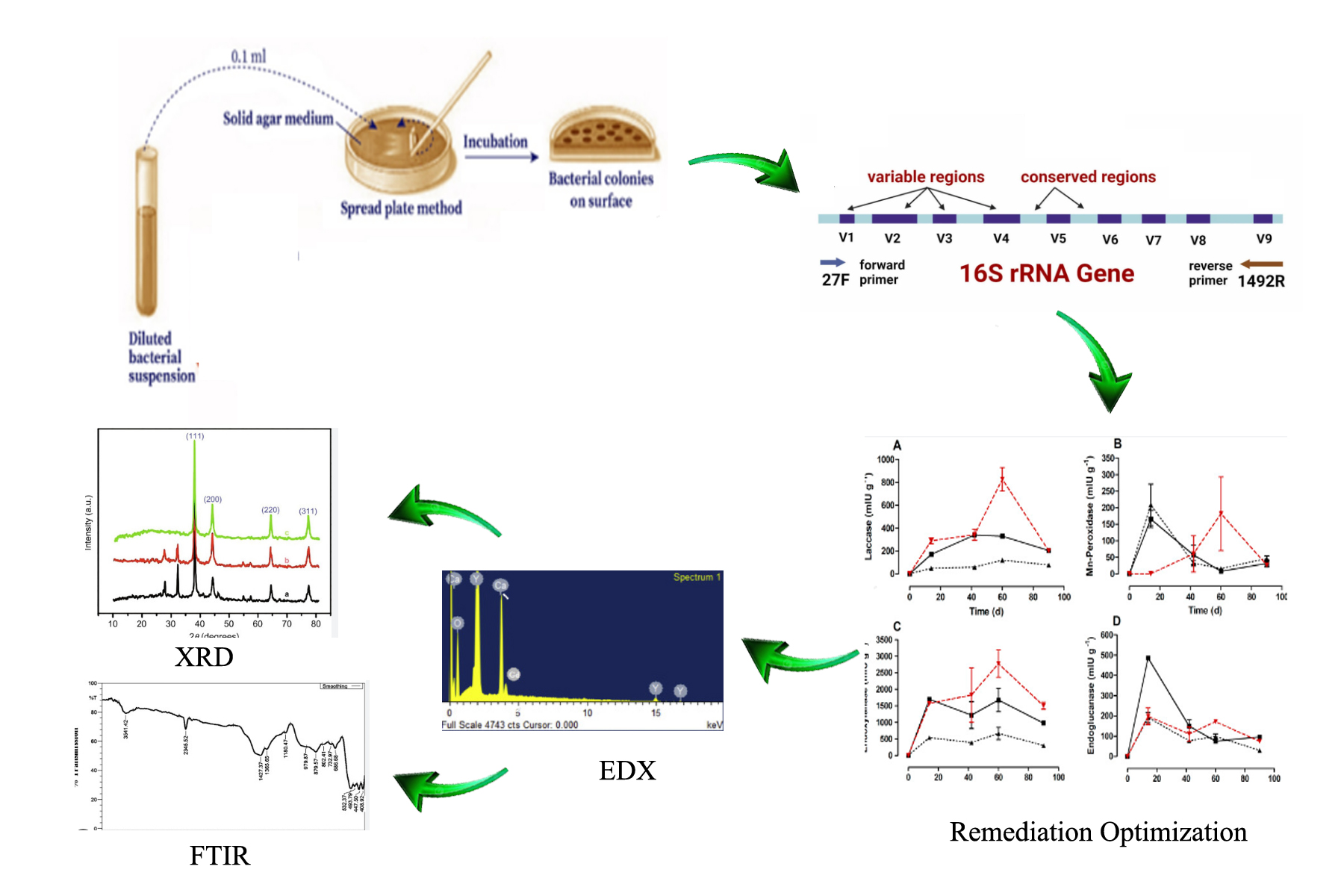
Rapid industrialization has resulted in widespread metal contamination of ecosystems, creating a need for effective biological remediation strategies. This study investigated the metal tolerance and biosorption characteristics of Burkholderia cenocepacia isolated from heavy metal-contaminated soil. The strain demonstrated effective removal of different metal ions, including As³⁺, Pb²⁺, Zn²⁺, and Cr⁶⁺, from multi-metal solutions. Minimum inhibitory concentration (MIC) assays revealed variations in metal tolerance, indicating strain-specific responses to metal stress. The strain showed strong metal tolerance capacity; however, the simultaneous presence of multiple metal ions resulted in competitive binding and reduced metal removal, suggesting inhibition of metal adsorption onto extracellular polymeric substances (EPS). FTIR analysis confirmed the involvement of bacterial functional groups in metal binding and revealed the appearance of new peaks following metal exposure, indicating possible EPS production and associated changes in cellular surface chemistry. EDX analysis further demonstrated metal deposition on bacterial surfaces and within cytoplasmic regions, together with morphological changes and distinct metal adsorption patterns. XRD and EDX analyses confirmed intracellular metal accumulation, highlighting the complexity of microbial–metal interactions. Differences in metal distribution patterns suggested species-specific accumulation mechanisms influenced by metal availability and environmental conditions. The findings emphasize the importance of selecting suitable bacterial strains for specific metal containing effluents, particularly where competitive interactions may limit simultaneous metal uptake. The broad metal tolerance and removal capacity of B. cenocepacia indicate its potential application in heavy metal remediation through bioreactors or in situ treatment systems.
Article Details

This work is licensed under a Creative Commons Attribution-NonCommercial-NoDerivatives 4.0 International License.
References
Ragini G. Pankaj B. Cynobacteria: A comprehensive review. Int Res J Pharm. 2012;3(2):1-5.
Mandal AK, Sarma PM, Singh B, Jeyaseelan CP, Channashettar VA, Lal B, Datta J. Bioremediation: An Environment Friendly Sustainable Biotechnological Solution for Remediation of Petroleum Hydrocarbon Contaminated Waste. ARPN J Sci Technol. 2012;2:1-12.
Vaishnav VK, Chatterjee T, Agrawal M. Bioremediation potential of consortium Bacillus cereus and Micrococcus luteus in soil polluted by heavy metal and phytotoxicity studies. Asia Pac J Sci Technol. 30(4);2025:1-9.
Alavijeh PK, Halimoon N, Zakaria MP, Johari WLW, Karimi B. Crude oil biodegradation using isolated bacteria from oil polluted soil. In: From Sources to Solution. Singapore: Springer Singapore; 2014. p. 127-129.
Naik MM, Pandey A, Dubey SK. Bioremediation of metals mediated by marine bacteria. In: Microorganisms in Environmental Management. Dordrecht: Springer Netherlands; 2012. p. 665-682.
Sharma S. Bioremediation: Features, Strategies and applications. Asian J Pharm Life Sci. 2012;2(2):1-12.
Salem IB, Sghaier H, Trifi1 H, Héni S, Khwaldia K, Saidi M, Landoulsi A. Isolation and characterization of a novel Micrococcus strain for bioremediation of strontium in radioactive residues. Afr J Microbiol Res. 2012;6(4):851-858.
Bahig AE, Aly EA, Khaled AA, Amel KA. Isolation, Characterization and Application of Bacterial Population from Agricultural Soil at Sohag Province, Egypt. Malays J Microbiol. 2008;4(2):42-50.
Perriello FA, inventor; Hydrocarbon Technologies, Inc., assignee. Remediation of metal contaminants with hydrocarbon utilizing bacteria. United States patent. 2005.
Garbisu C, Alkorta I. Basic concepts on heavy metal soil bioremediation. Eur J Miner Process Environ Prot. 2003;3(1):58-66.
Das N, Vimala R, Karthika P. Biosorption of heavy metals—An overview. Indian J Biotechnol. 2008;7(2):159-169.
Basha SA, Rajaganesh K. Microbial Bioremediation of Heavy Metals from Textile Industry Dye Effluents using Isolated Bacterial Strains. Int J Curr Microbiol App Sci. 2014;3(5):785-794.
Azad AK, Nahar A, Hasan MM, Islam K, Azim MF, Hossain MS, et al. Fermentation of solid wastes by bacterial isolates for productio of raw protein degradation Proteases. Asian J Microbiol Biotechnol Environ Sci. 2013;15:365-374.
Carlos FS, Giovanella P, Bavaresco J, Borges C de S, Camargo FA de O. A comparison of microbial bioaugmentation and biostimulation for hexavalent chromium removal from wastewater. Water Air Soil Pollut. 2016;227:175.
Zahoor A, Rehman A. Isolation of Cr (VI) reducing bacteria from industrial e_uents and their potential use in bioremediation of chromium containing wastewater. J Environ Sci. 2009;21:814-820.
François F, Lombard C, Guigner J-M, Soreau P, Brian-Jaisson F, Martino G, et al. Isolation and characterization of environmental bacteria capable of extracellular biosorption of mercury. Appl Environ Microbiol. 2012;78(4):1097-1106.
Mzimela ZNT, Linganiso LZ, Revaprasadu N, Motaung TE. Comparison of cellulose extraction from sugarcane bagasse through alkali. Mater Res. 2018;21(6).
Feng Y-H, Cheng T-Y, Yang W-G, Ma P-T, He H-Z, Yin X-C, et al. Characteristics and environmentally friendly extraction of cellulose nanofibrils from sugarcane bagasse. Ind Crops Prod. 2018;111:285-291.
Ahalya N, Ramachandra TV, Kanamadi RD. Biosorption of heavy metals. Res J Chem Environ. 2003;7(4):71-78.
Vijayaraghavan K, Yun Y-S. Bacterial biosorbents and biosorption. Biotechnol Adv. 2008;26(3):266-291.
Kiran I, Akar T, Tunali S. Biosorption of Pb(II) and Cu(II) from aqueous solutions by pretreated biomass of Neurospora crassa. Process Biochem. 2005;40(11):3550-3558.
Zhou Y, Gu X, Xu J, Li H. Mechanisms of lead biosorption on cellulose/chitosan-based hydrogels: FTIR, XPS, and SEM analysis. Environ Sci Pollut Res. 2014;21(4):3611-3618.
Dash HR, Mangwani N, Chakraborty J, Kumari S, Das S. Marine bacteria: potential candidates for enhanced bioremediation. Appl Microbiol Biotechnol. 2013;97(2):561-571.
Pagnanelli F, Esposito A, Toro L, Vegliò F. Metal speciation and pH effect on Pb, Cu, Zn and Cd biosorption onto Sphaerotilus natans: Langmuir-type empirical model. Water Res. 2003;37(3):627-633.
Yang J, Volesky B. Biosorption of uranium on Sargassum biomass. Water Res. 1999;33(15):3357-3363.
Rao RAK, Rehman F, Ahmad S. Removal of lead ions from aqueous solution by activated carbon prepared from Dalbergia sissoo wood by chemical activation. Ind J Chem Technol. 2002;9(1):15-20.
Wang J, Chen C. Biosorption of heavy metals by Saccharomyces cerevisiae: a review. Biotechnol Adv. 2006;24(5):427-451.
Gadd GM. Biosorption: critical review of scientific rationale, environmental importance and significance for pollution treatment. J. Chem. Technol. Biotechnol. 2009;84(1):13-28.
