
Fuzzy logic enhanced machine learning framework for adaptive thermal absorber configuration optimization in building integrated photovoltaic thermal systems
Article Sidebar
Main Article Content
Abstract
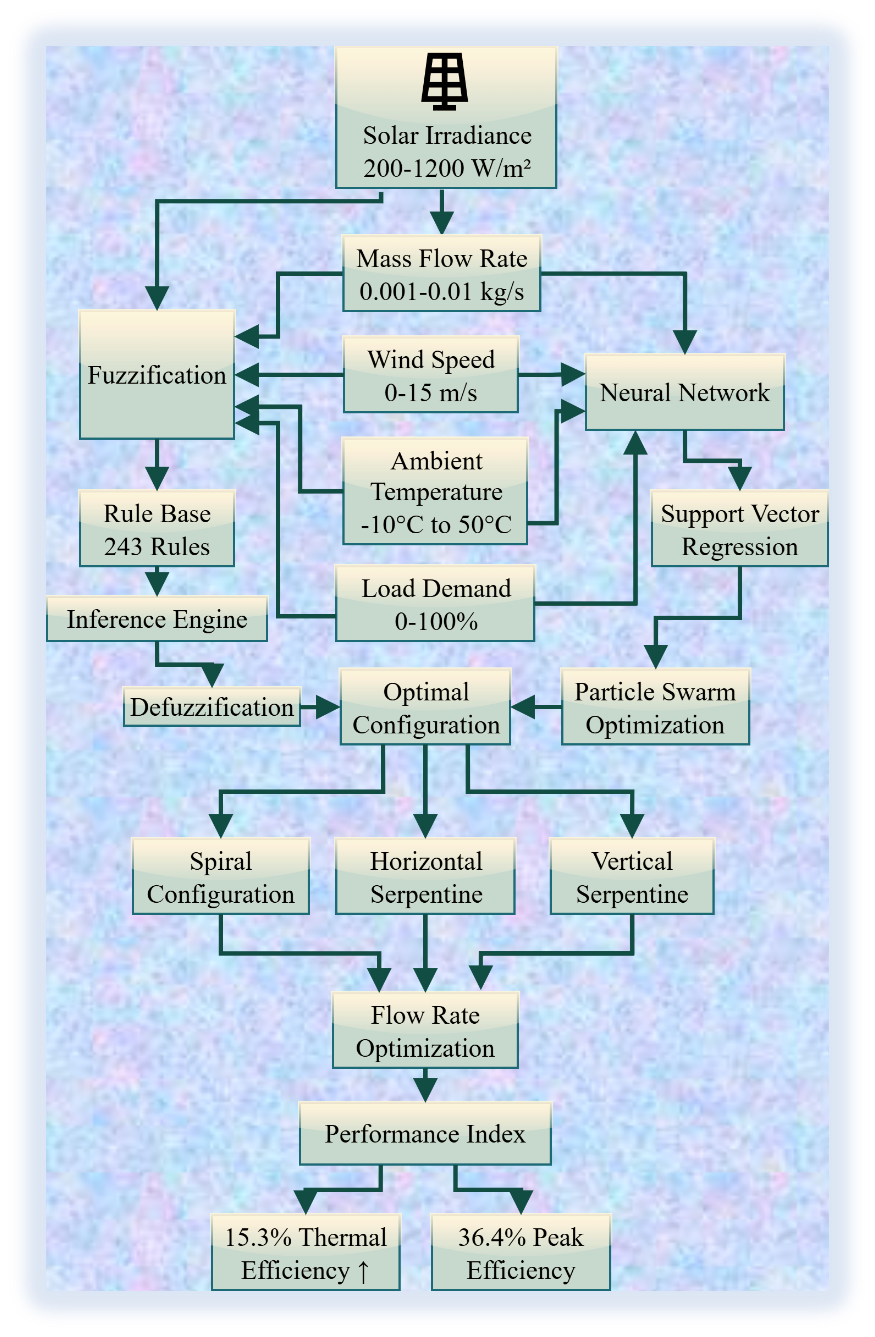
Building integrated photovoltaic thermal (BIPVT) systems represent a promising technology for achieving net-zero energy buildings by simultaneously generating electricity and thermal energy. However, optimizing thermal absorber configurations remains challenging due to complex interactions between environmental variables, system parameters, and performance objectives. This paper presents a novel fuzzy logic-enhanced machine learning framework for adaptive thermal absorber configuration optimization in BIPVT systems. The proposed framework integrates fuzzy inference systems with advanced machine learning algorithms to dynamically optimize absorber tube geometries, material properties, and operational parameters. The methodology incorporates real-time environmental data, system performance metrics, and user preferences to provide intelligent decision-making capabilities. Experimental validation demonstrates that the proposed framework achieves 15.3% improvement in thermal efficiency and 12.7% enhancement in overall system performance compared to conventional optimization approaches. The fuzzy logic component enables interpretable decision-making while maintaining robustness under uncertain operating conditions. Results indicate that spiral absorber configurations optimized through the proposed framework achieve the highest performance with 36.4% overall efficiency at 1000 W/m² solar irradiance.
Article Details

This work is licensed under a Creative Commons Attribution-NonCommercial-NoDerivatives 4.0 International License.
References
Gharaee H, Erfanimatin M, Bahman AM. Machine learning development to predict the electrical efficiency of photovoltaic-thermal (PVT) collector systems. Energy Conv Manag. 2024;315:118808.
Hamada A, Emam M, Refaey HA, Moawed M, Abdelrahman MA, Elsayed MEA. Identification of a different design of a photovoltaic thermal collector based on fuzzy logic control and the ARMAX model. Therm Sci Eng Prog. 2024;48:102395.
Chekifi T. Artificial Intelligence for thermal energy storage enhancement: A Comprehensive Review. J Energy Resour Technol. 2024;146(6):1-2.
Safari A, Oshnoei A. An overview of artificial intelligence recent applications for combined heat and power systems optimization in smart cities. Authorea. 2024;18(11):2891.
Xiao H, Lai A, Chen A, Lai S, He W, Deng X, Zhang C, Ren H. Application of Photovoltaic and Solar thermal technologies in buildings: A mini-review. Coatings. 2024;14(3):257-259.
Taft CA, Canchaya JGS. Overview: Photovoltaic solar cells, science, materials, artificial intelligence, nanotechnology and state of the art. In: Trends and innovations in energetic sources, functional compounds and biotechnology. Engineering materials. Cham Springer. 2024;1:5-8.
Sayed ET, Rezk H, Olabi AG, Gomaa MR, Hassan YB, Rahman SMA, Shah SK, Abdelkareem MA. Application of artificial intelligence to improve the thermal energy and exergy of nanofluid-based PV thermal/nano-enhanced phase change material. Energies. 2022;15(22):8494.
Sohani A, Sayyaadi H, Cornaro C, Shahverdian MH, Pierro M, Moser D, Karimi, Doranehgard MH, Li LKB. Using machine learning in photovoltaics to create smarter and cleaner energy generation systems: A comprehensive review. J Clean Prod. 2022;364:132701.
Shahsavar A, Moayedi H, Waeli AHAA, Chelvanathan P. Machine learning predictive models for optimal design of building-integrated photovoltaic-thermal collectors. Int J Energy Res. 2020;44(7):5675-5695.
Dash AK, Agrawal S, Gairola S, Shukla S. Exergoeconomic and envirnoeconomic analysis of building integrated photovoltaic thermal (BIPVT) system and its optimization. IOP Conf Ser Mater Sci Eng. 2019;691(1):012078.
Qian Y, Ji J, Xie H, Jia H, Meng H, Li J, Mu Y. Performance investigation of multi-functional series-connected building-integrated photovoltaic/thermal system and analysis of its multi-objective optimization design strategy. Build Environ. 2024;5:112126.
Li Z, Shahsavar A, Rashed AAA, Kalbasi R, Afrand M, Talebizadehsardari P. Multi-objective energy and exergy optimization of different configurations of hybrid earth-air heat exchanger and building integrated photovoltaic/thermal system. Energy Conv Manag. 2019;195:1098-1110.
Rao VT, Sekhar YR. Hybrid photovoltaic/thermal (PVT) collector systems with different absorber configurations for thermal management –A review. Energy Environ. 2021;34(3):690-735.
Chandrasekar M. Building-integrated solar photovoltaic thermal (BIPVT) technology: a review on the design innovations, aesthetic values, performance limits, storage options and policies. Adv Build Energy Res. 2023;17(2):223-254.
Yip S, Athienitis AK, Lee B. Sensitivity analysis of building form and BIPVT energy performance for net-zero energy early-design stage consideration. IOP Conf Ser Earth Environ Sci. 2019;238:012065.
Chialastri A, Isaacson M. Performance and optimization of a BIPV/T solar air collector for building fenestration applications. Energy Build. 2017;150:200-210.
Rajasundrapandiyanleebanon T, Kumaresan K, Murugan S, Subathra MSP, Sivakumar M. Solar energy forecasting using machine learning and deep learning techniques. Arch Comput Methods Eng. 2023;30:3059-3079.
Kabilan R, Chandran V, Yogapriya J, Karthick A, Gandhi PP, Mohanavel V, Rahim R, Manoharan S. Short-Term power prediction of building integrated photovoltaic (BIPV) system based on machine learning algorithms. Int J Photoenergy. 2021;2021:1-11.
Asif, Ahmad W, Qureshi MB, Khan MM, Fayyaz MAB, Nawaz R. Optimizing large-scale PV systems with machine learning: A neuro-fuzzy MPPT control for PSCs with uncertainties. Electronics. 2023;12(7):1720.
Tina GM, Ventura C, Ferlito S, Vito SD. A State-of-Art-Review on machine-learning based methods for PV. Appl Sci. 2021;11(16):7550.
Dhanraj JA, Mostafaeipour A, Velmurugan K, Techato K, Chaurasiya PK, Solomon JM, Gopalan A, Phoungthong K. An effective evaluation on fault detection in solar panels. Energies. 2021;14(22):7770.
Romero MHF, Rosa MEC, Callejo LH, Rebollo MAG, Payo VC, Gómez VA, Saavedra SG, Aragonés JIM. Enhancing photovoltaic cell classification through mamdani fuzzy logic: a comparative study with machine learning approaches employing electroluminescence images. Prog Artif Intell. 2025;14:49-59.
Patel D, Patel S, Patel P, Shah M. Solar radiation and solar energy estimation using ANN and Fuzzy logic concept: A comprehensive and systematic study. Environ Sci Pollut Res. 2022;29:32428-32442.
Lawani AO, Adeleke TB, Osuizugbo IC. Solar photovoltaic systems: A Review of risks, fault detection, and mitigation Strategies. Proc 5th IEEE Int Conf Electro-Computing Technologies for Humanity (NIGERCON). Ado Ekiti, Nigeria. 2024;26:1-5.
Khadka N, Bista A, Adhikari B, Shrestha A, Bista D, Adhikary B. Current practices of solar photovoltaic panel cleaning system and future prospects of machine learning implementation. IEEE Access. 2020;8:135948-135962.
Farajollahi A, Baharvand M, Takleh HR. Modeling and optimization of hybrid geothermal-solar energy plant using coupled artificial neural network and genetic algorithm. Process Saf Environ Prot. 2024;186:348-360.
Almaraashi M. Using particle swarm optimization of fuzzy logic systems as a hybrid soft computing method to enhance solar energy prediction. Neural Comput Appl. 2023;35:21903-21914.
Shezan SA, Ishraque MF, Shafiullah MG, Kamwa I, Paul LC, Muyeen SM, Ramakrishna NSS, Saleheen MZ, Kumar PP. Optimization and control of solar-wind islanded hybrid microgrid by using heuristic and deterministic optimization algorithms and fuzzy logic controller. Energy Rep. 2023;10:3272-3288.
Gao W, Moayedi H, Shahsavar A. The feasibility of genetic programming and ANFIS in prediction energetic performance of a building integrated photovoltaic thermal (BIPVT) system. Sol Energy. 2019;183:293-305.
