
In vitro α-glucosidase inhibitory, antioxidant and cytotoxic activities of Cnidoscolus aconitifolius leaf fractions from Thailand
Article Sidebar
Main Article Content
Abstract
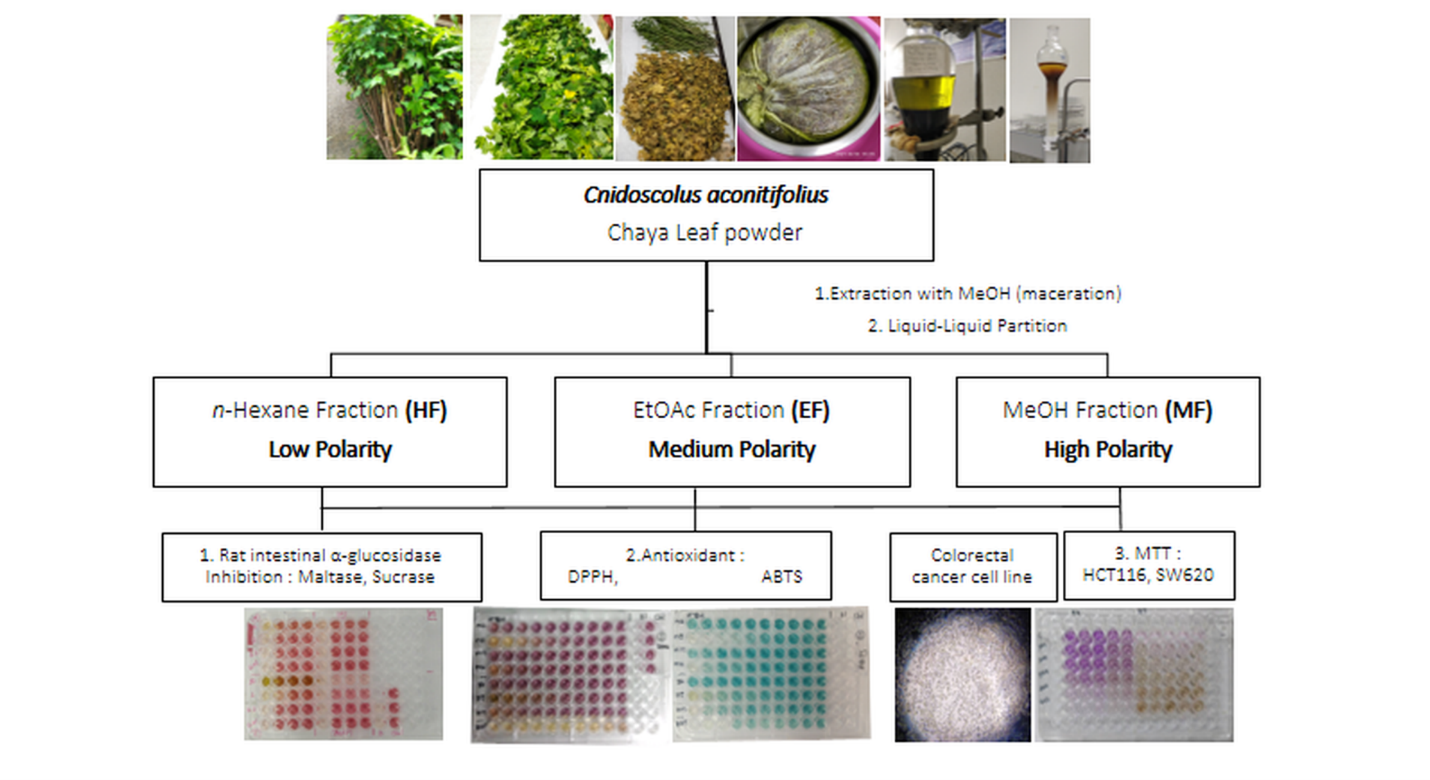
Cnidoscolus aconitifolius is a widely consumed vegetable that has potential bioactive compounds to attenuate several complex diseases, including cancer and diabetes. This study aimed to evaluate bioactivity of different polarity C. aconitifolius fractions, including antioxidant, α-glucosidase inhibition, and cytotoxicity on colorectal cancer cell lines. C. aconitifolius leaves were macerated with methanol and then partitioned with n-hexane and ethyl acetate, respectively, to obtain three different polarity fractions; n-hexane (HF), ethyl acetate (EF), and methanol (MF) fractions, which were low, medium, and high polarity fractions, respectively. The fractions were examined for antioxidant activities , antidiabetic activity, colorectal cancer cytotoxicity activities against HCT116 and SW620 cell lines ], and phytochemicals. The antioxidant evaluation using the DPPH reagent indicated that the EF had the greatest scavenging ability, while the MF had the highest result against the ABTS reagent. The α- glucosidase inhibition assay using maltose substrate revealed EF had the strongest inhibitory activity, and MF had the best result with sucrose substrate. The HF inhibited HCT116 cell line development the most, whereas the EF effectively reduced SW620 cell line growth. Meanwhile, the MF had no effect against both cell lines. HF, EF and MF were analyzed for the compounds’ content and found varied compounds, which should be further purified for bioactive compounds. Different polarity fractions of C. aconitifolius leaf showed distinct bioactivities. The characteristic of therapeutic drug discovery for cancer and diabetes diseases can be concerned with the selectable polarity of solvents.
Article Details

This work is licensed under a Creative Commons Attribution-NonCommercial-NoDerivatives 4.0 International License.
References
Maya-Lastra CA, Steinmann VW. A nomenclator of Cnidoscolus (Euphorbiaceae). Phytotaxa. 2018;346(1).
Nascimento JB do, Viturino JJF, Ribeiro MAM, Costa JGM da. Nutritional Value, Ethnopharmacology, Chemistry, and Biological Activities of Species of the Genus Cnidoscolus: An Updated Review. Foods. 2025;14(12):2092.
Grubben GJH, editor. Vegetables. Wageningen: PROTA Foundation; 2004. (Plant Resources of Tropical Africa; vol. 2).
Kongphapa J, Chupanit P, Anutrakulchai S, Cha’on U, Pasuwan P. Nutritional and phytochemical properties of Chaya leaves (Cnidoscolus chayamansa Mc Vaugh) planted in Northeastern Thailand. Asia Pacific J Sci Technol. 2022;27(1):APST-27-01-08.
Manzanilla Valdez ML, Acevedo Fernandez JJ, Segura Campos MR. Antidiabetic and hypotensive effect of Cnidoscolus aconitifolius (Mill) IM Johnst leaves extracts. J Food Meas Charact. 2021;15(6):5245–5255.
Li D. Diabetes and pancreatic cancer. Mol Carcinog. 2012;51(1):64-74.
Wojciechowska J, Krajewski W, Bolanowski M, Kręcicki T, Zatoński T. Diabetes and cancer: a review of current knowledge. Exp Clin Endocrinol Diabetes. 2016;124(05):263-275.
Giovannucci E, Harlan DM, Archer MC, Bergenstal RM, Gapstur SM, Habel LA, et al. Diabetes and cancer: a consensus report. CA Cancer J Clin. 2010;60(4):207-221.
Bodmer M, Becker C, Meier C, Jick SS, Meier CR. Use of metformin is not associated with a decreased risk of colorectal cancer: a case-control analysis. Cancer Epidemiol biomarkers Prev. 2012;21(2):280-286.
Ndip RN, Tanih NF, Kuete V. Antidiabetes activity of African medicinal plants. In: Medicinal Plant Research in Africa. 2013. Elsevier: 753–786.
Sánchez-Aguirre OA, Juárez-Aguilar E, Montoya-Hernández EL, Vázquez-Hernández M, Colorado-Peralta R, Sánchez-Medina A, et al. Antioxidant potential of Cnidoscolus multilobus (Pax) IM Johnst and its antiproliferative and cytotoxic effect on cervical cancer cells. Eur J Integr Med. 2022;53:102134.
Somade OT, Ugbaja RN, Idowu MA, Akinloye OA. Cnidoscolus aconitifolius leaf extract and ascorbate confer amelioration and protection against dimethyl nitrosamine-induced renal toxicity and testicular abnormalities in rats. Toxicol Reports. 2021;8:1098-1108.
Abolmaesoomi M, Aziz AA, Junit SM, Ali JM. Ficus deltoidea: Effects of solvent polarity on antioxidant and anti-proliferative activities in breast and colon cancer cells. Eur J Integr Med. 2019;28:57-67.
Nawaz H, Shad MA, Rehman N, Andaleeb H, Ullah N. Effect of solvent polarity on extraction yield and antioxidant properties of phytochemicals from bean (Phaseolus vulgaris) seeds. Brazilian J Pharm Sci. 2020;56:e17129.
Li Y, Huang J, Lin W, Yuan Z, Feng S, Xie Y, et al. In vitro anticancer activity of a nonpolar fraction from Gynostemma pentaphyllum (Thunb.) Makino. Evid Based Complement Alternat Med. 2016;2016(1):6308649.
Luciani S, Nederveen L, Martinez R, Caixeta R, Chavez C, Sandoval RC, et al. Noncommunicable diseases in the Americas: a review of the Pan American Health Organization’s 25-year program of work. Rev Panam Salud Pública. 2023;47:e13.
Zhang Q-W, Lin L-G, Ye W-C. Techniques for extraction and isolation of natural products: A comprehensive review. Chin Med. 2018;13:1-26.
Do QD, Angkawijaya AE, Tran-Nguyen PL, Huynh LH, Soetaredjo FE, Ismadji S, et al. Effect of extraction solvent on total phenol content, total flavonoid content, and antioxidant activity of Limnophila aromatica. J Food Drug Anal. 2014;22(3):296-302.
Gaber NB, El-Dahy SI, Shalaby EA. Comparison of ABTS, DPPH, permanganate, and methylene blue assays for determining antioxidant potential of successive extracts from pomegranate and guava residues. Biomass Convers Biorefinery. 2021;13:4011-4020.
Jo SH, Ka EH, Lee HS, Apostolidis E, Jang HD, Kwon YI. Comparison of antioxidant potential and rat intestinal α-glucosidases inhibitory activities of quercetin, rutin, and isoquercetin. Int J Appl Res Nat Prod. 2009;2(4):52-60.
Hanyu X, Lanyue L, Miao D, Wentao F, Cangran C, Hui S. Effect of Ganoderma applanatum polysaccharides on MAPK/ERK pathway affecting autophagy in breast cancer MCF-7 cells. Int J Biol Macromol. 2020;146:353-362.
Daddiouaissa D, Amid A, Kabbashi NA, Fuad FAA, Elnour AM, Epandy MA. Antiproliferative activity of ionic liquid-graviola fruit extract against human breast cancer (MCF-7) cell lines using flow cytometry techniques. J Ethnopharmacol. 2019;236:466-473.
Luo J-G, Ma L, Kong L-Y. New triterpenoid saponins with strong α-glucosidase inhibitory activity from the roots of Gypsophila oldhamiana. Bioorg Med Chem. 2008;16(6):2912-2920.
Ferlay J, Shin H, Bray F, Forman D, Mathers C, Parkin DM. Estimates of worldwide burden of cancer in 2008: GLOBOCAN 2008. Int J cancer. 2010;127(12):2893–2917.
Wong JH, Ng TB, Chan HHL, Liu Q, Man GCW, Zhang CZ, et al. Mushroom extracts and compounds with suppressive action on breast cancer: evidence from studies using cultured cancer cells, tumor-bearing animals, and clinical trials. Applied Microbiology and Biotechnology. 2020;104(11):4675–4703.
Siegel R, Naishadham D, Jemal A. Cancer statistics for hispanics/latinos, 2012. CA Cancer J Clin. 2012;62(5):283-298.
Wild S, Roglic G, Green A, Sicree R, King H. Global prevalence of diabetes: estimates for the year 2000 and projections for 2030. Diabetes Care. 2004;27(5):1047-1053.
de Andrade SF, Lemos M, Comunello E, Noldin VF, Cechinel Filho V, Niero R. Evaluation of the antiulcerogenic activity of Maytenus robusta (Celastraceae) in different experimental ulcer models. J Ethnopharmacol. 2007;113(2):252-257.
Liu JP, Zhang M, Wang W, Grimsgaard S. Chinese herbal medicines for type 2 diabetes mellitus. Cochrane Database Syst Rev. 2002;(3):CD003642.
Kang W, Song Y, Gu X. α-glucosidase inhibitory in vitro and antidiabetic activity in vivo of Osmanthus fragrans. J Med Plants Res. 2012;6(14):2850-2856.
Hwang IG, Kim HY, Woo KS, Hong JT, Hwang BY, Jung JK, et al. Isolation and characterisation of an α-glucosidase inhibitory substance from fructose–tyrosine Maillard reaction products. Food Chem. 2011;127(1):122-126.
Welch JP, Donaldson GA. The clinical correlation of an autopsy study of recurrent colorectal cancer. Ann Surg. 1979;189(4):496.
Harris IS, DeNicola GM. The complex interplay between antioxidants and ROS in cancer. Trends Cell Biol. 2020;30(6):440-451.
Singh R, Manna PP. Reactive oxygen species in cancer progression and its role in therapeutics. Explor Med. 2022;43-57.
Berkelaar D. Chaya. ECHO Technical Note. North Fort Myers (FL): ECHO; 2006.
Moura LFWG, da Silva Neto JX, Lopes TDP, Benjamin SR, Brito FCR, Magalhães FEA, et al. Ethnobotanic, phytochemical uses and ethnopharmacological profile of genus Cnidoscolus spp. (Euphorbiaceae): A comprehensive overview. Biomed Pharmacother. 2019;109:1670-1679.
Rajput A, San Martin ID, Rose R, Beko A, LeVea C, Sharratt E, et al. Characterization of HCT116 human colon cancer cells in an orthotopic model. J Surg Res. 2008;147(2):276-281.
Hu T, Li Z, Gao C-Y, Cho CH. Mechanisms of drug resistance in colon cancer and its therapeutic strategies. World J Gastroenterol. 2016;22(30):6876.
García-Rodríguez RV, Gutiérrez-Rebolledo GA, Méndez-Bolaina E, Sánchez-Medina A, Maldonado-Saavedra O, Domínguez-Ortiz MÁ, et al. Cnidoscolus chayamansa Mc Vaugh, an important antioxidant, anti-inflammatory and cardioprotective plant used in Mexico. J Ethnopharmacol. 2014;151(2):937-943.
Mohammed MJ, Anand U, Altemimi AB, Tripathi V, Guo Y, Pratap-Singh A. Phenolic composition, antioxidant capacity and antibacterial activity of white wormwood (Artemisia herba-alba). Plants. 2021;10(1):1-14.
Ezema BO, Eze CN, Ayoka TO, Nnadi CO. Antioxidant-enzyme Interaction in Non-communicable Diseases. J Explor Res Pharmacol. 2024;9(4):262-275.
Guerrero L, Castillo J, Quinones M, Garcia-Vallve S, Arola L, Pujadas G, et al. Inhibition of angiotensin-converting enzyme activity by flavonoids: structure-activity relationship studies. PLoS One. 2012;7(11):e49493.
Ajiboye BO, Ojo OA, Okesola MA, Oyinloye BE, Kappo AP. Ethyl acetate leaf fraction of Cnidoscolus aconitifolius (Mill.) IM Johnst: antioxidant potential, inhibitory activities of key enzymes on carbohydrate metabolism, cholinergic, monoaminergic, purinergic, and chemical fingerprinting. Int J Food Prop. 2018;21(1):1697-1715.
Proença C, Freitas M, Ribeiro D, Oliveira EFT, Sousa JLC, Tomé SM, et al. α-Glucosidase inhibition by flavonoids: an in vitro and in silico structure–activity relationship study. J Enzyme Inhib Med Chem. 2017;32(1):1216-1228.
Nazaruk J, Borzym-Kluczyk M. The role of triterpenes in the management of diabetes mellitus and its complications. Phytochem Rev. 2015;14:675-690.
Saeidnia S, Abdollahi M. Anticancer terpenoids. In: Saeidnia S, editor. New approaches to natural anticancer drugs. Cham: Springer; 2015. p. 67-92.
Normén AL, Brants HAM, Voorrips LE, Andersson HA, van den Brandt PA, Goldbohm RA. Plant sterol intakes and colorectal cancer risk in the Netherlands Cohort Study on Diet and Cancer. Am J Clin Nutr. 2001;74(1):141-148.
Uaraksakul P, Chanprapai P. In vitro antifungal activity of Boesenbergia rotundo Linn. and Syzygium aromaticum L. Merr. and Perry extracts against Aspergillus flavus. Med Sci Forum. 2022;12(1):8.
Uaraksakul P, Silawong K, Sornkaew N. Comparison of the efficacy of Rhizome extracts of some family Zingiberaceae plants for antifungal Rhizoctonia solani Kuhn. J BSRU Res Dev Inst. 2014;9(2):52-61.
Phong HX, Viet NT, Quyen NTN, Van Thinh P, Trung NM, Ngan TTK. Phytochemical screening, total phenolic, flavonoid contents, and antioxidant activities of four spices commonly used in Vietnamese traditional medicine. Mater Today Proc. 2022;56:A1-A5.
Uaraksakul P, Sornkaew N, Phuwapraisirisan P, Syukriya AJ, Yanatatsaneejit P. In vitro α-Glucosidase Inhibitory, Antioxidant and Anti-Colorectal Cancer Activities of Gourd (Coccinia grandis) Stems Fractions and its Compounds. Trop J Nat Prod Res. 2025;9(8):3951-3960.
