
Evaluation of the biochemical constituents and antioxidant potential of Heterotrigona itama bee bread extracted using the bromelain-assisted method
Article Sidebar
Main Article Content
Abstract
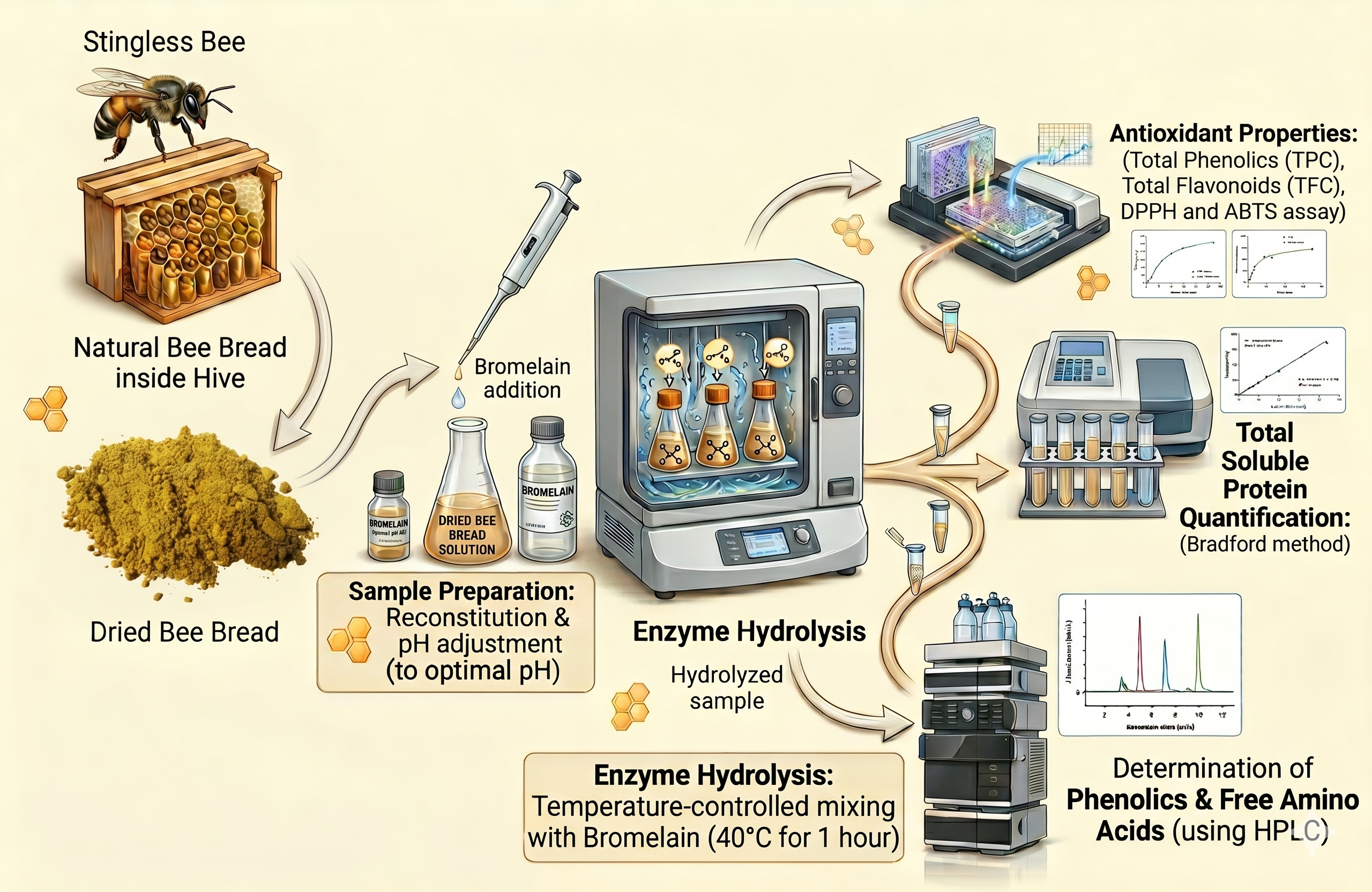
Bee bread is a nutrient-dense substance produced through the microbial fermentation of pollen, nectar, and bee secretions, serving as the primary nourishment for stingless bee colonies. This study aimed to evaluate the biochemical constituents of Heterotrigona itama bee bread, specifically investigating how bromelain-assisted extraction influences its antioxidant potential and nutrient solubility. Nutritional profiling of the fresh bee bread revealed a high content of carbohydrates (57.0%) and proteins (23.3%). The results demonstrated that bromelain treatment significantly improved the biochemical profile of the enzymatically-treated bee bread (EBB) compared to the raw (RBB) and water-extracted (WBB) controls. Post-treatment, the total soluble protein content increased substantially from 195.8 mg/mL in RBB to 456.7 mg/mL in EBB. Furthermore, enzymatic hydrolysis significantly retained and enhanced the antioxidant capacity, showing a 26.5% to 32.2% increase in radical-scavenging activity through DPPH and ABTS assays relative to the raw samples. The main phenolic acids found in all samples analyzed using HPLC were gallic acid, protocatechuic acid, 4-hydroxybenzoic acid, caffeic acid, and rutin. Proline was identified as the predominant free amino acid, with all nine essential amino acids present, alongside non-protein amino acids such as gamma-aminobutyric acid (GABA). These findings indicate that bromelain-assisted extraction effectively enhances the nutritional composition and antioxidant potential of H. itama bee bread.
Article Details

This work is licensed under a Creative Commons Attribution-NonCommercial-NoDerivatives 4.0 International License.
References
Mărgăoan R, Stranț M, Varadi A, Topal E, Yücel B, Cornea-Cipcigan M, et al. Bee Collected Pollen and Bee Bread: Bioactive Constituents and Health Benefits. Antioxidants. 2019;8(12):568.
Mohammad SM, Mahmud-Ab-Rashid NK, Zawawi N. Botanical Origin and Nutritional Values of Bee Bread of Stingless Bee (Heterotrigona itama) from Malaysia. J Food Qual. 2020;(1):2845757.
Bakour M, Laaroussi H, Ousaaid D, El Ghouizi A, Es-Safi I, Mechchate H, et al. Bee Bread as a Promising Source of Bioactive Molecules and Functional Properties: An Up-to-Date Review. Antibiotics. 2022;11(2).
Wouters AGB, Rombouts I, Fierens E, Brijs K, Delcour JA. Relevance of the Functional Properties of Enzymatic Plant Protein Hydrolysates in Food Systems. Compr Rev Food Sci Food Saf. 2016;15(4):786–800.
Manzoor Z, Nawaz A, Mukhtar H, Haq I. Bromelain: Methods of Extraction, Purification and Therapeutic Applications. Braz Arch Biol Technol. 2016(5):16150010.
Alcalá-Orozco M, Lobo-Farfan I, Tirado DF, Mantilla-Escalante DC. Enhancing the Nutritional and Bioactive Properties of Bee Pollen: A Comprehensive Review of Processing Techniques. Foods. 2024;13(21).
Ćirić J, Haneklaus N, Rajić S, Baltić T, Lazić IB, Đorđević V. Chemical composition of bee bread (perga), a functional food: A review. J Trace Elem Miner. 2022(2):100038.
Kaplan M, Karaoglu Ö, Eroglu N, Silici S. Fatty acid and proximate composition of bee bread. Food Technol Biotechnol. 2016;54(4):497–504.
Aksoy A, Altunatmaz SS, Aksu F, Tokatlı Demirok N, Yazıcı K, Yıkmış S. Bee Bread as a Functional Product: Phenolic Compounds, Amino Acid, Sugar, and Organic Acid Profiles. Foods. 2024;13(5):795.
Damulienė V, Kaškonienė V, Kaškonas P, Maruška A. The Influence of Enzymatic Hydrolysis on Bee Pollen Antioxidant and Antibacterial Activities. Foods. 2023;12(19).
AOAC International. Official methods of analysis of AOAC International. 19th ed. Gaithersburg, MD; 2012.
Singleton VL, Rossi JA. Colorimetry of Total Phenolics with Phosphomolybdic-Phosphotungstic Acid Reagents. Am J Enol Vitic. 1965;16(3).
Zhishen J, Mengcheng T, Jianming W. The determination of flavonoid contents in mulberry and their scavenging effects on superoxide radicals. Food Chem. 1999;64(4):555–559.
Thaipong K, Boonprakob U, Crosby K, Cisneros-Zevallos L, Hawkins Byrne D. Comparison of ABTS, DPPH, FRAP, and ORAC assays for estimating antioxidant activity from guava fruit extracts. J Food Compost Anal. 2006;19(6–7):669–675.
Re R, Pellegrini N, Proteggente A, Pannala A, Yang M, Rice-Evans C. Antioxidant activity applying an improved ABTS radical cation decolorization assay. Free Radic Biol Med. 1999;26(9–10):1231–7.
Bradford MM. A rapid and sensitive method for the quantitation of microgram quantities of protein utilizing the principle of protein-dye binding. Anal Biochem. 1976;72(1–2):248–254.
Kahar AA, Koh SP, Danial AM, Long K. Effect of soaking conditions on gamma-aminobutyric acid (GABA) and amino acids content in mung bean. Food Res. 2022(6):109–116.
Mat Rashid Z, Abd Rashid KA, Rois Anwar NZ. Heterotrigona Itama Bee Bread Extracts: Effect of Solvent Polarity on Extraction Yield, Chemical Characteristics and Antioxidant Activity. J Agrobiotechnol. 2023;14(1):44–53.
Aylanc V, Falcão SI, Vilas-Boas M. Bee pollen and bee bread nutritional potential: Chemical composition and macronutrient digestibility under in vitro gastrointestinal system. Food Chem. 2023(413):135597.
Svečnjak L, Bošković K, Prđun S, Mrkonjić Fuka M, Tanuwidjaja I. Metric and Spectral Insight into Bee-Pollen-to-Bee-Bread Transformation Process. Foods. 2023;12(22):4149.
Campos MGR, Bogdanov S, de Almeida-Muradian LB, Szczesna T, Mancebo Y, Frigerio C, et al. Pollen composition and standardisation of analytical methods. J Apic Res. 2008;47(2):154–161.
Bakour M, Fernandes Â, Barros L, Sokovic M, Ferreira ICFR, Badiaa lyoussi. Bee bread as a functional product: Chemical composition and bioactive properties. Lebenson Wiss Technol. 2019(109):276–282.
Ismail WIW, Hussin NN, Mazlan SNF, Hussin NH, Radzi MNFM. Physicochemical Analysis, Antioxidant and Anti Proliferation Activities of Honey, Propolis and Beebread Harvested from Stingless Bee. IOP Conf Ser Mater Sci Eng. 2018;440(1):012048.
Chuttong B, Phongphisutthinant R, Sringarm K, Burgett M, Barth OM. Nutritional composition of pot-pollen from four species of stingless bees (Meliponini) in southeast Asia. In: Pot-Pollen in Stingless Bee Melittology. Cham: Springer International Publishing; 2018. p. 313–324.
Rebelo KS, Ferreira AG, Carvalho-Zilse GA. Physicochemical characteristics of pollen collected by Amazonian stingless bees. Ciência Rural. 2016;46(5):927–932.
Shahbal N, Jing X, Bhandari B, Dayananda B, Prakash S. Effect of enzymatic hydrolysis on solubility and surface properties of pea, rice, hemp, and oat proteins: Implication on high protein concentrations. Food Biosci. 2023(53):102515.
Marinova M, Cuc NTK, Tchorbanov B. Enzymatic Hydrolysis of Soy Protein Isolate by Food Grade Proteinases and Aminopeptidases of Plant Origin. Biotechnol Biotechnol Equip. 2008;22(3):835–838.
Martins IM, Roberto BS, Blumberg JB, Chen CYO, Macedo GA. Enzymatic biotransformation of polyphenolics increases antioxidant activity of red and white grape pomace. Food Res Int. 2016(89):533–539.
Ee KY, Khoo LY, Ng WJ, Wong FC, Chai TT. Effects of Bromelain and Trypsin Hydrolysis on the Phytochemical Content, Antioxidant Activity, and Antibacterial Activity of Roasted Butterfly Pea Seeds. Processes. 2019;7(8):534.
Benzie IFF, Devaki M. The ferric reducing/antioxidant power (FRAP) assay for non-enzymatic antioxidant capacity: concepts, procedures, limitations and applications. In: Measurement of Antioxidant Activity & Capacity. Chichester, UK: John Wiley & Sons, Ltd; 2017. p. 77–106.
Soobrattee MA, Neergheen VS, Luximon-Ramma A, Aruoma OI, Bahorun T. Phenolics as potential antioxidant therapeutic agents: Mechanism and actions. Mutat Res. 2005;579(1–2):200–213.
Arshad ZIM, Amid A, Yusof F, Jaswir I, Ahmad K, Loke SP. Bromelain: An overview of industrial application and purification strategies. Appl Microbiol Biotechnol. 2014;98(17):7283–7297.
Cosme P, Rodríguez AB, Espino J, Garrido M. Plant Phenolics: Bioavailability as a Key Determinant of Their Potential Health-Promoting Applications. Antioxidants 2020;9(12):1263.
Meng C, Wang J, Zeng Y, Yao X, Meng J. Dietary Proline Supplementation Promotes Growth and Development in Weaned Foals by Modulating Gut Microbial Amino Acid Metabolism. Microorganisms. 2025;13(11):2598.
McCaslin TG, Pagba C V., Chi SH, Hwang HJ, Gumbart JC, Perry JW, et al. Structure and Function of Tryptophan–Tyrosine Dyads in Biomimetic β Hairpins. J Phys Chem B. 2019;123(13):2780–2791.
