
The Efficiency of Hybrid K-Means and Density Peak Clustering Algorithms for Multidimensional Poverty Clustering Using Thai People Map and Analytics Platform (TPMAP) Database
Article Sidebar
Main Article Content
Abstract
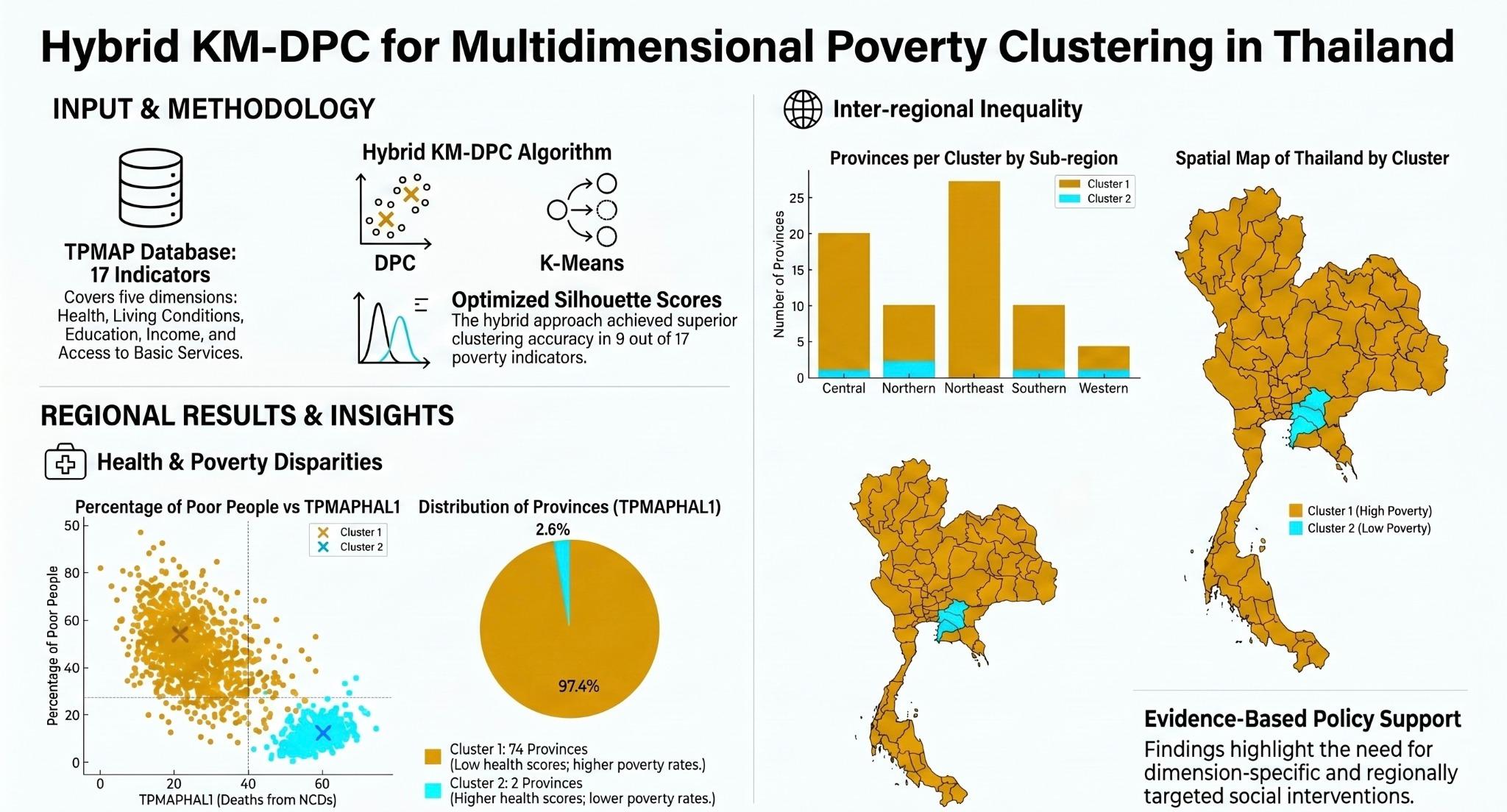
Multidimensional poverty remains a critical challenge for sustainable development in Thailand, requiring analytical approaches that can reveal complex regional patterns of deprivation. This study evaluated the effectiveness of a hybrid clustering algorithm that integrated the K-Means and Density Peak Clustering (DPC) algorithms to categorize Thai provinces based on multidimensional poverty characteristics. The analysis used data from the Thai People Map and Analytics Platform (TPMAP), incorporating seventeen indicators across five key dimensions: living conditions, health, education, income, and access to basic services. The proposed hybrid method combined the computational efficiency of K-Means with the density-based cluster detection capability of DPC to improve clustering accuracy. The clustering results were evaluated using the Silhouette Score and visualized by scatter plots, bar charts, pie charts, and spatial maps to illustrate regional poverty patterns. The results indicated that the hybrid approach produced more coherent and well-separated clusters compared to the traditional K-Means algorithm, revealing clear inter-regional disparities in multidimensional poverty across Thai provinces. The findings suggested that poverty characteristics differ significantly by dimension and region, highlighting the importance of dimension-specific and regionally targeted policy interventions. This study demonstrated the potential of hybrid clustering algorithms as an effective data-driven tool to support evidence-based policymaking for reducing social inequality.
Article Details

This work is licensed under a Creative Commons Attribution-NonCommercial-NoDerivatives 4.0 International License.
References
Alkire S, Foster J. Counting and multidimensional poverty measurement. J Public Econ. 2011;95(7–8):476–487.
United Nations Development Programme (UNDP) and Oxford Poverty and Human Development Initiative (OPHI). Global Multidimensional Poverty Index 2023: Unstacking global poverty. New York: UNDP; 2023.
The Office of National Economic and Social Development Board (NESDB) and National Electronics and Computer Technology Center (NECTEC), National Science and Technology Development Agency (NSTDA), Ministry of Science and Technologies. The Thai People Map and Analytics Platform (TPMAP). https://www.tpmap.in.th.
Jain AK. Data clustering: 50 years beyond K-means. Pattern Recognit Lett. 2010;31(8):651–666.
Sarker IH. Machine learning: Algorithms, real-world applications and research directions. SN Comput Sci. 2021;2(3):160.
Xu D, Tian Y. A comprehensive survey of clustering algorithms. Ann Data Sci. 2015;2(2):165–193.
Basu S, Banerjee A, Mooney RJ. Semi-supervised clustering by seeding. In: Proceedings of the 19th International Conference on Machine Learning (ICML 2002); 2002. p. 19-26.
MacQueen J. Some methods for classification and analysis of multivariate observations. In: Proceedings of the Fifth Berkeley Symposium on Mathematical Statistics and Probability. Berkeley (CA): University of California Press; 1967. p. 281-297.
Rodriguez A, Laio A. Clustering by fast search and find of density peaks. Science. 2014;344(6191):1492-1496.
Sun L, Qin X, Ding W, Xu J, Zhang S. Density peaks clustering based on k-nearest neighbors and self-recommendation. Int J Mach Learn Cybern. 2021;12(7):1913–1938.
Jean N, Burke M, Xie M, Alampay Davis WM, Lobell DB, Ermon S. Combining satellite imagery and machine learning to predict poverty. Science. 2016;353(6301):790–794.
Rahman MA, Alam MR, Hossain MA. A clustering approach to identify multidimensional poverty using K-means with cosine similarity. PLOS ONE. 2021;16(7):e0255312.
Zhang M, Ma Y, Li J, Zhang J. A density connection weight-based clustering approach for dataset with density-sparse region. Expert Syst Appl. 2023;230:120633.
Kanungo T, Mount DM, Netanyahu NS, Piatko CD, Silverman R, Wu AY. An efficient k-means clustering algorithm: analysis and implementation. IEEE Trans Pattern Anal Mach Intell. 2002;24(7):881–892.
Bradley PS, Bennett KP, Demiriz A. Constrained K-means clustering. Technical Report MSR-TR-2000-65. Redmond (WA): Microsoft Research; 2000.
Bradley PS, Fayyad UM. Refining initial points for K-means clustering. In: Proceedings of the Fifteenth International Conference on Machine Learning; 1998 Jul 24–27; Madison, WI. p. 91–99.
Sinaga KP, Yang M-S. Unsupervised K-means clustering algorithm. IEEE Access. 2020;8:80716–80727.
Cao L, Liu Y, Wang D, Wang T, Fu C. A novel density peak fuzzy clustering algorithm for moving vehicles using traffic radar. Electronics. 2020;9(1):46.
Wang Y, Wei Z, Yang J. Feature trend extraction and adaptive density peaks search for intelligent fault diagnosis of machines. IEEE Trans Ind Inform. 2019;15(1):105–115.
Tian J, Zhao J, Zheng C. Clustering of cancer data based on Stiefel manifold for multiple views. BMC Bioinformatics. 2021;22:268.
