
Feasibility of Floating Photovoltaic Systems in Nong Han Lake, Sakon Nakhon Province, Thailand
Article Sidebar
Main Article Content
Abstract
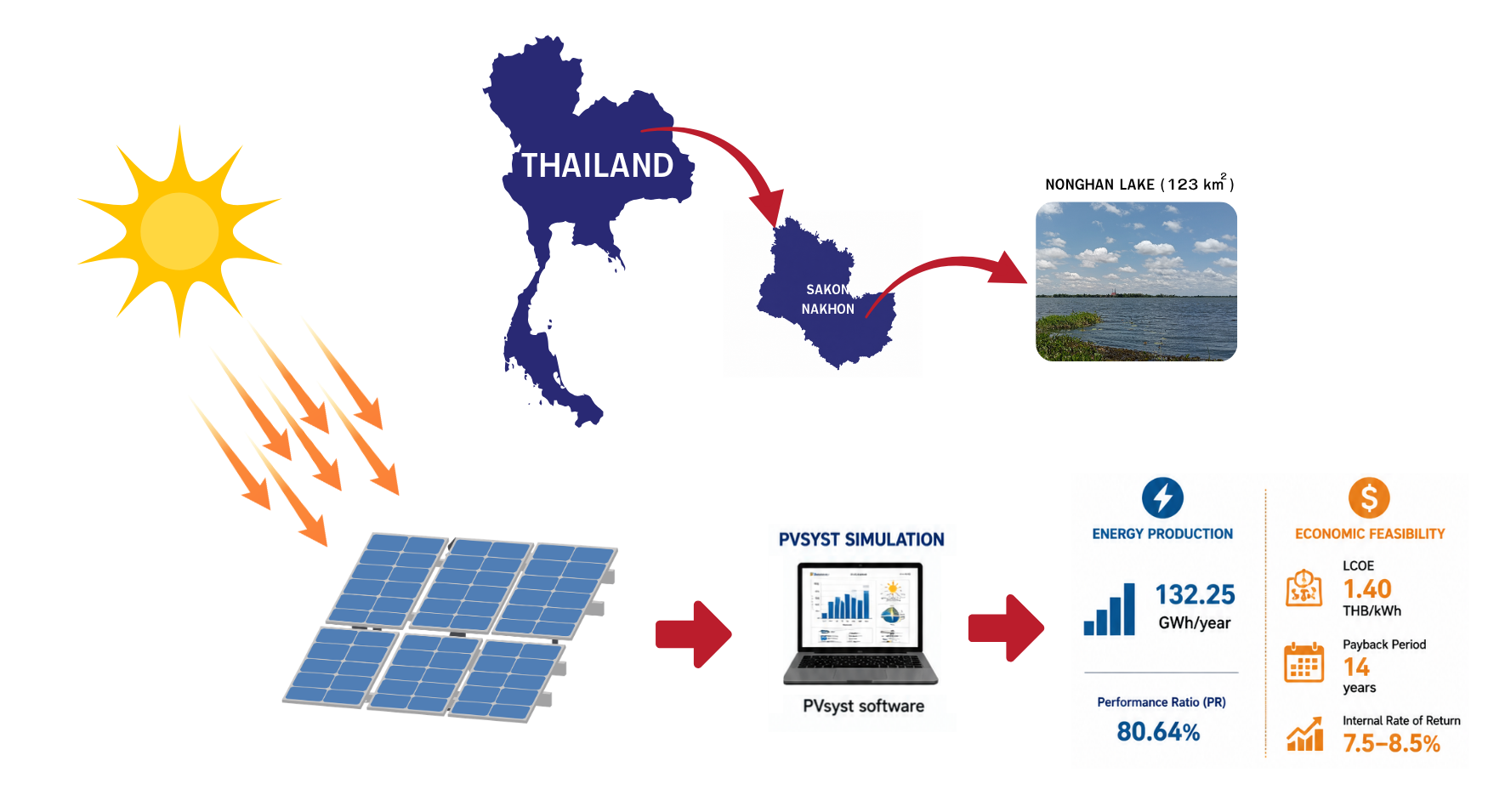
This study aims to assess the potential and feasibility of developing and installing a floating solar photovoltaic (FPV) power generation system on Nong Han Lake in Sakon Nakhon Province, Thailand. This novel assessment of a large-scale, natural water body fills a research gap, as most previous FPV initiatives in Thailand have focused on artificial reservoirs. The feasibility analysis focuses on both technical and economic aspects. The methodological approach integrates field data, a comprehensive site suitability analysis, and simulations using PVsyst software. The results indicate that an FVP system in the 80-hectare pilot area can support a capacity of 96.34 MWp, generating approximately 132.25 GWh/year, with a performance ratio of 80.64% and a levelized cost of energy of 1.40 THB/kWh, which is significantly lower than the current feed-in tariff. The project demonstrates strong economic viability, featuring a 14-year payback period and an internal rate of return of 7.5–8.5%. This study highlights FPV as a promising renewable energy solution and offers a strategic framework for FPV deployment in unique natural aquatic environments across the region.
Article Details

This work is licensed under a Creative Commons Attribution-NonCommercial-NoDerivatives 4.0 International License.
References
Office of Alternative Energy Development and Energy Conservation (Ministry of Energy). Report on the loss situation of Thailand (preliminary). 2024 July.
Khrueakham A, Anurugsa B, Hangsapung N. Influence of chemical fertilizer application on water quality in paddy filed in Nong Harn Sakon Nakhon Province. Kasetsart J Nat Sci. 2015;46(6):868-879.
Ananpreechakorn W, Khrueakham A. Preparation of activated carbon from Phu Phan Dendrocalamus asper Backer. Asia Pac J Sci Technol. 2021;26(1):APST-26-01-04.
Kasetsart University Chalermphrakiat Sakon Nakhon Province Campus. Feasibility study project for sustainable well-being development of Nong Harn. 2017 March.
Boyle G. Renewable energy: Power for a sustainable future. 3 ed. Oxford University Press; 2012.
Choi Y-K, Lee N-H, Lee A-K, Kim K-J. A study on major design elements of tracking-type floating photovoltaic systems. Int J of Smart Grid and Clean Energy. 2014;3(1):70-74.
Electricity Generating Authority of Thailand (EGAT). “Floating hybrid solar cells” are a prototype of clean energy power plants for Thai people [Internet]. Bangkok: Electricity Generating Authority of Thailand; 2021 [cited 2025 Aug 5]. Available form: https://energysolutions.egat.co.th/index.php/article/article-floatingsolarcell.
Micheli L, Talavera DL. Economic feasibility of floating photovoltaic power plants: Profitability and competitiveness. Renew Energy. 2023;211:607-616.
Rifansyah M, Hakam DF. Techno economic study of a floating solar photovoltaic project in Indonesia using RETscreen. Cleaner Energy Syst. 2024;9:100155.
Manolache M, Manolache AI, Andrei G. Floating solar energy systems: A Review of economic feasibility and cross-sector integration with marine renewable energy, aquaculture and hydrogen. J of Mar Sci and Eng. 2025;13(8).
Rajendran N, Pandey A, Gnansounou E, Gurunathan B, Han J. Techno-economic analysis of biodiesel production from nonedible biooil using catalytic transesterification. In: Gurunathan B, Sahadevan R, editors. Biofuels and Bioenergy: Elsevier; 2022. p. 601-626.
Elhadj Sidi CEB, Ndiaye ML, El Bah M, Mbodji A, Ndiaye A, Ndiaye PA. Performance analysis of the first large-scale (15MWp) grid-connected photovoltaic plant in Mauritania. Energy Convers and Manag. 2016;119:411-421.
Gadzanku S, Mirletz H, Lee N, Daw J, Warren A. Benefits and critical knowledge gaps in determining the role of floating photovoltaics in the energy-water-food nexus. Sustainability. 2021;13(8):4317.
Alhassan MO, Opoku R, Uba F, Obeng GY, Sekyere CKK, Nyanor P. Techno-economic and environmental estimation assessment of floating solar PV power generation on Akosombo Dam reservoir in Ghana. Energy Rep. 2023;10:2740-2755.
Farfan J, Breyer C. Combining floating solar photovoltaic power plants and hydropower reservoirs: A virtual battery of great global potential. Energy Procedia. 2018;155:403-411.
Lee N, Grunwald U, Rosenlieb E, Mirletz H, Aznar A, Spencer R, et al. Hybrid floating solar photovoltaics-hydropower systems: Benefits and global assessment of technical potential. Renew Energy. 2020;162:1415-1427.
Yashas V, Aman B, Dhanush S. Feasibility study of floating solar panels over lakes in Bengaluru City, India. Proc of the Inst of Civ Eng - Smart Infrastruct and Constr. 2021;174(1):1-10.
Febrian HG, Supriyanto A, Purwanto H. Calculating the energy capacity and capacity factor of floating photovoltaic (FPV) power plant in the Cirata Reservoir using different types of solar panels. J of Phys: Conf Ser. 2023;2498(1):012007.
Kagan J. Payback Period: What It Is, How to Calculate It, and Examples [Internet]. New York (NY): Investopedia; 2025 [cited 2025 Aug 5]. Available from: https://www.investopedia.com/terms/p/paybackperiod.asp
Vipond T. Internal Rate of Return (IRR) [Internet]. Vancouver (BC): Corporate Finance Institute; 2020 [cited 2025 Aug 5]. Available from: https://corporatefinanceinstitute.com/resources/valuation/internal-rate-return-irr/.
Sukarso AP, Kim KN. Cooling effect on the floating solar PV: Performance and economic analysis on the case of West Java Province in Indonesia. Energies. 2020;13(9).
Anusuya K, Vijayakumar K. A comparative study of floating and ground-mounted photovoltaic power generation in Indian contexts. Cleaner Energy Sys. 2024;9:100140.
