
Age-Dependent Bromelain Enzyme Activity in Pineapple Rhizomes (“Smooth Cayenne” cultivar) Predicted by Fourier-Transform Near-Infrared Spectroscopy
Article Sidebar
Main Article Content
Abstract
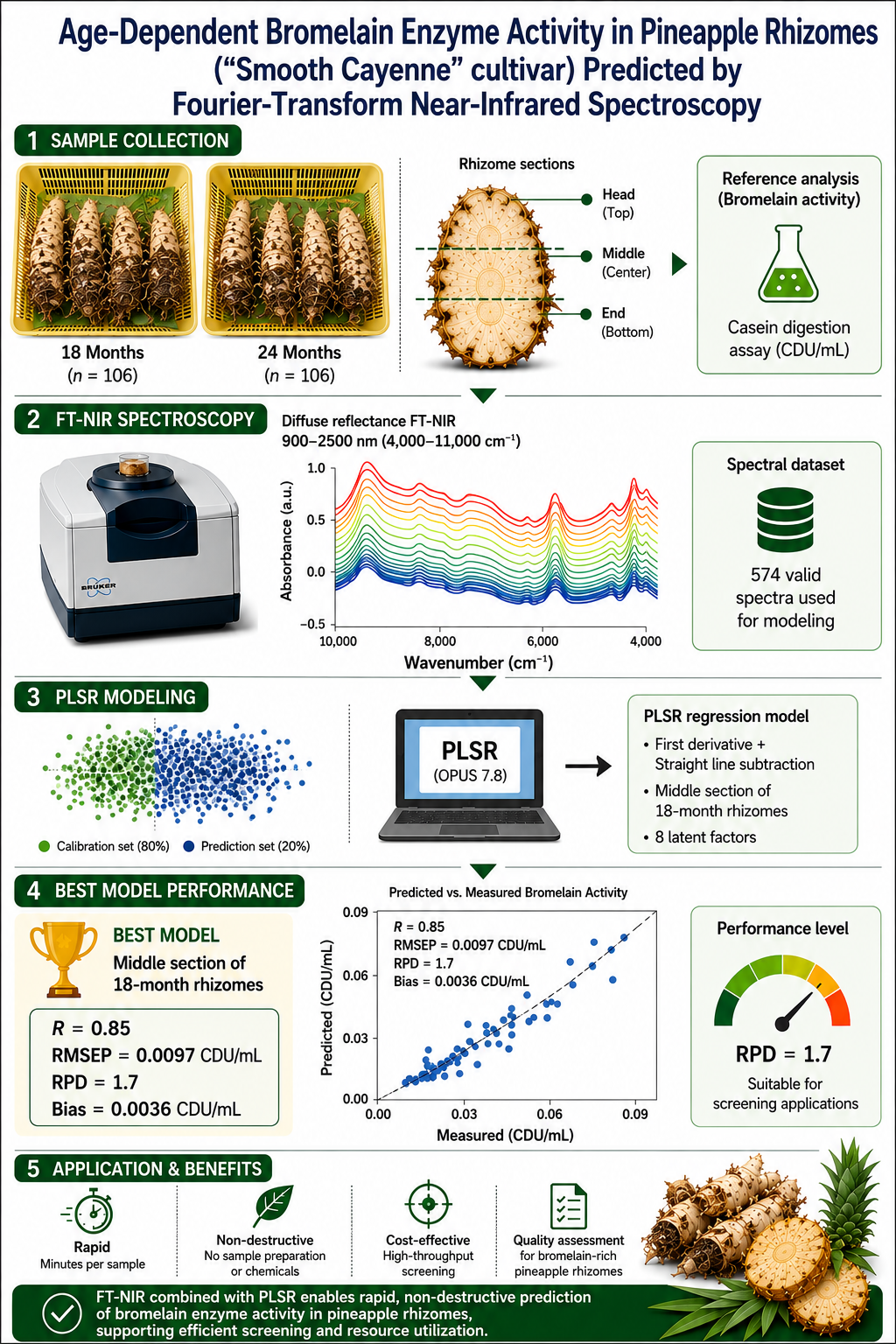
Bromelain is a proteolytic enzyme complex derived from pineapple with extensive medicinal properties. The purpose of this study was to use near-infrared (NIR) spectroscopy to predict bromelain enzyme activity in “Smooth Cayenne” pineapple rhizomes. Samples from 18- and 24-month-old rhizomes were analyzed. A total of 574 NIR spectra (derived from 106 rhizomes, each divided into three anatomical sections and scanned twice) were used to develop the predictive models, with 459 spectra assigned to the calibration set and 115 spectra to the prediction set. NIR spectra were measured with an Fourier-transform NIR spectrometer in diffuse reflection mode at a wavenumber of 11000–4000 cm–1 (909–2500 nm); then, bromelain enzyme activity was measured. A prediction model was established by partial least squares regression and validated by the test set validation method. A calibration equation was used to predict the activity of bromelain enzyme in a prediction set. The results showed bromelain enzyme activity of 0.0328 ± 0.0193 and 0.0293 ± 0.0182 CDU/mL in 18- and 24-month-old pineapple rhizomes, respectively. The calibration equation to predict bromelain enzyme activity based on spectral scanning of the middle of 18-month-old pineapple rhizomes had a correlation coefficient of 0.85, a root mean square error of prediction of 0.0097 CDU/mL, a bias of 0.0036 CDU/mL, and a ratio of prediction to deviation of 1.7. Although the model can be used for screening and predicting the approximate bromelain enzyme activity in 18-month-old pineapple rhizomes, it needs to be improved to provide more accurate predictions.
Article Details

This work is licensed under a Creative Commons Attribution-NonCommercial-NoDerivatives 4.0 International License.
References
Pongsrihadulchi A. Thailand agriculture policies and delvelopment strategies [Internet]. 2019 [cited 2025 Jan 14]. Available from: http://ap.fftc.agnet.org/index.php.
Wali N. Chapter 3.34 - Pineapple (Ananas comosus). In: Nabavi SM, Silva AS, editors. Nonvitamin and Nonmineral Nutritional Supplements. London: Academic Press; 2019. p. 367-373.
Athukorala PC, Gulati A, Jayasuriya S, Mehta R, Nidhiprabha B. International food safety regulation and processed food exports from developing countries: The policy context, and the purpose and scope of the research project. Paper presented the Thammasat conference; 2002; Bangkok, Thailand.
Gautam SS, Mishra SK, Dash V, Goyal AK, Rath G. Comparative study of extraction, purification and estimation of bromelain from stem and fruit of pineapple plant. TJPS. 2010;34:67-76.
Arshad ZIM, Amid A, Yusof F, Jaswir I, Ahmad K, Loke SP. Bromelain: an overview of industrial application and purification strategies. Appl Microbiol Biotechnol. 2014;98:7283-7297.
Chobotova K, Vernallis AB, Majid FAA. Bromelain’s activity and potential as an anti-cancer agent: current evidence and perspectives. Cancer Lett. 2010;290(2):148–156.
Pavan R, Jain S, Shraddha, Kumar A. Properties and therapeutic application of bromelain: a review. Biotechnol Res Int. 2012;2012:976203.
Salma ME, Nehal MR, Nada FA. Ameliorative effects of bromelain on aluminum-induced Alzheimer's disease in rats through modulation of TXNIP pathway. Int J Biol Macromol. 2023;227:1119-1131.
Heinicke RM. Complementary enzyme actions in the clotting of milk. Science. 1953;118:753–754.
Benucci I, Liburdi K, Garzillo AM, Esti M. Bromelain from pineapple stem in alcoholic–acidic buffers for wine application. Food Chem. 2011;124:1349–1353.
Heinicke RM, Cortnor WA. Stem bromelain a new protease preparation from pineapple plant. Econ Bot. 1957;11:25-28.
Insuan O, Janchai P, Thongchuai B, Chaiwongsa R, Khamchun S, Saoin S, et al. Anti-Inflammatory Effect of Pineapple Rhizome Bromelain through Downregulation of the NF-B- and MAPKs-Signaling Pathways in Lipopolysaccharide (LPS)-Stimulated RAW264.7 Cells. Curr Issues Mol Biol. 2021;43(1):93-106.
O'Neil MJ, editor. The Merck Index - An Encyclopedia of Chemicals, Drugs, and Biologicals. 13th ed. Whitehouse Station (NJ): Merck and Co., Inc.; 2001.
Leung AY, Foster S. Encyclopedia of Common Natural Ingredients Used in Food, Drugs, and Cosmetics. New York (NY): John Wiley & Sons, Inc.; 1996.
Scocca J, Lee YC. The composition and structure of carbohydrate of pineapple stem bromelain. J Biol Chem. 1969;244(18):4852-4863.
Pinzi S, Alonso F, Olmo JG, Dorado MP. Near infrared reflectance spectroscopy and multivariate analysis to monitor reaction products during biodiesel production. Fuel. 2012;92(1):354-359.
Palou A, Miró A, Blanco M, Larraz R, Gómez JF, Martínez T, et al. Calibration sets selection strategy for the construction of robust PLS models for prediction of biodiesel/diesel blends physico-chemical properties using NIR spectroscopy. Spectrochim Acta A Mol Biomol Spectrosc. 2017;180:119-126.
Zhang H, Yao HY, Chen F. Accumulation of gamma-aminobutyric acid in rice germ using protease. Biosci Biotechnol Biochem. 2006;70:1160-1165.
Oh SH. Stimulation of gamma- amino butyric acid synthesis activity in brown rice by a chitosan/glutamic acid germination solution and calcium/calmodulin. J Biochem Mol Biol. 2003;36(3):319-325.
Kaewsorn K, Sirisomboon P. Study on evaluation of gamma oryzanol of germinated brown rice by near infrared spectroscopy. J Innov Opt Health Sci. 2014;7(4):1450002.
Kaewsorn K, Sirisombbon P. Determination of the gamma-aminobutyric acid (GABA) content of germinated brown rice by near infrared spectroscopy. J Near Infrared Spectrosc. 2014;22(1):45-54.
Picque A, Corrieu C. A near-infrarod spectroscopy technique for the control of fermentation processes: An application to lactic acid fermentation. Biotechnol Bioeng. 1994;43(10):913-917.
Blanco M, Coello J, Iturriaga H, Maspoch S, González Baño R. On-line monitoring of starch enzymatic hydrolysis by nearinfrared spectroscopy. Analyst. 2000;125:749–752.
Shinya Y, Tetsuya T, Michiyoshi K, Takanori H, Masakazu F, Masahito O, et al. Immobilization of bromelain onto porous copoly (γ-methyl- -glutamate/-leucine) beads. Eur Polym J. 2003;39:173-180.
Yamada S, et al. Bromein, a Bromelain Inhibitor from Pineapple Stem: Structural and Functional Characteristics. J Am Soc Mass Spectrom. 2018;29(10):2056-2065.
Zou X, Zou X, Neuteboom LW, Matsumoto KO, Christopher DA. Extended AE-Rich N-Terminal Trunk in Secreted Pineapple Cystatin Enhances Inhibition of Fruit Bromelain and Is Posttranslationally Removed during Ripening. Plant Physiol. 2009;151(2):515–526.
Silva GM, Santos MCS, Lago ALS, Silva CG, Andrade LSS, Castro MLL, et al. Effect of salt stress on the activity of bromelain in pineapple plants grown In vitro. Revista Caatinga. 2015;28(4):104-110.
Lemos A, Lemos MCS, Santos MCS, Andrade LSS, Lago ALS, Guimarães LBS, et al. Nitric Oxide Mediates the Hormonal Control of Crassulacean Acid Metabolism Expression in Young Pineapple Plants. Plant Physiol. 2010;152(4):1971-1980.
Kong J, Yu S. Fourier Transform Infrared Spectroscopic Analysis of Protein Secondary Structures. Acta Biochim Biophys Sin. 2007;39(8):549-559.
Barth A. The Amide I Band of Proteins as a Marker for Secondary Structure: History and Recent Progress. Biochim Biophys Acta Bioenerg. 2007;1767(9):1071-1105.
da Silva RS, Sorokin AV, Goncharova SS, Lavlinskaya MS, Holyavka MG, Faizullin DA, et al. Complexation of Bromelain, Ficin, and Papain with the Graft Copolymer of Carboxymethyl Cellulose Sodium Salt and N-Vinylimidazole Enhances Enzyme Proteolytic Activity. Int J Mol Sci. 2023;24(15):12349.
Schwanninger M, Hinterstoisser J, Messner D, Fischer RFH. Effects of the chemical composition of wood on the near-infrared (NIR) spectra of different wood species. J Near Infrared Spectrosc. 2004;12(3):195-209.
Osborne BG, Fearn T, Hindle PH. Practical NIR spectroscopy with applications in food and beverage analysis. New York: John Wiley and Sons; 1993.
Williams P. Near-infrared Technology–Getting the best out of light. 5th ed. Nanaimo (BC): PDK Grain; 2007.
