
Cultivation of Ganoderma multipileum on Rubber Wood Sawdust and Coffee Grounds: Growth Performance and Bioactive Properties
Article Sidebar
Main Article Content
Abstract
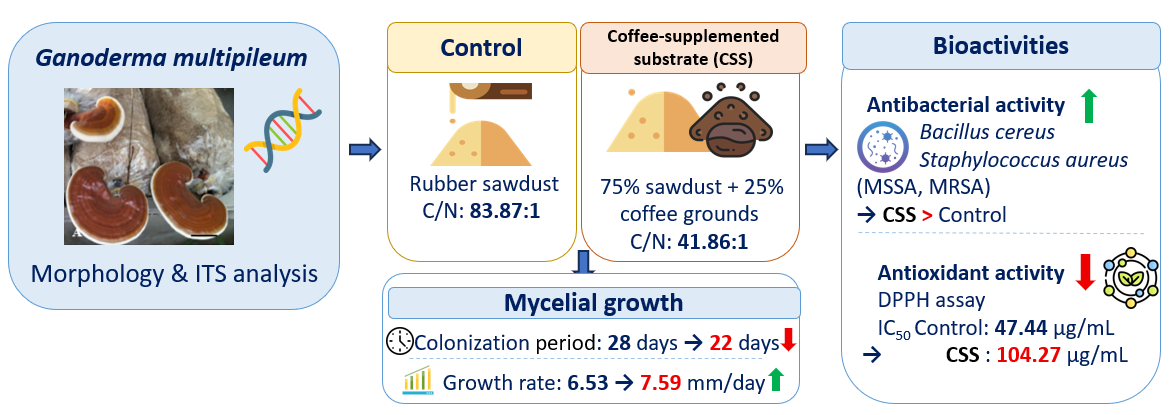
Ganoderma multipileum is a tropical wood-decaying fungus with high capacity for crop waste disposal and promising medicinal properties. In this study, a Vietnamese strain of G. multipileum was identified through morphological characterization and phylogenetic analysis of the internal transcribed spacer (ITS) region. To enhance sustainable mushroom production, two cultivation substrates were compared: rubber tree sawdust by itself (control) and rubber tree sawdust supplemented with 25% coffee grounds. The coffee-supplemented substrate reduced the carbon/nitrogen ratio from 83.87:1 to 41.86:1, accelerated mycelial colonization from 28 to 22 days, and increased the mycelial growth rate from 6.53 to 7.59 mm/day. Ethanolic extracts from fruiting bodies grown on the supplemented substrate showed higher antibacterial activity against both methicillin-sensitive and methicillin-resistant Staphylococcus aureus and Bacillus cereus compared with the control. Antioxidant capacity, as measured by DPPH assay, was reduced in the supplemented treatment, with a higher IC₅₀ value (104.27 μg/mL) compared with the control (47.44 μg/mL). These findings highlight the potential of lignocellulolytic Ganoderma fungi in a circular economy for reducing agro-industrial waste byproducts like sawdust and coffee grounds. An additional benefit accrues because the use of such substrates enhances the cultivation efficiency and bioactive properties of G. multipileum, promoting its application in pharmaceutical and cosmetic production as well as waste reduction.
Article Details

This work is licensed under a Creative Commons Attribution-NonCommercial-NoDerivatives 4.0 International License.
References
Paterson RRM. Ganoderma-A therapeutic fungal biofactory. Phytochemistry. 2006;67(18):1985–2001.
Karunarathna SC, Patabendige NM, Hapuarachchi KK, Promputtha I. Exploring the health benefits of Ganoderma: antimicrobial properties and mechanisms of action. Front Cell Infect Microbiol. 2025;15: 1535246.
Zhou X-W, Su K-Q, Zhang Y-M. Applied modern biotechnology for cultivation of Ganoderma and development of their products. Appl Microbiol Biotechnol. 2012;93(3):941–963.
Akcay C, Arslan R, Ceylan F. Valorization of various lignocellulosic wastes to Ganoderma lucidum (Reishi Mushroom) cultivation and their FT-IR assessments. PLoS One. 2025;20(7):e0328732.
Atila F. Comparative study on the mycelial growth and yield of Ganoderma lucidum (Curt.: Fr.) Karst. on different lignocellulosic wastes. Acta Ecol Sin. 2020;40(2):153–7.
Thanh BT, Duc LA, An NPT. Study on the Production Formula Establishment of Multi-component Pellets from Sawdust and Food Plastic Waste. In: Long BT, Kim YH, Ishizaki K, Toan ND, Parinov IA, Vu NP, editors. Proceedings of the 2nd Annual International Conference on Material, Machines and Methods for Sustainable Development (MMMS2020). Cham: Springer International Publishing; 2021, p. 710–20.
Loc NQ, Bui TKL, Tu NM, Nguyen TTT, Hoang ND, Nguyen TB, et al. Enhancing circular economy in the mushroom production chain: systematic literature review and field study in the Central Highlands of Vietnam. J Solid Waste Technol Manag. 2024;50(4):689–710.
Serna-Jiménez JA, Siles JA, de los Ángeles Martín M, Chica AF. A Review on the Applications of Coffee Waste Derived from Primary Processing: Strategies for Revalorization. Processes. 2022;10(11):2436.
Vanni Arianna. Incorporating Circular Economy Practices into the Coffee Industry: The Case of Delta Cafés [Internet]. [Portugal]: Universidade NOVA de Lisboa; 2021 [cited 2025 May 13]. Available from: https://www.proquest.com/openview/8cc7e2a8648ac2bdb8e5b988e4685a91/1?cbl=2026366&diss=y&pq-origsite=gscholar.
Chai WY, Krishnan UG, Sabaratnam V, Tan JBL. Assessment of coffee waste in formulation of substrate for oyster mushrooms Pleurotus pulmonarius and Pleurotus floridanus. Future Foods. 2021;4:100075.
Wang DM, Wu SH, Su CH, Peng JT, Shih YH, Chen LC. Ganoderma multipileum, the correct name for “G. lucidum” in tropical Asia. Bot Stud. 2009;50:451–458.
Luangharn T, Karunarathna SC, Dutta AK, Paloi S, Promputtha I, Hyde KD, et al. Ganoderma (Ganodermataceae, Basidiomycota) Species from the Greater Mekong Subregion. J Fungi. 2021;7(10):819.
Nguyen TTT, Nguyen HD, Bui AT, Pham KHT, Pham VKT, Tran LT, et al. Phylogenetic analysis and morphology of Ganoderma multipileum, a Ganoderma species associated with dieback of the metropolitan woody plant Delonix regia (Boj. ex Hook.) Raf. in Vietnam. Sci Prog. 2023;106(3):1–18.
Umar A, Ahmed S, Guzmán-Dávalos L, Cabarroi-Hernández M. Ganoderma multipileum and Tomophagus cattienensis— new records from Pakistan. Mycotaxon. 2022;137:135–151.
Alshiekheid MA, Umar A, Ameen F, Alyahya SA, Dufossé L. Biodegradation of chromium by laccase action of Ganoderma multipileum. J King Saud Univ - Sci. 2023;35(10):102948.
Kornerup A, Wanscher JH. Methuen Handbook of Colour - Third Edition. Third Edition. London: Eyre Methuen; 1978.
Karsten PA. Enumeratio Boletinarum et Polyporarum Fennicarum systemate novo dispositorum. Rev Mycol. 1881;3:16–19.
Gardes M, Bruns TD. ITS primers with enhanced specificity for basidiomycetes - application to the identification of mycorrhizae and rusts. Mol Ecol. 1993;2(2):113–118.
White TJ, Bruns T, Lee S, Taylor JW. Amplification and direct sequencing of fungal ribosomal RNA genes for phylogenetics. In: PCR Protocols: A Guide to Methods and Applications. New York: Academic Press; 1990, p. 315–322.
Darriba D, Taboada GL, Doallo R, Posada D. jModelTest 2: more models, new heuristics and parallel computing. Nat Methods. 2012;9:772.
Sun YF, Xing JH, He XL, Wu DM, Song CG, Liu S, et al. Species diversity, systematic revision and molecular phylogeny of Ganodermataceae (Polyporales, Basidiomycota) with an emphasis on Chinese collections. Stud Mycol. 2022;101:287–415.
Cao Y, Wu SH, Dai YC. Species clarification of the prize medicinal Ganoderma mushroom “Lingzhi.” Fungal Divers. 2012;56(1):49–62.
Zhou LW, Cao Y, Wu SH, Vlasák J, Li DW, Li MJ, et al. Global diversity of the Ganoderma lucidum complex (Ganodermataceae, Polyporales) inferred from morphology and multilocus phylogeny. Phytochemistry. 2015;117:7–15.
Xing JH, Sun YF, Han YL, Cui BK, Dai YC. Morphological and molecular identification of two new Ganoderma species on Casuarina equisetifolia from China. MycoKeys. 2018;(34):93–108.
Náplavová K, Beck T, Pristaš P, Gáperová S, Šebesta M, Piknová M, et al. Molecular Data Reveal Unrecognized Diversity in the European Ganoderma resinaceum. Forests. 2020;11(8):850.
Hapuarachchi KK, Karunarathna SC, McKenzie E, Wu X, Kakumyan P, Hyde K, et al. High phenotypic plasticity of Ganoderma sinense (Ganodermataceae, Polyporales) in China. Asian J Mycol. 2019;2(1):1–47.
Luangharn T, Karunarathna S, Mortimer P, Hyde K, Thongklang N, Xu J. A new record of Ganoderma tropicum (Basidiomycota, Polyporales) for Thailand and first assessment of optimum conditions for mycelia production. MycoKeys. 2019;51:65–83.
Matheny PB, Wang Z, Binder M, Curtis JM, Lim YW, Henrik Nilsson R, et al. Contributions of rpb2 and tef1 to the phylogeny of mushrooms and allies (Basidiomycota, Fungi). Mol Phylogenet Evol. 2007;43(2):430–451.
Le XT, Nguyen Le QH, Pham ND, Duong VH, Dentinger BTM, Moncalvo JM. Tomophagus cattienensis sp. nov., a new Ganodermataceae species from Vietnam: Evidence from morphology and ITS DNA barcodes. Mycol Prog. 2012;11(3):775–780.
Royse DJ. Effect of Spawn Run Time and Substrate Nutrition on Yield and Size of the Shiitake Mushroom. Mycologia. 1985;77(5):756–762.
Bahadori M, Tofighi H. A Modified Walkley-Black Method Based on Spectrophotometric Procedure. Commun Soil Sci Plant Anal. 2016;47(2):213–220.
Clinical and Laboratory Standards Institute (CLSI). Performance Standards for Antimicrobial Susceptibility Testing. 33rd ed. CLSI supplement M100. Clinical and Laboratory Standards Institute; 2023.
Mayur B, Sandesh S, Shruti S, Sung-Yum S. Antioxidant and α-glucosidase inhibitory properties of Carpesium abrotanoides L. J Med Plants Res. 2010;4(15):1547–1553.
Bae B, Kim M, Kim S, Ro HS. Growth Characteristics of Polyporales Mushrooms for the Mycelial Mat Formation. Mycobiology. 2021;49(3):280–284.
Pérez-Chávez AM, Mayer L, Albertó E. Mushroom cultivation and biogas production: A sustainable reuse of organic resources. ESD, 2019;50:50-60.
Meez E, Rahdar A, Kyzas George KZ. Sawdust for the removal of heavy metals from water: a review. Molecules, 2021;26(14):4318.
Chan YS, Chong KP. Bioactive Compounds of Ganoderma boninense Inhibited Methicillin-Resistant Staphylococcus aureus Growth by Affecting Their Cell Membrane Permeability and Integrity. Molecules. 2022;27(3):838.
Soliman A, Yonus A, Abdelbary S, Abdelghany T. Trends in Assessment of Ganoderma lucidum Methanol Extract Against MRSA Infection In Vitro and In Vivo with Nutrition Support. J Adv Pharm Res. 2022;6(1):46–57.
El-Dein MMN, El-Fallal AA, El-Sayed AKA, El-Esseily SR. Antimicrobial Activities of Ganoderma mbrekobenum Strain EGDA (Agaricomycetes) from Egypt. Int J Med Mushrooms. 2023;25(9):31–41.
Rajasekaran M, Kalaimagal M. In Vitro Antioxidant Activity of Ethanolic Extract of a Medicinal Mushroom, Ganoderma lucidum. J Pharm Sci Res. 2011;3(9):1427–1433.
Swan SY, Mokhtar NM, Aziz MAA, Arifin MA. Evaluation of antioxidant, antibacterial and anticancer activities of Ganoderma lucidum extracts. Mater Today Proc. 2024;107:82-91.
Sijia W, Siyuan Z, Bo P, Dechao T, Mingyue W, Jinchao W, et al. Ganoderma lucidum: a comprehensive review of phytochemistry, effi cacy, safety and clinical study. FSHW. 2024;13:568–596.
Lu X, Li H, Cao L, Liang R, He W, Wei F, et al. A review of Ganoderma lucidum: Cultivation, active ingredients and its application as functional ingredients. J Food Compos Anal. 2026; 149:108822.
Galappaththi MCA, Patabendige NM, Premarathne BM, Hapuarachchi KK, Tibpromma S, Dai DQ, et al. A Review of Ganoderma Triterpenoids and Their Bioactivities. Biomolecules. 2023;13:24.
Ewunkem A, Merrills L, Williams Z, Justice B, Iloghalu U, Williams V, et al. In Vitro Antimicrobial Efficacy Assessment of Ethanolic, Aqueous, and Dual Solvent Extracts of Mushroom Ganoderma lucidum: Genomic and Morphological Analysis. Antibiotics. 2024; 13:1109.
Moyen UPk, Rabiul IT, Mhammad KIS, Tasnia R, Rumana P, Matiar R, el at. Effect of Solvents on Phytochemicals Content and Antioxidant Activity of Ganoderma lucidum. Open Microbiol L. 2019;13:10–15.
Bristy AT, Islam T, Ahmed R, Hossain J, Reza HM, Jain P. Evaluation of Total Phenolic Content, HPLC Analysis, and Antioxidant Potential of Three Local Varieties of Mushroom: A Comparative Study. Int J Food Sci Tech. 2022:3834936.
