
Optimization and sensory evaluation of sweet potato (Ipomoea batatas L.) - chili pepper (Capsicum annum) hot sauce formulation for commercialization potential
Article Sidebar
Main Article Content
Abstract
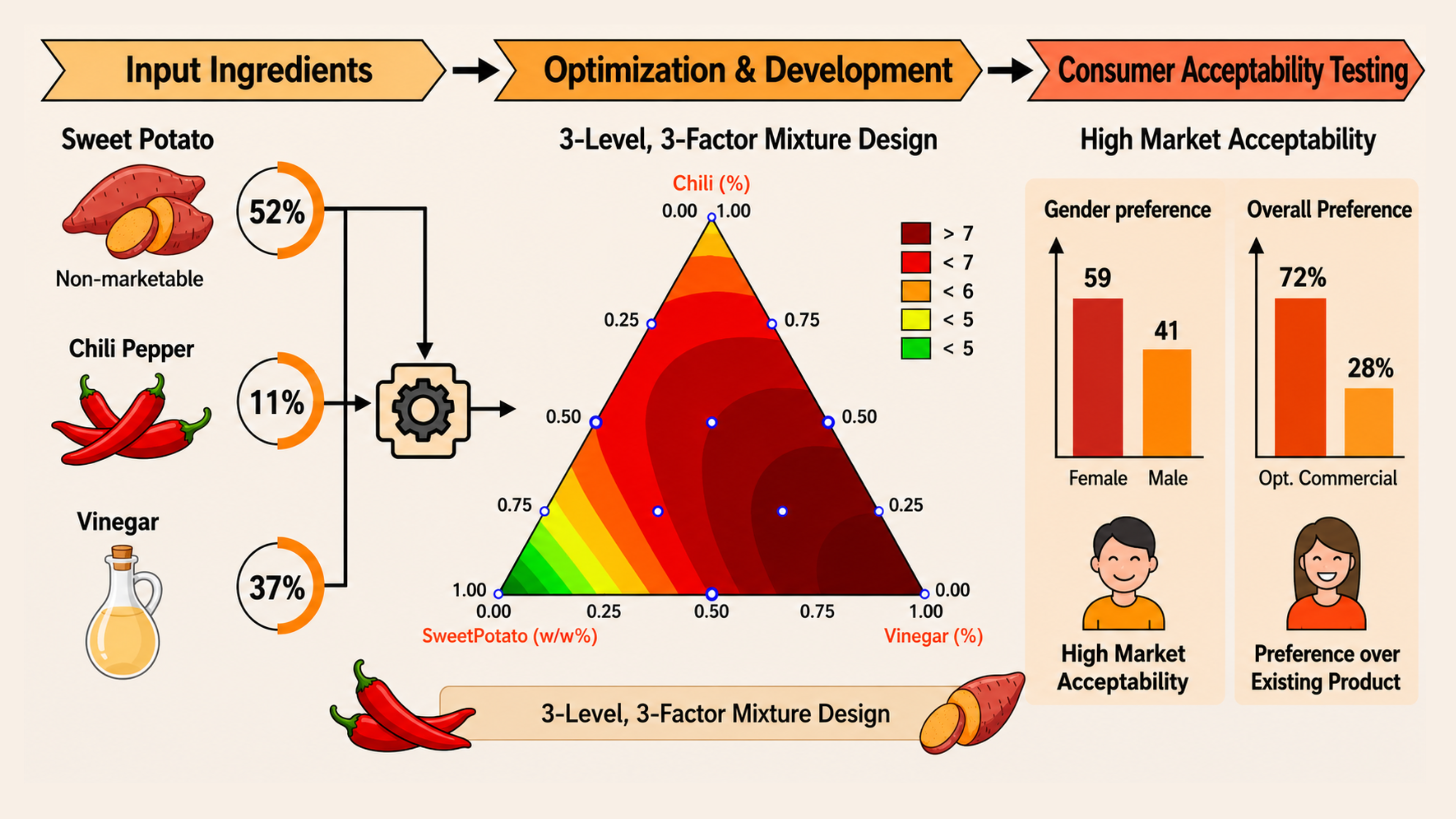
Sweet potato is considered an alternative staple crop, and its use is typically limited to traditional applications. The study aims to use sweet potato, especially the non-marketable variety, as the primary base ingredient for developing a hot sauce. Several studies have examined sauces that use tomato, banana, and oil in other Asian and Western foods, and no records of hot sauces were identified; hence, this study. A product development experimental study in a three-level, three-factor mixture design, following the set plan 11.6 of Cochran and Cox (1957) for sensory evaluation, was used to optimize the formulation of hot sauce products. The sweet potato-chili sauce has a rust-brown to red-orange color and a well-blended flavor of sweetness, sourness, and spiciness. The optimum formulation was attained at 52% w/w sweet potato, 37% v/w vinegar, and 11% w/w chili, with a predicted acceptability rating of 7, which was moderate on the 9-point hedonic scale. Seventy-two percent (72%) of the respondents, composed of 45% of females and 27% of males, preferred the formulated sweet potato-chili sauce compared to the commercially available sriracha. This implies a good probability of market survival in terms of consumer acceptability.
Article Details

This work is licensed under a Creative Commons Attribution-NonCommercial-NoDerivatives 4.0 International License.
References
Zhao S, Zhong L, Li X, Qin L, Zhou Y, Lei X, et al. Comparative Analysis of Nutrients, Phytochemicals, and Minerals in Colored Sweet Potato (Ipomoea batatas L.) Roots. Foods. 2024;13(22):1–18.
Nabot M, Garcia C, Seguin M, Ricci J, Brabet C, Remize F. Bioactive Compound Diversity in a Wide Panel of Sweet Potato (Ipomoea batatas L.) Cultivars: A Resource for Nutritional Food Development. Metabolites. 2024;14(10):523.
Noerrizki AM, Karuniawan A, Suganda T, Andriani Y, Concibido V, ILevita J. Sweet Potato ( Ipomoea batatas [ L .] Lam ) – A Review on Its Bioprospecting. IOSR J Pharm Biol Sci. 2020;15(3):1–7.
Makhubu FN, Laurie SM, Rauwane ME, Figlan S. Trends and gaps in sweet potato (Ipomoea batatas L.) improvement in sub-Saharan Africa: Drought tolerance breeding strategies. Food Energy Secur. 2024;13(3):1–21.
Cerio C. Value chain of sweet potato: A sociological analysis. IOP Conf Ser Earth Environ Sci. 2021;892(1):012031.
PSA. Major Vegetables and Root Crops Quarterly Bulletin. Philippine Statistics Authority. 2023.
Cao Y, Tian B, Zhang Z, Yang K, Cai M, Hu W, et al. Positive effects of dietary fiber from sweet potato [Ipomoea batatas (L.) Lam.] peels by different extraction methods on human fecal microbiota in vitro fermentation. Front Nutr. 2022;9:986667.
Histifarina D, Purnamasari NR, Rahmat R. Potential development and utilization of sweet potato flour as a raw material for the food industry. IOP Conf Ser Earth Environ Sci. 2023;1230(1).
Noreen S, Niazi MK, Shehzadi S, Ikram A, Arshad MT, Gnedeka KT. Extend the emphasis to encompass sweet potatoes health advantages, industrial applications, and nutritional qualities. CYTA - J Food. 2024;22(1).
Islam S. Sweetpotatoes [Ipomoea batatas (L.) lam]: the super food of the Next Century? An intensive review on their potential as a sustainable and versatile food source for future generations. CYTA - J Food. 2024;22(1).
Ndanyi VCM, Abong’ GO, Okoth MW, Odhiambo EG. Postharvest Handling Practices of Sweet potato in Kenya: A case of Bungoma and Homabay Counties. East African J Sci Technol Innov. 2021;2(Special Issue):1–32.
Rahul J, Khayer N, Foysal Uddin M, Chakraborty S, Rajwana Haque M. Considerations in the Design of an Efficient Network to Transport Perishable Crops. 2023;230–237.
Ray RC, Ravi V. Post harvest spoilage of sweetpotato in tropics and control measures. Crit Rev Food Sci Nutr. 2005;45(7–8):623–644.
Abong GO, Ndanyi VCM, Kaaya A, Shibairo S, Okoth MW, Lamuka PO, et al. A review of production, post-harvest handling and marketing of sweetpotatoes in Kenya and Uganda. Curr Res Nutr Food Sci. 2016;4(3):162–181.
Villa-Rivera MG, Ochoa-Alejo N. Ascorbic Acid in Chili Pepper Fruits: Biosynthesis, Accumulation, and Factors Affecting its Content. J Mex Chem Soc. 2023;67(3):187–199.
Martirosyan G, Avagyan A, Pahlevanyan A, Adjemyan G, Vardanian I, Khachatryan L, et al. Biochemical composition of Armenian chili pepper varieties: insights for functional food applications. Funct Food Sci. 2024;4(11):443–451.
Cochran WG, Cox GM. Experimental designs, 2nd ed. Experimental designs, 2nd ed. Oxford, England: John Wiley & Sons; 1957. xiv, 611–xiv, 611.
Stevenson RJ. The role of attention in flavour perception. Flavour. 2012;1(1):1–8.
Nabubuya A, Namutebi A, Byaruhanga Y, Schuller RB, Narvhus J, Wicklund T. Viscoelastic properties of sweet potato complementary porridges as influenced by endogenous amylases. Food Sci Nutr. 2017;5(6):1072–1078.
