
Protective and Therapeutic Effects of Thai Vegetable Extracts Against Oxidative Stress and Apoptosis in RAW 264.7 Macrophage Cells
Article Sidebar
Main Article Content
Abstract
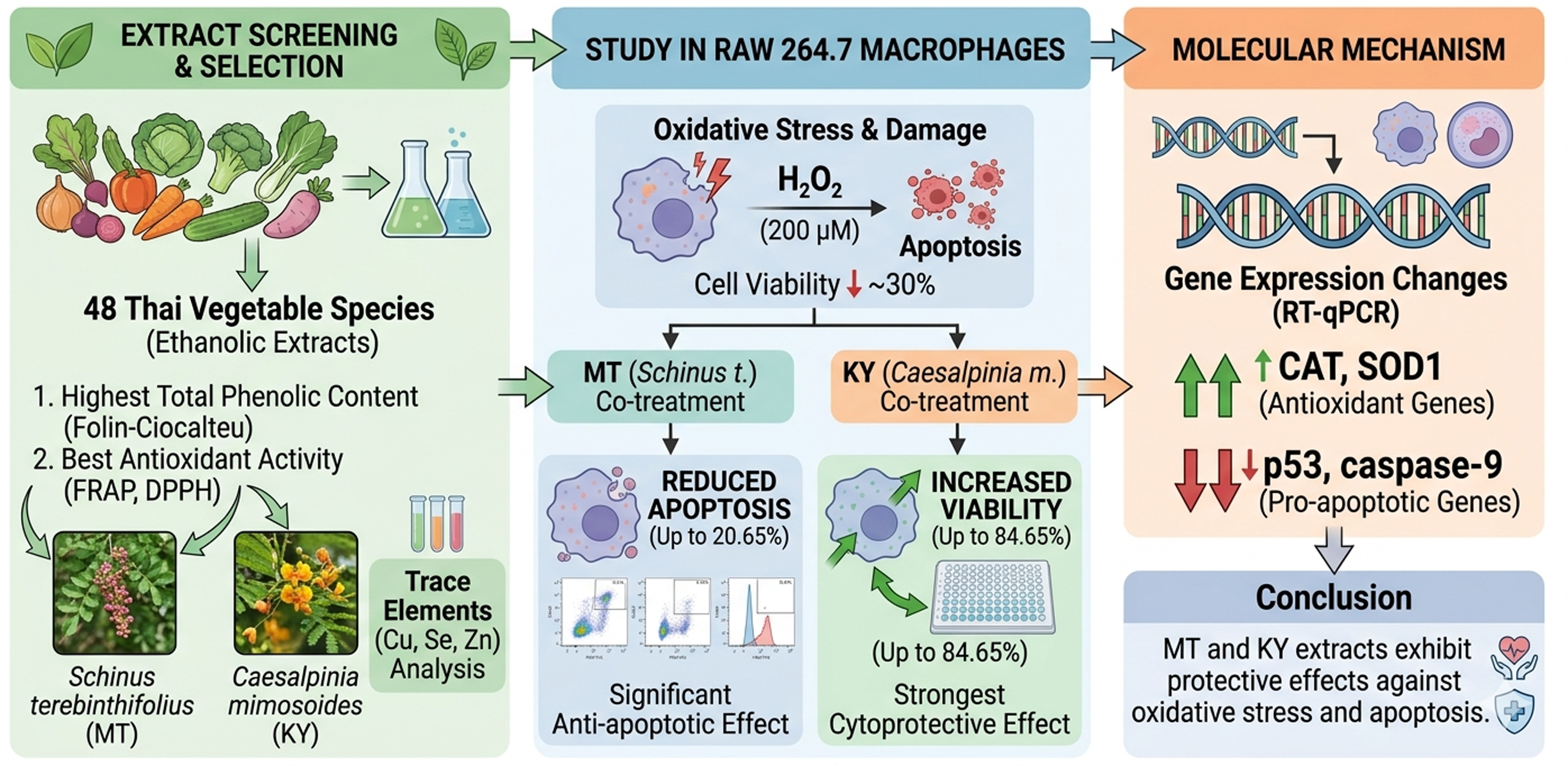
Consuming vegetables is vital for disease prevention, and Thailand’s diverse vegetable resources are of particular interest. This study investigated the antioxidant and anti-apoptotic activities of ethanolic extracts from 48 Thai vegetable species. Antioxidant capacity was evaluated using FRAP and DPPH assays, and total phenolic content was determined by the Folin-Ciocalteu method. Schinus terebinthifolius (MT) and Caesalpinia mimosoides (KY) exhibited the highest phenolic content and antioxidant activity and were selected for further study. In RAW 264.7 macrophages exposed to H2O2 (200 µM), cell viability decreased to approximately 30%, whereas co-treatment with KY extract (12.5-100 µg/mL) restored viability in a dose-dependent manner, reaching 84.65%, while MT extract increased viability to approximately 50%. Flow cytometric analysis revealed that H2O2 induced apoptosis in ~90% of cells; MT extract reduced apoptotic cells by up to 20.65%, whereas KY extract produced a modest reduction (≤3.37%). RT-qPCR analysis demonstrated the upregulation of antioxidant-related genes (CAT, SOD1) and downregulation of pro-apoptotic genes (p53, caspase-9). Trace-element analysis further suggested that copper, selenium, and zinc may contribute to antioxidant enzyme activity. Collectively, MT and KY extracts exhibit significant antioxidant and anti-apoptotic effects, supporting their potential as non-toxic natural agents for mitigating oxidative stress and apoptosis-related conditions.
Article Details

This work is licensed under a Creative Commons Attribution-NonCommercial-NoDerivatives 4.0 International License.
References
Farooq B, Koul B, Mahant D, Yadav D. Phytochemical analyses, antioxidant and anticancer activities of ethanolic leaf extracts of Moringa oleifera Lam. varieties. Plants. 2021;10:2348.
Mellendick K, Shanahan L, Wideman L, et al. Diets rich in fruits and vegetables are associated with lower cardiovascular disease risk in adolescents. Nutrients. 2018;10:136.
Okaiyeto K, Falade AO, Oguntibeju OO. Traditional uses, nutritional and pharmacological potentials of Clerodendrum volubile. Plants. 2021;10:1893.
Omar SH, Scott CJ, Hamlin AS, Obied HK. The protective role of plant biophenols in mechanisms of Alzheimer's disease. J Nutr Biochem. 2017;47:1-20.
Williams B, Watanabe CMH, Schultz PG, et al. Age-related effects of Ginkgo biloba extract on synaptic plasticity and excitability. Neurobiol Aging. 2004;25(7):955-962.
Bhattacharyya A, Chattopadhyay R, Mitra S, Crowe SE. Oxidative stress: an essential factor in the pathogenesis of gastrointestinal mucosal diseases. Physiol Rev. 2014;94:329-354.
Jena AB, Samal RR, Bhol NK, Duttaroy AK. Cellular red-ox system in health and disease: the latest update. Biomed Pharmacother. 2023;162:114542.
Liu RH. Potential synergy of phytochemicals in cancer prevention: mechanism of action. J Nutr. 2004;134:3475S-3489S.
Uliana MP, Fronza M, da Silva AG, et al. Composition and biological activity of Brazilian rose pepper (Schinus terebinthifolius Raddi) leaves. Ind Crops Prod. 2016;83:235-240.
Daduang J, Suk V, Vichitphan A, et al. High phenolics and antioxidants of some tropical vegetables related to antibacterial and anticancer activities. Afr J Pharm Pharmacol. 2011;5:608-615.
Chanwitheesuk A, Teerawutgulrag A, Rakariyatham N. Screening of antioxidant activity and antioxidant compounds of some edible plants of Thailand. Food Chem. 2005;92(3):491-497.
Yodsaoue O, Karalai C, Ponglimanont C, et al. Potential anti-inflammatory diterpenoids from the roots of Caesalpinia mimosoides Lamk. Phytochemistry. 2010;71(14-15):1756-1764.
Palasap A, Limpaiboon T, Boonsiri P, et al. Cytotoxic effects of phytophenolics from Caesalpinia mimosoides Lamk on cervical carcinoma cell lines through an apoptotic pathway. Asian Pac J Cancer Prev. 2014;15:449-454.
Rangsinth P, Prasansuklab A, Duangjan C, et al. Leaf extract of Caesalpinia mimosoides enhances oxidative stress resistance and prolongs lifespan in Caenorhabditis elegans. BMC Complement Altern Med. 2019;19(1):164.
Singleton VL, Rossi JA. Colorimetry of total phenolics with phosphomolybdic-phosphotungstic acid reagents. Am J Enol Vitic. 1965;16:144-158.
Mensor LL, Menezes FS, Leitao GG, et al. Screening of Brazilian plant extracts for antioxidant activity by the use of DPPH free radical method. Phytother Res. 2001;15(2):127-130.
Livak KJ, Schmittgen TD. Analysis of relative gene expression data using real-time quantitative PCR and the 2−ΔΔCT method. Methods. 2001;25:402-408.
Velmurugan BK, Rathinasamy B, Lohanathan BP, Thiyagarajan V, Weng CF. Neuroprotective role of phytochemicals. Molecules. 2018;23:2485.
Gunawardena S, Nadeeshani H, Amarasinghe V, et al. Bioactive properties and therapeutic aspects of fermented vegetables: a review. Food Prod Process Nutr. 2024;6:31.
Chandimali N, Bak SG, Park EH, et al. Free radicals and their impact on health and antioxidant defenses: a review. Cell Death Discov. 2025;11:19.
Nanasombat S, Teckchuen N. Antimicrobial, antioxidant, and anticancer activities of Thai local vegetables. J Med Plants Res. 2009;3(5):443-449.
Chansiw N, Chotinantakul K, Srichairatanakool S. Anti-inflammatory and antioxidant activities of the extracts from leaves and stems of Polygonum odoratum Lour. Anti-Inflamm Anti-Allergy Agents Med Chem. 2019;18:45-54.
Buranrat B, Boontha S, Temkitthawon P, Chomchalao P. Anticancer activities of Careya arborea Roxb on MCF-7 human breast cancer cells. Biologia (Bratisl). 2020;75:2359-2366.
Payoungkiattikun W, Joompang A, Thongchot S, et al. Evidence of multi-functional peptide activity: potential role of KT2 and RT2 for anti-inflammatory, anti-oxidative stress, and anti-apoptosis properties. Appl Biol Chem. 2020;63:5.
Tangsaengvit N, Kitphati W, Tadtong S, et al. Neurite outgrowth and neuroprotective effects of quercetin from Caesalpinia mimosoides Lamk. on cultured P19-derived neurons. Evid Based Complement Alternat Med. 2013;2013:838690.
Rocha PS, Campos JF, Nunes-Souza V, et al. Antioxidant and protective effects of Schinus terebinthifolius Raddi against doxorubicin-induced oxidative stress in normal cells. Pharm Biol. 2018;56:407-414.
Kodirov SA. Comparison of Superoxide Dismutase Activity at the Cell, Organ, and Whole-Body Levels. Cell Biochemistry and Biophysics. 2025;83(3):2713-2726.
Azadmanesh J, Borgstahl GE. A review of the catalytic mechanism of human manganese superoxide dismutase. Antioxidants (Basel). 2018;7:25.
Forman HJ, Davies KJA, Ursini F. How do nutritional antioxidants really work: nucleophilic tone and para-hormesis versus free radical scavenging in vivo. Free Radic Biol Med. 2014;66:24-35.
Brigelius-Flohé R, Maiorino M. Glutathione peroxidases. Biochim Biophys Acta. 2013;1830(5):3289-3303.
Kim KB, Lee S, Kang I, Kim JH. Momordica charantia ethanol extract attenuates H₂O₂-induced cell death by its antioxidant and anti-apoptotic properties in human neuroblastoma SK-N-MC cells. Nutrients. 2018;10:1368.
Frontiers in Molecular Biosciences. Antioxidant and oxidative enzymes, genetic variants, and cofactors as prognostic biomarkers of COVID-19 severity and mortality. Front Mol Biosci. 2025; PMID: 41209585.
Anam K, Ananyan S, Rishabh M, et al. Zinc, copper, and selenium levels in vitiligo: a systematic review and meta-analysis. Sci Rep. 2024;14(1):23700.
