
Advancing sustainable agriculture through beneficial microbes: From microbial physiology to synthetic community-based innovations
Article Sidebar
Main Article Content
Abstract
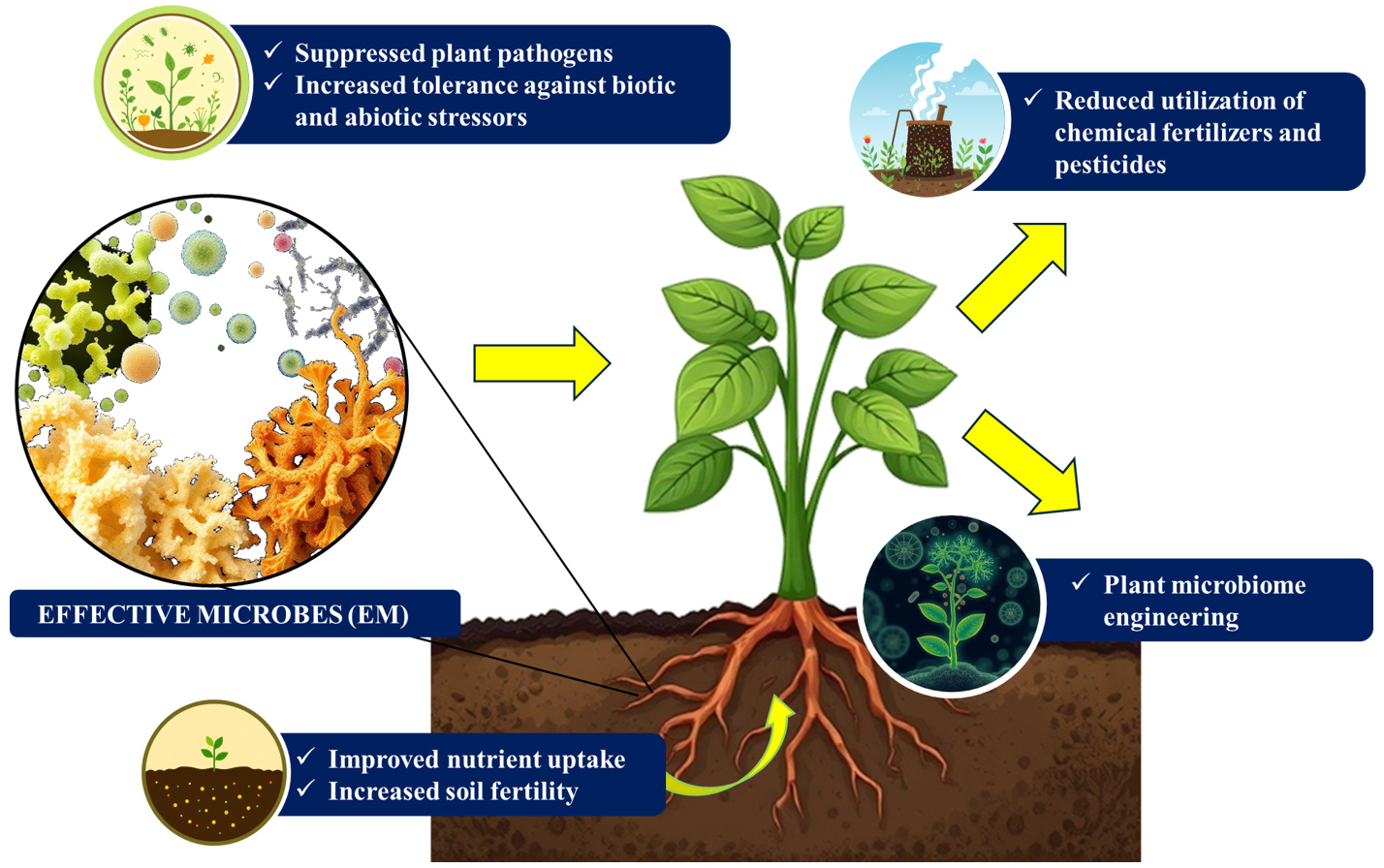
This is a review of the use of effective microorganisms (EM) in sustainable agriculture to improve soil quality, increase crop yields, and control plant diseases. This review aims to contribute to understanding sustainable agriculture using microbes for our benefit by integrating microbial physiology and synthetic microbial innovations, with respect to community-level microbial interactions. Using a literature search strategy, the physiological mechanisms by which EM may enhance soil fertility through improved nutrient cycling and increased nutrient availability to plants, and/or by creating or modifying soil structure to support root growth, were described. Results showed that EM also increase the ability of plants to grow despite biotic stressors, such as soil-borne pathogens, through both the creation of antimicrobial compounds and competitive exclusion. Microbes also enhance plant tolerance to abiotic stressors, such as water loss from drought or salt accumulation, by altering how plants respond physiologically and by retaining soil moisture. This could be achieved by using effective microbes in agriculture via synthetic microbial communities (SynCom), which will enable greater resource efficiency, a lower environmental footprint, and contribute to achieving food security while addressing current global issues such as climate change and growing populations. However, there is still much to be learned about the long-term ecological implications, scalability, regulatory environments, and socio-economic feasibility of agricultural technologies based on microorganisms and SynComs, especially in developing and climate-vulnerable countries. Therefore, a comprehensive review that links microbial physiology, SynCom design, empirical data from crop studies, and future paths to innovation is both timely and needed.
Article Details

This work is licensed under a Creative Commons Attribution-NonCommercial-NoDerivatives 4.0 International License.
References
Apoorva MS, Kundlas K. Negative impacts of intensive agricultural practices on environment and ecosystem: A review. Int J Res Agron. 2024;7(12):285-289.
Chauhan P, Sharma N, Tapwal A, Kumar A, Verma GS, Meena M, et al. Soil Microbiome: Diversity, Benefits and Interactions with Plants. Sustain J. 2023;15(19):14643.
Yusuf A, Li M, Zhang SY, Fidelis Odedishemi-Ajibade, Luo RF, Wu YX, et al. Harnessing plant–microbe interactions: strategies for enhancing resilience and nutrient acquisition for sustainable agriculture. Front Plant Sci. 2025;16:1503730.
Bursakov SA, Karlov GI, Kroupin PYu, Divashuk MG. Microorganisms as potential accelerators of speed breeding: mechanisms and knowledge gaps. Plants J. 2025;14(17):2628.
Dubey S, Bhattacharjee A, Oza Y, Saxena SS, Pradhan S, Sharma A, et al. Harnessing SynComs for rhizosphere engineering to alleviate salt stress in Vigna radiata: From lab experiments to the field. Plant Physiol Biochem. 2025;229:110304.
Rezaee Danesh Y. Harnessing beneficial microbes and sensor technologies for sustainable smart agriculture. Sensors J. 2025;25(21):6631.
Lopes MJ dos S, Dias-Filho MB, Gurgel ESC. Successful plant growth-promoting microbes: inoculation methods and abiotic factors. Front Sustain Food Syst. 2021;5:606454.
Naik K, Mishra S, Srichandan H, Singh PK, Choudhary A. Microbial formulation and growth of cereals, pulses, oilseeds and vegetable crops. Sustain Environ Res. 2020;30(1):10.
Raman J, Kim JS, Choi KR, et al. Application of lactic acid bacteria (LAB) in sustainable agriculture: advantages and limitations. Int J Mol Sci. 2022;23(14):7784.
Kowalska J, Krzymińska J, Tyburski J. Yeasts as a potential biological agent in plant disease protection and yield improvement—a short review. Agriculture J. 2022;12(9):1404.
Ezeagu G, Omotosho A, Suleiman K. Effective microorganisms: a review of their products and uses. Nile J Eng Appl Sci. 2023;(0):1.
Lee SK, Lur HS, Liu CT. From lab to farm: elucidating the beneficial roles of photosynthetic bacteria in sustainable agriculture. Microorganisms J. 2021;9(12):2453.
Oyedoh OP, Yang W, Dhanasekaran D, Santoyo G, Glick BR, Olubukola Oluranti Babalola. Sustainable agriculture: rare - actinomycetes to the rescue. Agronomy J. 2023;13(3):666.
Gurikar C, Sreenivasa MY, Nanje Gowda NA, Lokesh AC. Azotobacter—a potential symbiotic rhizosphere engineer. Elsevier eBooks; 2022.
Cheng Y, Narayanan M, Shi X, Chen X, Li Z, Ma Y. Phosphate-solubilizing bacteria: their agroecological function and optimistic application for enhancing agro-productivity. Sci Total Environ. 2023;901:166468.
Olanrewaju OS, Glick BR, Babalola OO. Mechanisms of action of plant growth promoting bacteria. World J Microbiol Biotechnol. 2017;33(11):197.
Osillos PL, Nagpala AL. The effects of arbuscular mycorrhizal fungi (AMF) as biofertilizer on the growth, yield and nutrient uptake of tomato (Lycopersicon esculentum Mill.). Int J Sci Eng Res. 2014;3(11):49-65.
Nadarajah K, Abdul Rahman NSN. The microbial connection to sustainable agriculture. Plants J. 2023;12(12):2307.
Mirsalami SM, Mirsalami M. Advances in genetically engineered microorganisms: transforming food production through precision fermentation and synthetic biology. Fut Foods. 2025;11:100601.
Yan D, Tajima H, Cline LC, et al. Genetic modification of flavone biosynthesis in rice enhances biofilm formation of soil diazotrophic bacteria and biological nitrogen fixation. Plant Biotechnol J. 2022;20(11):2135-2148.
Buqori DMAI, Sugiharto B, Suherman, Siswoyo TA, Hariyono K. Mitigating drought stress by application of drought-tolerant Bacillus spp. enhanced root architecture, growth, antioxidant and photosynthetic genes expression in sugarcane. Sci Rep. 2025;15(1): 5259.
Xiao Z, Zhao Q, Li W, Gao L, Liu G. Strain improvement of Trichoderma harzianum for enhanced biocontrol capacity: strategies and prospects. Front Microbiol. 2023;14:1146210.
Elnahal ASM, El-Saadony MT, Saad AM, et al. The use of microbial inoculants for biological control, plant growth promotion, and sustainable agriculture: a review. Eur J Plant Pathol. 2022;162(4):759-792.
Mitter EK, Tosi M, Obregón D, Dunfield KE, Germida JJ. Rethinking crop nutrition in times of modern microbiology: innovative biofertilizer technologies. Front. Sustain Food Syst. 2021;5:606815.
Naamala J, Smith DL. Relevance of plant growth promoting microorganisms and their derived compounds, in the face of climate change. Agronomy J. 2020;10(8):1179.
Mącik M, Gryta A, Frąc M. Biofertilizers in agriculture: an overview on concepts, strategies and effects on soil microorganisms. Adv Agron. 2020;162:31-87.
Shayanthan A, Ordoñez PAC, Oresnik IJ. The role of synthetic microbial communities (syncom) in sustainable agriculture. Front Agron. 2022;4:896307.
Meena B, Sharma T, P. Supriya, Soam SK, Ch. Srinivasa Rao. Next-generation sequencing technology: a boon to agriculture. Genet Resour Crop Evol. 2022;70(2):353-372.
Schmitz L, Yan Z, Martinus Schneijderberg, et al. Synthetic bacterial community derived from a desert rhizosphere confers salt stress resilience to tomato in the presence of a soil microbiome. ISME J. 2022;16(8):1907-1920.
Zhou X, Wang J, Liu F, et al. Cross-kingdom synthetic microbiota supports tomato suppression of Fusarium wilt disease. Nat Commun. 2022;13(1):7890.
Zhou J, Liu Y, Xu W, Wang Z, Chen W, Hu Y. Effect of synthetic microbial communities on rhizosphere and root-endophytic microbiota of soybean. Chin J Eco-Agric. 2024;32(4):571-581.
Zhuang L, Li Y, Wang Z, et al. Synthetic community with six Pseudomonas strains screened from garlic rhizosphere microbiome promotes plant growth. Microb Biotechnol. 2021;14(2):488-502.
Qiao Y, Wang Z, Sun H, et al. Synthetic community derived from grafted watermelon rhizosphere provides protection for ungrafted watermelon against Fusarium oxysporum via microbial synergistic effects. Microbiome J. 2024;12(1):101.
Yin C, Hagerty CH, Paulitz TC. Synthetic microbial consortia derived from rhizosphere soil protect wheat against a soilborne fungal pathogen. Front Microbiol. 2022;13:908981.
De La Vega Camarillo E, Sotelo-Aguilar J, Rios-Galicia B, et al. Promotion of the growth and yield of Zea mays by synthetic microbial communities from Jala maize. Front Microbiol. 2023;14:1167839.
Wang L, Zang X, Zhou J. Synthetic biology: A powerful booster for future agriculture. Advanced Agrochem. 2022;1(1):7-11.
Yang P, Lu L, Condrich A, et al. Innovative approaches for engineering the seed microbiome to enhance crop performance. Seeds J. 2025;4(2):24.
Hao J, Yang Y, Futrell S, et al. CRISPR/Cas9-mediated mutagenesis of carotenoid cleavage dioxygenase (CCD) genes in sorghum alters strigolactone biosynthesis and plant biotic interactions. Phytobiomes J. 2023;7(3):339-351.
Zhao F, Xin X, Cao Y, et al. use of carbon nanoparticles to improve soil fertility, crop growth and nutrient uptake by corn (Zea mays L.). Nanomaterials J. 2021;11(10):2717.
Aban JL. In vitro growth-promoting properties of non-dominant root symbiotic fungi (ND-RSF) from Drynaria quercifolia L. and their effects on PSB Rc10 rice (Oryza sativa L.). Philipp. J. Sci. 2020 Sep 1;149(3).
