
Rice straw decomposition as a source of nutrients and bacteria with potential antagonistic traits: Insights from two localities in Iloilo, Philippines
Article Sidebar
Main Article Content
Abstract
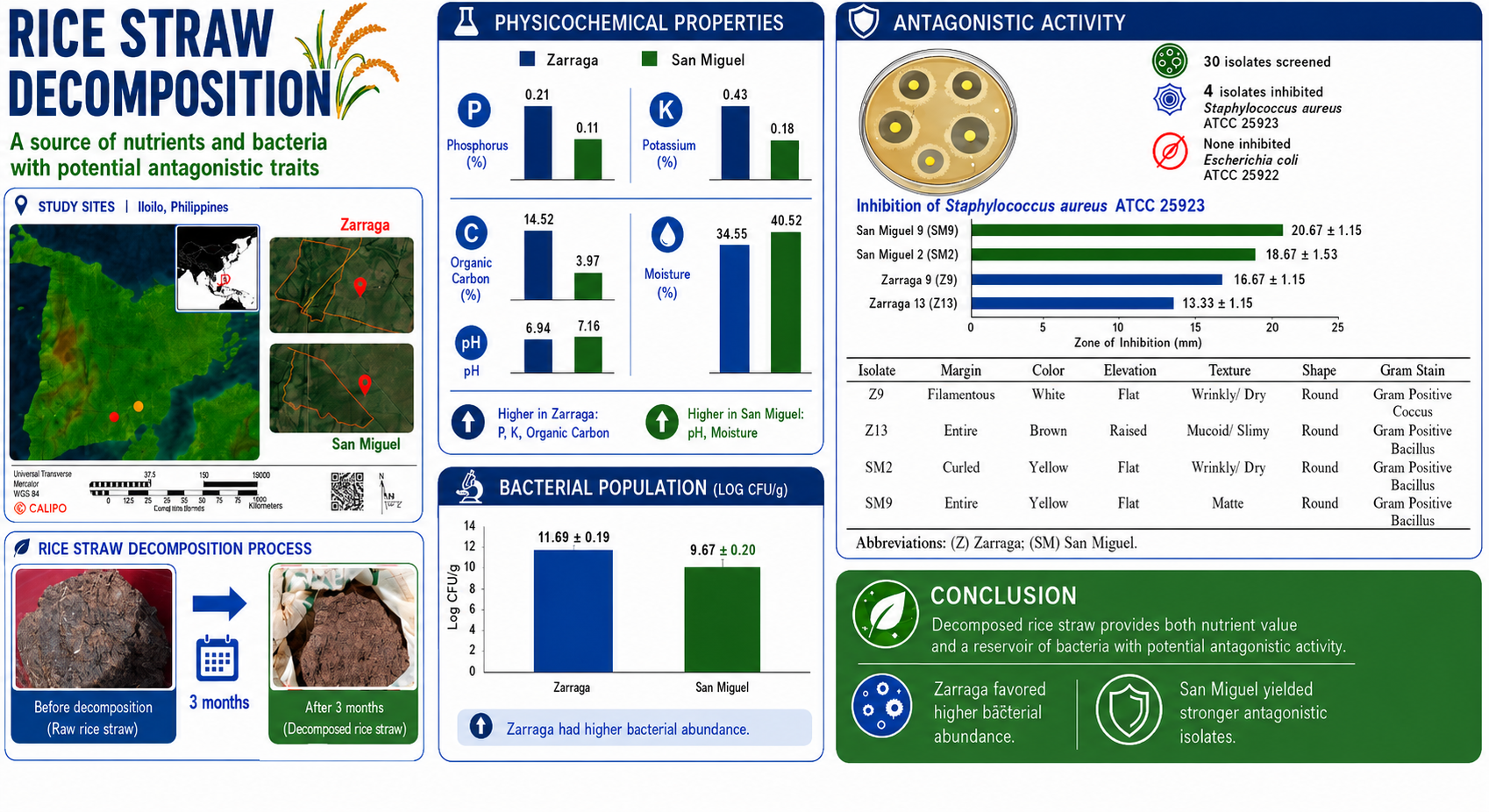
Rice straw is an abundant agricultural byproduct that contributes to soil fertility and supports diverse microbial communities. While organic decomposition is well-documented, the specific microbial dynamics and antagonistic potential inherent in the resulting decomposed rice straw remain under-explored. This study aimed to (1) evaluate the physicochemical characteristics of decomposed rice straw after three months of decomposition from two locations in Iloilo, Philippines (Zarraga and San Miguel), and (2) evaluate the antagonistic activity of bacterial isolates against Escherichia coli ATCC 25922 and Staphylococcus aureus ATCC 25923 using agar plug method. Physicochemical analysis showed higher phosphorus (0.21 ± 0.00%), potassium (0.43 ± 0.01%), and organic carbon (14.52 ± 0.88%) in Zarraga compared to San Miguel (0.11 ± 0.00%, 0.18 ± 0.02%, and 3.97 ± 0.21%, respectively; p < 0.05). Viable counts were also greater in Zarraga (11.69 ± 0.19 log CFU/g) than in San Miguel (9.67 ± 0.20 log CFU/g; p < 0.05). Among 30 isolates obtained, four inhibited S. aureus, with the strongest inhibition observed in San Miguel isolates SM9 (20.67 ± 1.15 mm) and SM2 (18.67 ± 1.53 mm). No isolates inhibited E. coli. These results may suggest that nutrient-rich conditions in Zarraga supported higher bacterial abundance, whereas the unique physicochemical conditions in San Miguel could favor isolates with stronger antagonistic activity. Overall, the findings indicate that decomposed rice straw provides both nutrients and microbial communities with potential antagonistic traits. Further molecular and functional characterization is needed to identify these isolates and evaluate their relevance for agricultural and ecological potential.
Article Details

This work is licensed under a Creative Commons Attribution-NonCommercial-NoDerivatives 4.0 International License.
References
Kilo A, Djafar Y, Iyabu H. Evaluation of Nitrogen, Phosphorus, and Potassium Levels in Rice Straw Compost for Sweet Corn Growth in Gorontalo. Jamb J Chem. 2023;5(1):81–89.
Chivenge P, Rubianes F, Chin D, Khang V, Romasanta R, Hung N, Trinh M. Rice Straw Incorporation Influences Nutrient Cycling and Soil Organic Matter. In: Gummert M, Hung N, Chivenge P, Douthwaite B, editors. Sustainable Rice Straw Management. Cham: Springer; 2020. p. 131–144.
Yang J, Liao B, Fang C, Sheteiwy M, Yi Z, Liu S, Li C, Ma G, Tu N. Effects of Applying Different Organic Materials on Grain Yield and Soil Fertility in a Double-Season Rice Cropping System. Agronomy. 2022;12(11).
Iqbal N, Agrawal A, Dubey S, Kumar J. Role of Decomposers in Agricultural Waste Management. IntechOpen. 2021.
Wei B, Bi J, Qian X, Peng C, Sun M, Wang E, Liu X, Zeng X, Feng H, Song A, et al. Organic Manure Amendment Fortifies Soil Health by Enriching Beneficial Metabolites and Microorganisms and Suppressing Plant Pathogens. Agronomy. 2025;15:429.
Tao C, Li R, Xiong W, Shen Z, Liu S, Wang B, Ruan Y, Geisen S, Shen Q, Kowalchuk GA. Bio-organic fertilizers stimulate indigenous soil Pseudomonas populations to enhance plant disease suppression. Microbiome. 2020;8:137.
Reddy S, Golamari P, Srimoukthika B, Reddy VV. Isolation and Characterization of Bacteria from Compost for Municipal Solid Waste from Guntur and Vijayawada. J Pharm Sci Res. 2017;9:1490–1497.
Low ALM, Mohamad SAS, Abdullah MFF. Taxonomic Diversity and Antimicrobial Activities of Actinomycetes from Manure Composts. Res J Microbiol. 2015;10:513–522.
Chen H, Cao Q, Xiong G, Li W, Zhang A, Yu H, Wang J. Composition of wheat rhizosphere antagonistic bacteria and wheat sharp eyespot as affected by rice straw mulching. Pedosphere. 2010;20(4):505–514.
Newman DJ, Cragg GM. Natural Products as Sources of New Drugs over the Nearly Four Decades from 1981 to 2019. J Nat Prod. 2020;83(3):770–803.
Nazari MT, Machado BS, Marchezi G, Crestani L, Ferrari V, Colla LM, Piccin JS. Use of Soil Actinomycetes for Pharmaceutical, Food, Agricultural, and Environmental Purposes. 3 Biotech. 2022;12(9):232.
Billonid J, Padilla P, Muege M, Sumaryo M, Geduspan J. Bacterial Community Structure, Diversity, and Fertility of Soil with and without Press Mud in Two Sites in Panay, Philippines. J Trop Life Sci. 2023;13(1):23–36.
U.S. Food and Drug Administration. BAM R56: Peptone Diluent, 0.1%. In: Bacteriological Analytical Manual (BAM) [Internet]. Silver Spring (MD): U.S. Food and Drug Administration; 2020 [cited 2026 Jun 24]. Available from: https://www.fda.gov/food/laboratory-methods-food/bam-r56-peptone-diluent-01
Shen X, Sheng L, Benedict C, Kruger CE, Su Y, Schacht E, Zhang Y, Zhu MJ. Evaluation of Pre-Harvest Microbiological Safety of Blueberry Production with or without Manure-Derived Fertilizer. Front Microbiol. 2020;10:3130.
Tupas WP, Estrobo FEC, Tabiano AM, Billonid JG, Armada CD, Mamon RAG. Snapshot Sample of Gastropods and Bacterial Antagonistic Activity in Areas of a Mangrove Ecosystem Prone to Disturbance from the Iloilo River, Iloilo, Philippines. Asia-Pac J Sci Technol. 2025; 30(2):APST–30.
Armada CD, Brasileno AJD, Artesano., Mamon RAG, Billonid JG, Simora RMC. Isolation and characterization of amylase-producing Bacillus sp. ACoL20 isolated from the gut of flying fish, Cheilopogon intermedius. Int J Aquat Biol. 2026;14(1):69-80.
Breakwell D, Woolverton C, MacDonald B, Smith K, Robison R. Colony Morphology Protocol [Internet]. Washington (DC): American Society for Microbiology; 2007 [updated 2016; cited 2026 Jun 24]. Available from: https://asm.org/asm/media/protocol-images/colony-morphology-protocol.pdf
Sarkar MIU, Islam MN, Jahan A, Islam A, Biswas JC. Rice Straw as a Source of Potassium for Wetland Rice Cultivation. Geology, Ecology, and Landscapes. 2017;1(3):184-189.
Lestari Y, Maftu’ah E, Annis W. Rice Straw Composting by Cellulolytic Bacteria Isolate and Its Application on Rice in Acid Sulfate Soils. BIO Web Conf. 2020;20:01006.
Zarate-Valdez J, Zasoski R, Läuchli A. Short-Term Effects of Moisture Content on Soil Solution pH and Soil Eh. Soil Sci. 2006;171:423–431.
Liang Y, Jiang Y, Wang F, Wen C, Deng Y, Xue K, Zhou J. Long-Term Soil Transplant Simulating Climate Change with Latitude Significantly Alters Microbial Temporal Turnover. ISME J. 2019;13(4):1002–1017.
Guo T, Zhang Q, Ai C, Liang G, He P, Zhou W. Nitrogen Enrichment Regulates Straw Decomposition and Its Associated Microbial Community in a Double-Rice Cropping System. Sci Rep. 2018;8(1):1847.
Wang X, Liu H, Zhang Z, Wang X, Zhang T. Characteristics of Rice Straw Decomposition and Bacterial Community Succession. Sci Rep. 2022;12:15708.
Compant S, Samad A, Faist H, Sessitsch A. A Review on the Plant Microbiome: Ecology, Functions, and Emerging Trends in Microbial Application. J Adv Res. 2019;19:29–37.
Lopes R, Tsui S, Gonçalves PJ, Mendonça-Hagler LC. Antagonistic Bacteria: An Untapped Resource for Biocontrol in Agriculture. World J Microbiol Biotechnol. 2021;37(7):109.
Charousová I, Medo J, Hleba L, Císarová M, Javoreková S. Antimicrobial Activity of Actinomycetes and Characterization of Actinomycin-Producing Strain KRG-1 Isolated from Karoo, South Africa. Braz J Pharm Sci. 2019;55.
Thapa A, Budhathoki A, Sapkota A, Sainju M, Shrestha P, Pant SP. Isolation, Identification, and Screening of Bacillus Species with Antimicrobial Activity from Different Soil Samples of Kathmandu Valley. Nepal J Biotechnol. 2021;9(2):1–6.
Lutz S, Heuer H, Smalla K. Harnessing the Microbiomes of Suppressive Composts for Plant Protection. Front. Microbiol. 2020;11.
Pot S, Mba CC, Willems KA. Understanding the Shift in the Microbiome of Composts: From Waste to Ecosystem Service. Front Microbiol. 2021;12.
Mendes R, Garbeva P, Raaijmakers JM. The Rhizosphere Microbiome: Significance of Plant–Microbe Interactions for Plant Growth and Health. FEMS Microbiol Rev. 2013;37(5):634–663.
Xiong W, Li Z, Liu H, Xue C, Zhang R, Wu H, Shen Q. The Effect of Long-Term Continuous Cropping of Black Pepper on Soil Bacterial Communities as Determined by 454 Pyrosequencing. PLoS One. 2017;12(5).
Bouchtaoui EM, Aissi O, Ouari K, Ben Ali A. Exploring Mechanisms of Compost-Mediated Suppression: How Compost Suppresses Plant Disease. Ecotoxicol Environ Saf. 2024;271.
Ahmed T, Noman M, Qi Y, Shahid M, Hussain S, Masood HA, Xu L, Ali HM, Negm S, El-Kott AF, Yao Y, Li B. Fertilization of Microbial Composts: A Technology for Improving Stress Resilience in Plants Plants. 2023;12(20).
