
Sodium hypochlorite effectively revives slightly contaminated stage II and IV tissue-cultured ‘Cavendish’ banana
Article Sidebar
Main Article Content
Abstract
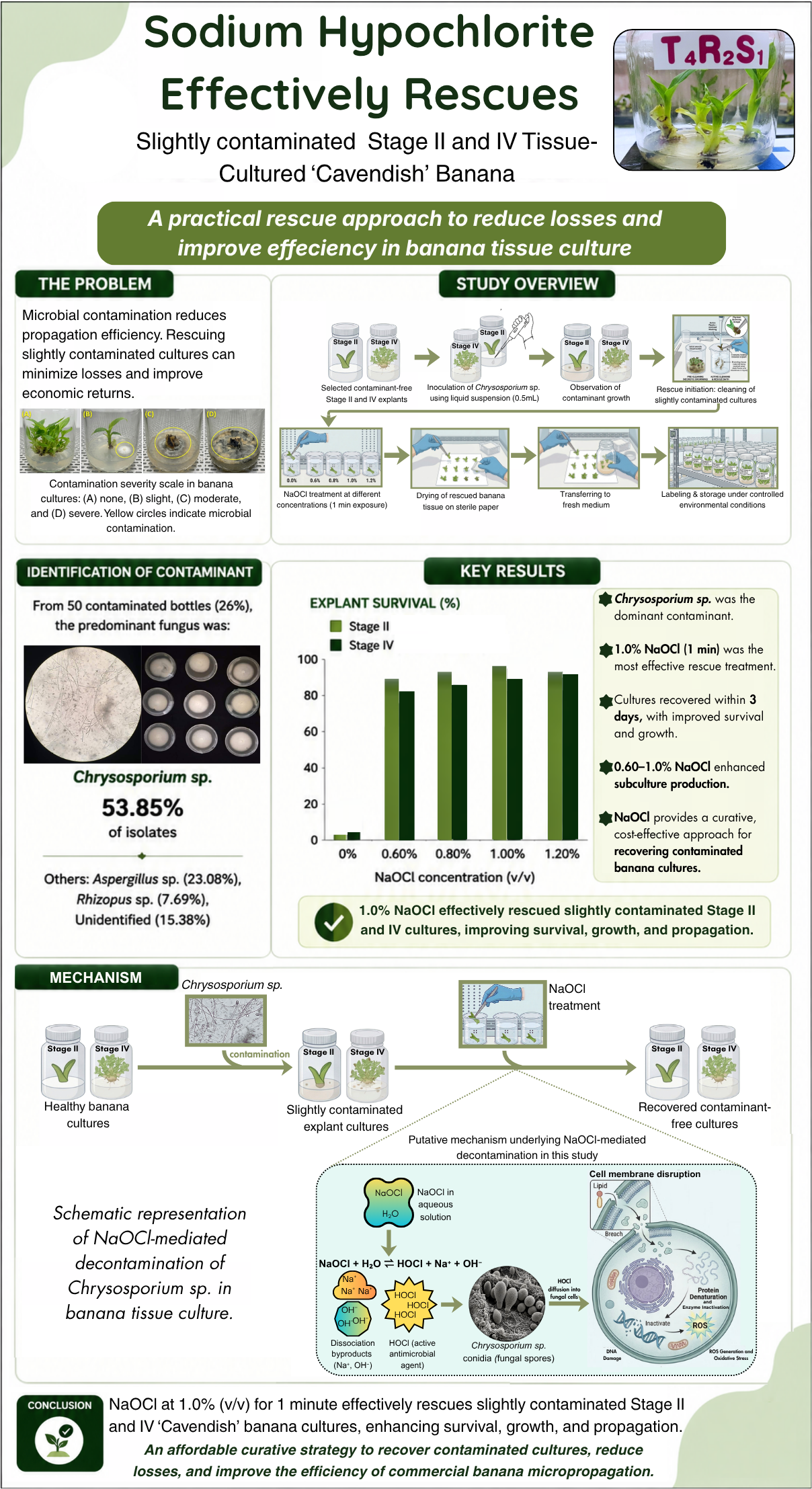
Contamination in plant tissue culture reduces explant survival and leads to significant losses in propagation efficiency. This study identified the dominant microbial contaminant in tissue-cultured ‘Cavendish’ banana and evaluated the effectiveness of sodium hypochlorite (NaOCl) in rescuing slightly contaminated cultures during multiplication (Stage II) and acclimatization (Stage IV). Fungal contaminants were isolated, purified, and identified, with Chrysosporium sp. emerging as the predominant species (53.85%), followed by Aspergillus sp. and Rhizopus sp. Slightly contaminated explants were treated with NaOCl at 0.60%, 0.80%, 1.00%, and 1.20% (v/v). NaOCl treatments improved explant survival and allowed recovery within three days. At Stage II, all tested concentrations enhanced callus formation and survivability, while at Stage IV, 1.0–1.2% (v/v) NaOCl resulted in better plant growth, including higher meristem height, increased leaf production, and improved rooting. Among the treatments, 1.0% (v/v) NaOCl was identified as the most consistent balance between contamination control and explant viability. Unlike most studies that focus on preventive sterilization at the initial stage (Stage I), this study demonstrates the potential of NaOCl as a curative approach for managing contamination at later stages of micropropagation. This offers a practical strategy to reduce losses and improve efficiency in commercial banana tissue culture systems.
Article Details

This work is licensed under a Creative Commons Attribution-NonCommercial-NoDerivatives 4.0 International License.
References
Philippine Statistics Authority. Major fruit crops quarterly bulletin, April–June 2019 [Internet]. Philippines: Philippine Statistics Authority. 2019 [cited 2022 Mar 12]. Available from: https://psa.gov.ph/fruits-crops-bulletin.
Singh C. Review on problems and its remedy in plant tissue culture. Asian J Biol Sci. 2018;11(4):165-172.
Suman S. Plant tissue culture: A promising tool of quality material production with special reference to micropropagation of banana. Biochem Cell Arch. 2017;17(1):1-26.
Haque MI, Singh PK, Ghuge S, Kumar A, Rai AC, Kumar A, et al. A general introduction to and background of plant tissue culture: Past, current, and future aspects. In: Advances in Plant Tissue Culture. Academic Press; 2022. p. 1-30.
Rane M, Khan S. Study of bacteria and fungi isolated from contaminated banana tissue culture. Int J Innov Res Sci Eng Technol. 2016;5(3):2795-2801.
Singh HP, Uma S, Selvarajan R, Karihaloo JL. Micropropagation for production of quality banana planting material in Asia-Pacific. New Delhi, India: Asia-Pacific Consortium on Agricultural Biotechnology (APCoAB); 2011.
Leelavathy S, Deepa Sankar P. Curbing the menace of contamination in plant tissue culture. J Pure Appl Microbiol. 2016;10(3):2145-2152.
da Cruz Nizer WS, Inkovskiy V, Overhage J. Surviving reactive chlorine stress: Responses of Gram-negative bacteria to hypochlorous acid. Microorganisms. 2020;8(8):1220.
Netravati J, Jagadeesh M, Mesta M, Rudresh. Effect of washing treatments on quality of banana fruits. J Pharmacogn Phytochem. 2018;7(2):3100-3103.
Hesami M, Daneshvar MH, Lofti-Jalalabadi A. The effect of sodium hypochlorite on control of in vitro contamination and seed germination of Ficus religiosa. Iran J Plant Physiol. 2017;7(4):2157-2162.
Keshari B, Pradhan B, Deo B. Effects of cytokinins and auxins on micropropagation of Musa spp. cv. Yangambi. Int. J. Environ. Agric. Res. 2016;2(5):156-158.
Hassen NI, Badaluddin NA, Mustapha Z, Zawawi D. Identification and prevention of microbial contaminants in Musa paradisiaca tissue culture. Malays Appl Biol. 2022;51(5):129-143.
Goswami NK, Handique PJ. In vitro sterilization protocol for micropropagation of Musa (AAA group) 'Amritsagar,' Musa (AAB group) 'Malbhog,' and Musa (AAB group) 'Chenichampa' banana. Indian J Appl Res. 2013;3(6):51-54.
Chang S, Li J, Sun W, Lin F, Xu B. A method to rescue the polluted explant in banana (Musa spp.) tissue culture. South Asian J Exp Biol. 2012;2(4):157‐161.
Hussain A, Qarsh IA, Nazir H, Ullah I. Plant tissue culture: Current status and opportunities. In: Recent advances in plant in vitro culture. Intech Open Access; 2012. p. 1-28.
Magbalot-Fernandez A, Hindoy CM Jr, Ubaub LT. In vitro efficacy of different antibiotics against contaminants of tissue-cultured ‘Lakatan’ banana. Ann Trop Res. 2021;43(2):35-50.
Reina O. How to detect, avoid, and deal with contaminated cell cultures [Internet]. Tempo Bioscience; 2016 [cited 2022 Mar 12]. Available from: https://www.tempobioscience.com/blog/?p=337
Cobrado J, Fernandez A. Common fungi contamination affecting tissue-cultured abaca (Musa textilis Nee) during the initial stage of micropropagation. Asian Res J Agric. 2016;1(2):1-7.
Wang Y, Yang X, Li Y, Wang B, Shi T. The genus Chrysosporium: A potential producer of natural products. Fermentation. 2023;9(1):76.
Bohacz J, Korniłłowicz-Kowalska T, Kitowski I, Ciesielska A. Degradation of chicken feathers by Aphanoascus keratinophilus and Chrysosporium tropicum strains from pellets of predatory birds and its practical aspect. Int Biodeterior Biodegrad. 2020;151:104968.
Ray SS, Ali N. Biotic contamination and possible ways of sterilization: A review with reference to bamboo micropropagation. Braz Arch Biol Technol. 2017;60:e16160485.
Okoroafor UE. Microbial contamination in plant tissue culture and elimination strategies. Nig Agric J. 2022;53(2):348-355.
Cornelison CT, Stubblefield B, Gilbert E, Crow SA Jr. Recurrent Aspergillus contamination in a biomedical research facility: A case study. J Ind Microbiol Biotechnol. 2012;39(2):329-335.
Lennartsson P, Taherzadeh MJ, Edebo L. Rhizopus. In: Batt CA, Tortorello ML, editors. Encyclopedia of food microbiology. 2nd ed. Oxford: Elsevier; 2014. p. 284-290.
Abatenh E, Gizaw B, Tsegaye Z. Contamination in a microbiological laboratory. Int J Res Stud Biosci. 2018;6(4):7-13.
Dangariya M, Khandhar D, Monpara J, Chudasama K, Thaker V. Detection and identification of microbial contaminants from plant tissue culture. Trop Plant Res. 2020;7(2):388-395.
Yildiz M, Özcan S, Kahramanoğulları C, Tuna E. The effect of sodium hypochlorite solutions on the viability and in vitro regeneration capacity of the tissue. Nat Prod J. 2012;2(4):328-331.
Sawa S. CLAVATA3. In: Karstin AJ, editor. Handbook of Biologically Active Peptides. 2nd ed. Academic Press; 2013. p. 1-4.
Ali A, Sajid A, Naveed N, Majid A, Saleem A, Khan U, et al. Initiation, proliferation, and development of micropropagation system for mass scale production of banana through meristem culture. Afr J Biotechnol. 2011;10(70):15731-15738.
Manigo BI. Bioefficacy test of Hatake™(Bacillus amyloliquefaciens D203 strain) for control of crown rot disease in 'Cavendish' bananas. Acta Hortic. 2019;1245:85-92.
Hossain A, Rubel M, Nasiruddin K, Evamoni F. Influence of BAP and NAA on in vitro plantlet regeneration of local and exotic banana cultivars. J Biosci Agric Res. 2016;6(2):553-564.
Buah J, Kawamitsu Y, Sato S, Murayama S. Effects of different types and concentrations of gelling agents on the physical and chemical properties of media and the growth. Plant Prod Sci. 1999;2(2):138-145.
Joy P, Anjana R, Jose P. Annual research and development report for 2012-13. Ernakulam: Kerala Agricultural University; 2013. p. 153-158.
