
Strain Selection and Characterization of Komagataeibacter hansenii for Bacterial Nanocellulose Production from Fruit Waste
Article Sidebar
Main Article Content
Abstract
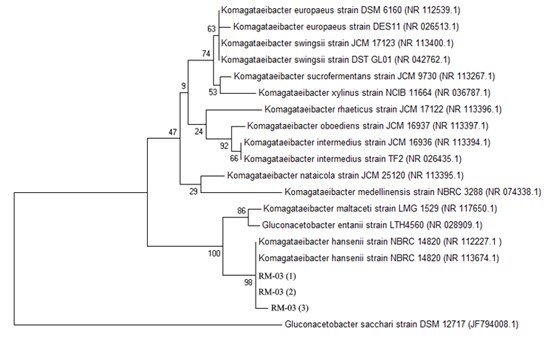
Bacterial nanocellulose (BNC) is a microorganism-derived homopolymer with a simpler, less harsh production route than its typical plant-based counterpart, offering unique properties valuable to high-end industries. This study aims to isolate and characterize bacteria that produce BNC from fermented rotten fruit waste, highlighting fermented starfruit as a selective and underexplored source for isolation. Among 80 isolates obtained using the fermented fruit juice method, strain RM-03 produced the highest cellulose concentration (0.092 g/100 mL) and was identified as Komagataeibacter hansenii (99.0% similarity). Using HS medium, it produced 0.277 ± 0.007 g/100 mL BNC at Day 16, a production within the range reported for some Komagataeibacter strains cultivated under comparable static, unoptimized conditions. Microscopy characterization revealed a dense network of nanofibers with an average fibril width of 35 nm. Spectroscopic and diffraction analyses confirmed cellulose type I with 78.24% crystallinity. The BNC exhibited excellent water-holding capacity (366.24%) and retained this moisture for up to 65 hours. These findings demonstrate that fermented rotten starfruit is a promising source for isolating functional BNC producers and that K. hansenii RM-03 shows strong potential for further bioprocess development and industrial applications.
Article Details

This work is licensed under a Creative Commons Attribution-NonCommercial-NoDerivatives 4.0 International License.
References
Liu Y, Ahmed S, Sameen DE, Wang Y, Lu R, Dai J, et al. A review of cellulose and its derivatives in biopolymer-based food packaging applications. Trends Food Sci Technol. 2021;112:532–546.
Felgueiras C, Azoia NG, Gonçalves C, Gama M, Dourado F. Trends on cellulose-based textiles: raw materials and technologies. Front Bioeng Biotechnol. 2021;9:608826.
Gopu G, Govindan S. Production of bacterial cellulose from Komagataeibacter saccharivorans strain BC1 isolated from rotten green grapes. Prep Biochem Biotechnol. 2018;48(9):842–852.
Dórame-Miranda RF, Gámez-Meza N, Medina-Juárez L, Ezquerra-Brauer JM, Ovando-Martínez M, Lizardi-Mendoza J. Bacterial cellulose production by Gluconacetobacter entanii using pecan nutshell as carbon source and its chemical functionalization. Carbohydr Polym. 2019;207:91–99.
Moniri M, Moghaddam AB, Azizi S, Rahim RA, Ariff AB, Saad WZ, et al. Production and status of bacterial cellulose in biomedical engineering. Nanomaterials. 2017;7(9):257.
Samyn P, Meftahi A, Geravand SA, Heravi MEM, Najarzadeh H, Sabery MSK, et al. Opportunities for bacterial nanocellulose in biomedical applications: Review on biosynthesis, modification and challenges. Int J Biol Macromol. 2023;231:123316.
Kamal T, Ul-Islam M, Fatima A, Ullah MW, Manan S. Cost-effective synthesis of bacterial cellulose and its applications in the food and environmental sectors. Gels. 2022;8(9):552.
Płoska J, Garbowska M, Ścibisz I, Stasiak-Różańska L. Study on obtaining bacterial cellulose by Komagataeibacter xylinus in co-culture with lactic acid bacteria in whey. Appl Microbiol Biotechnol. 2025;109(1):191.
Rangaswamy BE, Vanitha KP, Hungund BS. Microbial cellulose production from bacteria isolated from rotten fruit. Int J Polym Sci. 2015;2015:280784.
Singhaboot P, Kroeksakul P. High performance of bacterial strain isolated from bio-extract for cellulose production. Pertanika J Trop Agric Sci. 2022;45(4):1161.
Güzel M, Akpınar Ö. Production and characterization of bacterial cellulose from citrus peels. Waste Biomass Valorization. 2019;10:2165–2175.
Yan Y, Chen T, Tan R, Han S, Zhang X, Shen Y, et al. In situ production of bacterial nanocellulose-activated carbon composites from pear juice industry wastewater by two new Komagataeibacter intermedius and Komagataeibacter xylinus isolates for heavy metal removal. Environ Technol Innov. 2024;33:103497.
Park JK, Park YH, Jung JY. Production of bacterial cellulose by Gluconacetobacter hansenii PJK isolated from rotten apple. Biotechnol Bioprocess Eng. 2003;8:83-88.
Lin SP, Huang YH, Hsu KDi, Lai YJ, Chen YK, Cheng KC. Isolation and identification of cellulose-producing strain Komagataeibacter intermedius from fermented fruit juice. Carbohydr Polym. 2016;151:827–833.
Nielsen SS. Phenol-sulfuric acid method for total carbohydrates. In: Food analysis laboratory manual. Boston: Springer; 2010. p. 47–53.
Green PN. Genus I: Methylobacterium. In: Bergey’s Manual of Systematic Bacteriology. Volume Two: The Proteobacteria, Part C. 2nd ed. New York: Springer; 2005.
Rosenberg E, Lory S, Stackebrandt E, Thompson F. The prokaryotes: Alphaproteobacteria and betaproteobacteria. 4th ed. Berlin: Springer-Verlag; 2013.
Poblet M, Rozès N, Guillamón JM, Mas A. Identification of acetic acid bacteria by restriction fragment length polymorphism analysis of a PCR-amplified fragment of the gene coding for 16S rRNA. Lett Appl Microbiol. 2000;31(1):63-67.
Ge HJ, Du SK, Lin DH, Zhang JN, Xiang JLe, Li ZX. Gluconacetobacter hansenii subsp. nov., a high-yield bacterial cellulose producing strain induced by high hydrostatic pressure. Appl Biochem Biotechnol. 2011;165:1519–1531.
Segal L, Creely JJ, Martin AE, Conrad CM. An empirical method for estimating the degree of crystallinity of native cellulose using the X-ray diffractometer. Text Res J. 1959;29(10):786-794.
Semjonovs P, Ruklisha M, Paegle L, Saka M, Treimane R, Skute M, et al. Cellulose synthesis by Komagataeibacter rhaeticus strain P 1463 isolated from Kombucha. Appl Microbiol Biotechnol. 2017;101(3):1003–1012.
Zhang W, Wang X, Qi X, Ren L, Qiang T. Isolation and identification of a bacterial cellulose synthesizing strain from Kombucha in different conditions: Gluconacetobacter xylinus ZHCJ618. Food Sci Biotechnol. 2018;27(3):705–713.
Singh O, Panesar PS, Chopra HK. Isolation and characterization of cellulose-producing bacterial isolate from rotten grapes. Biosci Biotechnol Res Asia. 2017;14:373–380.
Park MS, Jung YH, Oh S-Y, Kim MJ, Bang WY, Lim YW. Cellulosic nanomaterial production via fermentation by Komagataeibacter sp. SFCB22-18 isolated from ripened persimmons. J Microbiol Biotechnol. 2019;29(4):617–624.
Salari M, Sowti Khiabani M, Rezaei Mokarram R, Ghanbarzadeh B, Samadi Kafil H. Preparation and characterization of cellulose nanocrystals from bacterial cellulose produced in sugar beet molasses and cheese whey media. Int J Biol Macromol. 2019;122:280–288.
Daud AD, Rahman NA, Foo HL, Mohamad R. Bacterial nanocellulose (BNC) biosynthesis by Komagataeibacter hansenii RM-03 using agricultural waste as substrates and BNC-silver nanocomposite preparation. Asia-Pac J Mol Biol Biotechnol. 2024;32(2):1-14.
Machado RTA, Meneguin AB, Sábio RM, Franco DF, Antonio SG, Gutierrez J, et al. Komagataeibacter rhaeticus grown in sugarcane molasses-supplemented culture medium as a strategy for enhancing bacterial cellulose production. Ind Crops Prod. 2018;122:637–646.
Costa L, Carvalho AF, Fernandes AJS, Campos T, Dourado N, Costa FM, et al. Bacterial nanocellulose as a simple and tailorable platform for controlled drug release. Int J Pharm. 2024;663:124560.
Lee CM, Gu J, Kafle K, Catchmark J, Kim SH. Cellulose produced by Gluconacetobacter xylinus strains ATCC 53524 and ATCC 23768: Pellicle formation, post-synthesis aggregation and fiber density. Carbohydr Polym. 2015;133:270–276.
Alex AM, Mathew MS, Kuruvilla KJ, Appukuttan S, Joseph K, Thomas S. Protein and enzyme protected metal nanoclusters. In: Luminescent Metal Nanoclusters. Cambridge: Woodhead Publishing; 2022. p. 303-348.
Dahlström C, Duan R, Eivazi A, Magalhães S, Alves L, Engholm M, et al. Stacking self-gluing cellulose II films: A facile strategy for the formation of novel all-cellulose laminates. Carbohydr Polym. 2024;344:122523.
Mehra S, Chadha P. Alterations in structure of biomolecules using ATR-FTIR and histopathological variations in brain tissue of Channa punctatus exposed to 2-naphthalene sulfonate. Toxicol Res (Camb). 2020;9(4):530-536.
Fadzil NF, Othman SA. Fourier transform infrared spectroscopy analysis of bio-based composite utilizing citrus waste: a comparative study. Food Res. 2024;8:50–54.
Ou R, Xie Y, Shen X, Yuan F, Wang H, Wang Q. Solid biopolymer electrolytes based on all-cellulose composites prepared by partially dissolving cellulosic fibers in the ionic liquid 1-butyl-3-methylimidazolium chloride. J Mater Sci. 2012;47:5978–5986.
Yadav A, Rai M. Bioreduction and mechanistic aspects involved in the synthesis of silver nanoparticles using Holarrhena antidysenterica. J Bionanoscience. 2011;5:70–73.
Shao W, Liu H, Liu X, Wang S, Zhang R. Anti-bacterial performances and biocompatibility of bacterial cellulose/graphene oxide composites. RSC Adv. 2015;5(7):4795–4803.
Persson BNJ, Ganser C, Schmied F, Yang YP, Zhang Y, Lang YX, et al. Structural ATR-IR analysis of cellulose fibers prepared from a NaOH complex aqueous solution. IOP Conf Ser Mater Sci Eng. 2017;213:012039.
Bahadur A, Shoaib M, Saeed A, Iqbal S. FT-IR spectroscopic and thermal study of waterborne polyurethane-acrylate leather coatings using tartaric acid as an ionomer. E-Polymers. 2016;16(6):463-474.
Mohite BV, Patil SV. Physical, structural, mechanical and thermal characterization of bacterial cellulose by G. hansenii NCIM 2529. Carbohydr Polym. 2014;106:132-141.
Supian M, Radzuan N, Maskat MY, Yusop SM, Luthfi AAI, Hussin NEC, et al. Bacterial cellulose containing antimicrobial agent from expired drinks as sustainable food absorbent pad. Food Packag Shelf Life. 2025;49:101497.
Machado RTA, Gutierrez J, Tercjak A, Trovatti E, Uahib FGM, Moreno GP, et al. Komagataeibacter rhaeticus as an alternative bacteria for cellulose production. Carbohydr Polym. 2016;152:841–849.
Lin D, Li R, Lopez-Sanchez P, Li Z. Physical properties of bacterial cellulose aqueous suspensions treated by high pressure homogenizer. Food Hydrocoll. 2015;44:435-442.
Ul-Islam M, Khan T, Park JK. Water holding and release properties of bacterial cellulose obtained by in situ and ex situ modification. Carbohydr Polym. 2012;88(2):596-603.
