
Effect of alkali surface treatments on mechanical and morphology of natural galangal fibers
Article Sidebar
Main Article Content
Abstract
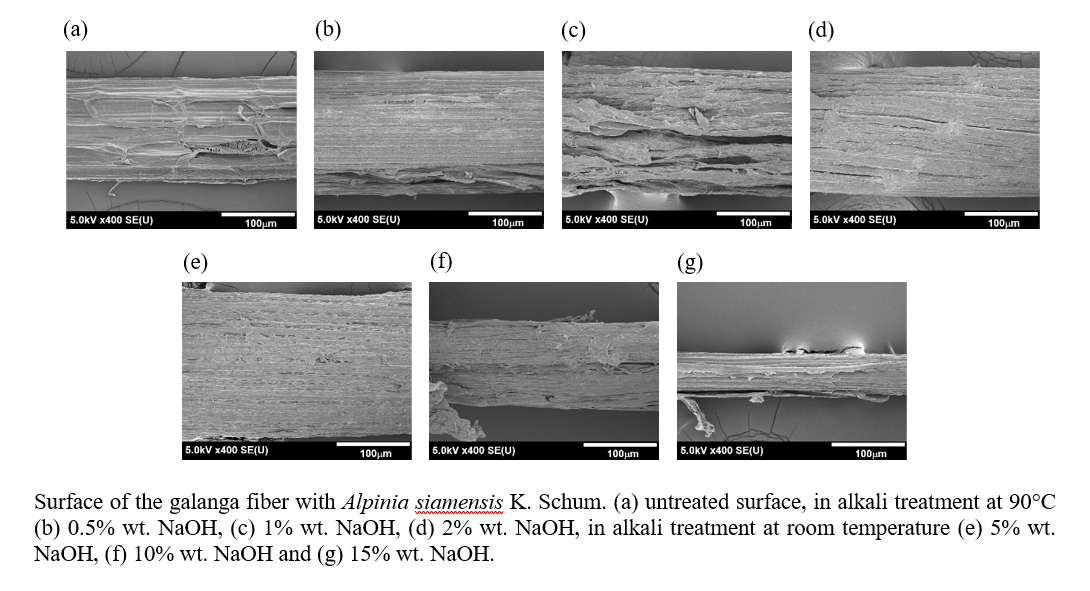
This study addresses the value-addition to agricultural residues by investigating the effects of alkali treatment on the physical and mechanical properties of Alpinia galanga (L.) Willd (AG) and Alpinia siamensis K. Schum (AS) pseudo-stem fibers. The fibers were extracted from pseudo-stem segments with an initial length of 25-30 cm. The untreated fiber diameters were 131.96 ± 38.42 µm for AG and 172.50 ± 42.94 µm for AS. To evaluate treatment efficiency, both a thermal-assisted at low concentration route and a conventional room-temperature process were compared. Morphological and surface roughness analyses ( and ) revealed that alkali treatments effectively dissolved surface impurities, reduced fiber diameters (reaching minimums of 107.99 ± 20.90 µm for AG at 10% wt. NaOH and 62.75 ± 11.77 µm for AS at 15% wt. NaOH), and induced distinct fibrillation. Regarding mechanical performance, the treated fibers showed enhanced tensile strength and elongation. The maximum tensile strength for AG was 147.67 ± 53.47 MPa (at 5% wt. NaOH), while AS peaked at 215.64 ± 95.57 MPa (at 0.5% wt. NaOH). Although extreme concentrations (15% wt. NaOH) yielded maximum elongation for both AG (7.25 ± 1.74%) and AS (5.93 ± 1.30%), they triggered cellulose degradation and reduced tensile strength. These findings highlight that optimized, low-chemical alkali treatments can successfully tailor galangal fibers into sustainable reinforcing materials, advancing circular economy principles in composite engineering.
Article Details

This work is licensed under a Creative Commons Attribution-NonCommercial-NoDerivatives 4.0 International License.
References
Mohammed M, Jawad AJM, Mohammed AM, Oleiwi JK, Adam T, Osman AF, et al. Challenges and advancement in water absorption of natural fiber-reinforced polymer composites. Polym Test. 2023;124:108083.
Sundar VJ, Sumithra S, Aaron KP. Development of composite sheet from leather waste and plant fibres - Value added sustainable product. Indian J Fibre Text Res. 2024;49:455-461.
Shanmugasundaram OL, Gowda RVM. Development and characterization of bamboo and organic cotton fibre blended baby diapers. Indian J Fibre Text Res. 2010;35:201-205.
Shanmugasundaram OL, Gowda RVM. Study of bamboo and cotton blended baby diapers. Res J Text Appar. 2011;15(4):37-43.
Yang L, Wu Y, Yang F, Wu X, Cai Y, Zhang J. A wood textile fiber made from natural wood. Mater Sci. 2021;56(27):15122-15133.
Awang M, Chik MS, Mustapha RB, Noraaini A. Utilization of agro-waste A. galanga natural fibers in composites. Adv Mater Res. 2013;634-638:1139-1142.
Sain MM, Bhatnagar A, inventors. Manufacturing of nano-fibrils from natural fibres, agro based fibres and root fibres. Canada patent CA 2437616. 2005 Feb 15.
Wang W, Wang X, Zhang Y, Yu Q, Tan X, Zhuang X, et al. Effect of sodium hydroxide pretreatment on physicochemical changes and enzymatic hydrolysis of herbaceous and woody lignocelluloses. Ind Crops Prod. 2020;145:112145.
Aditya BA, Pratim DP, Vijay C. Effect of moisture absorption on the properties of natural fiber reinforced polymer composites: A review. Mater Today: Proceedings. 2022;49:3403-3408.
Ravindran PN, Pillai GS, Balachandran I, Divakaran M. Galangal. In: Peter KV, editor. Handbook of herbs and spices. 2nd ed. Woodhead Publishing; 2012. p. 303-318.
Sathapanasiri Y, Meeboonya R, Jirapong C, Sirayakorn P, Praykaew A, Chanapag W. A survey on species diversity and utilization of genus Alpinia Roxb. (Zingiberaceae) in Samut Prakan Province. Huachiew Chalermprakiet Sci Technol J. 2025;11(2):13-28.
Supriya B, Jadhav A, Aman J. A review on herbal medicinal plant: Alpina galanga L. Willd. Int Res J Mod Eng Technol Sci. 2023;5(11):2411-2419.
Ahdi R. Effect of galangal (Alpinia galanga L.) rhizome for the health of cultured fish. Asian J Biol. 2023;18(3):37-44.
Trimanto T, Lia H, Dini D. Alpinia galanga (L.) willd: Plant morphological characteristic, histochemical analysis and review on pharmacological. AIP Conf Proc. 2021;2353(1):030021.
Arfa NMA, Ghannam HAE. Utilization of rhizome (Alpinia galanga L.) in improvement of some quality attributes of some processed meat. Food Nutr Sci. 2022;13(8):761-779.
Babu SS, Jiyas N, Sasidharan I, Kumar KB, Thomas VP, Thomas BT, et al. Sustainable valorization of Alpinia galanga pseudostem fibers for characterization and materials engineering applications. Sci Rep. 2025;15(1):10455.
International Organization for Standardization. ISO 5079:1995 Textile fibres -Determination of breaking force and elongation at break of individual fibres. Geneva: ISO; 1995.
Liu W, Mohanty AK, Drzal LT, Askel P, Misra M. Effects of alkali treatment on the structure, morphology and thermal properties of native grass fibers as reinforcements for polymer matrix composites. J Mater Sci. 2004;39(3):1051-1054.
Reddy KO, Reddy KRN, Zhang J, Zhang J, Varada Rajulu A. Effect of alkali treatment on the properties of century fiber. J Nat Fibers. 2013;10(3):282-296.
Sari NH, Wardana ING, Irawan YS, Siswanto E. The Effect of sodium hydroxide on chemical and mechanical properties of corn husk fiber. Orient J Chem. 2017;33(6):3037-3042.
Karthikeyan A, Balamurugan K, Kalpana A. The effect of sodium hydroxide treatment and fiber length on the tensile property of coir fiber-reinforced epoxy composites. Sci Eng Compos Mater. 2014;21(3):315–321.
Li X, Tabil LG, Panigrahi S. Chemical treatments of natural fiber for use in natural fiber-reinforced composites: a review. J Polym Environ. 2007;15(1):25-33.
Arsyad M, Kondo Y, Arman, Anzarih AM, Wahyuni N. Effect of sodium hydroxide concentration on the tensile strength of coconut fiber. J Phys Conf Ser. 2019;1341(5):052001.
Moorthy DN, Jayakumar L, Muthukumaran K. Characterization of chemicals from prosopis juliflora (PJ) - A potential enhancer for lightweight polymer applications. Mater Technol. 2021;55(5):619–624.
Abbas M, Bachtiar D, Siregar J, Rejab R. Effect of sodium hydroxide on the tensile properties of sugar palm fibre reinforced thermoplastic polyurethane composites. J Mech Eng Sci. 2016;10:1765-1777.
Liu H, You L, Jin H, Yu W. Influence of alkali treatment on the structure and properties of hemp fibers. Fibers Polym. 2013;14(3):389-395.
Lee S, Park CH. Influence of alkaline treatment on surface roughness and wetting properties of hydrophobized silk fabrics. Text Res J. 2018;88(7):777-789.
Wetaka C, Githinji DN, Namango S, Starovoytova D. Combined effect of water retting and sodium hydroxide concentration on properties of Luffa cylindrica fibres. Am J Eng Res. 2016;5(11):339-345.
Panesar D, Leung R, Sain M, Panthapulakkal S. The effect of sodium hydroxide surface treatment on the tensile strength and elastic modulus of cellulose nanofiber. In: Savastano Junior H, Fiorelli J, dos Santos SF, editors. Sustainable and nonconventional construction materials using inorganic bonded fiber Composites. Woodhead Publishing; 2017. p. 17-26.
