
Interpretable Machine Learning for Mental Workload Detection: From Binary to Multi-Class with Multimodal Physiology Signals
Article Sidebar
Main Article Content
Abstract
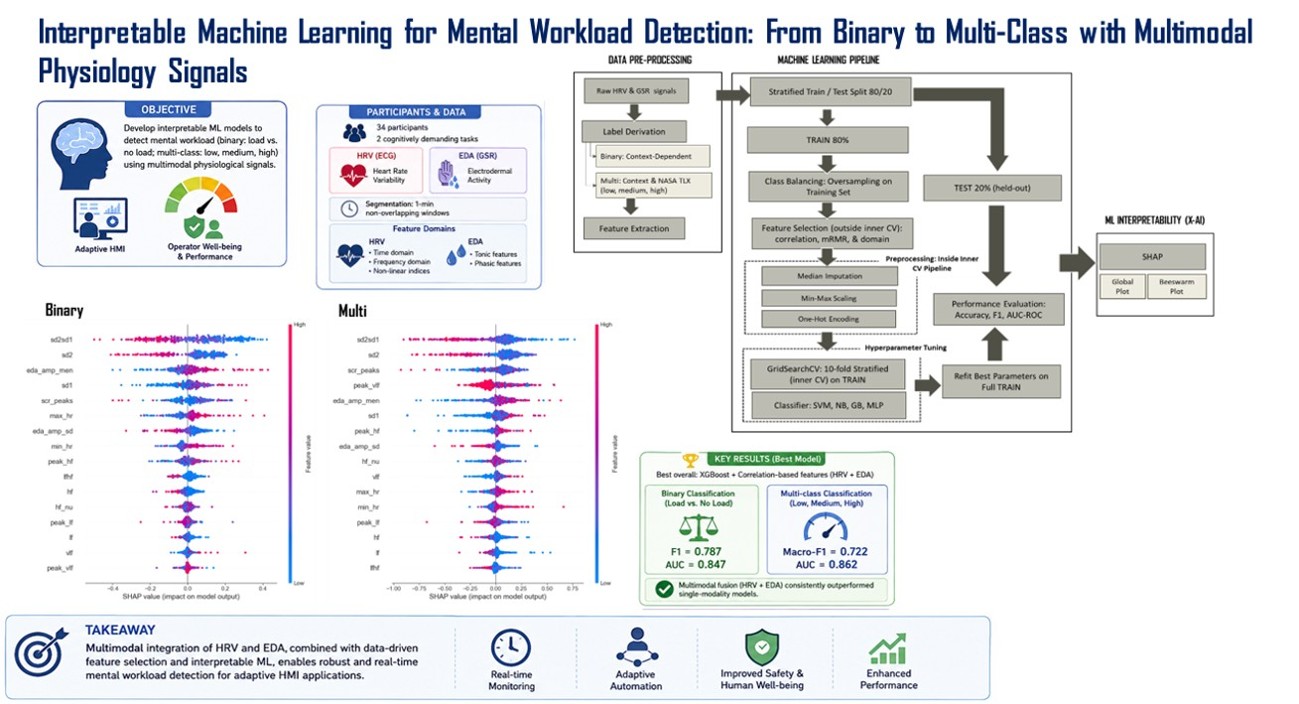
Accurate detection of mental workload is essential for developing adaptive human–machine interaction (HMI) systems that respond to cognitive states of users in real time. Therefore, this study aimed to develop as well as evaluate machine learning models for classifying mental workload into binary, namely load vs. no load, and multi-class comprising low, medium, and high levels using multimodal physiological signals. Thirty-four participants completed two cognitively demanding tasks, and heart rate variability (HRV) as well as electrodermal activity (EDA) were recorded during the tasks. Signals were segmented into 1-min non-overlapping windows, with features extracted from the time, frequency, and nonlinear HRV domains, as well as tonic and phasic EDA indices. Moreover, three feature selection strategies, correlation-based, domain-expert, and minimum redundancy maximum relevance (mRMR), were evaluated across multiple classifiers, including gradient boosting, XGBoost, random forest, k-nearest neighbor, and multilayer perceptron. The model performance was evaluated using an 80/20 subject-wise train–test split, with 10-fold cross-validation conducted on the training set. Additionally, oversampling was applied exclusively to the training data to address the class imbalance. The result showed that multimodal fusion of HRV and EDA consistently outperformed single-modality models, achieving the strongest performance with XGBoost and correlation-based feature selection (binary: F1 = 0.787, AUC = 0.847; multi-class: Macro-F1 = 0.722, AUC = 0.862). The Shapley additive explanations (ShAP) analysis identified nonlinear HRV indices and phasic EDA features as the dominant predictors. These outcomes showed the importance of multimodal integration and data-driven feature selection for robust mental workload detection in HMI.
Article Details

This work is licensed under a Creative Commons Attribution-NonCommercial-NoDerivatives 4.0 International License.
References
Iarlori S, Perpetuini D, Tritto M, et al. An Overview of Methods and Methods for the Cognitive Workload Estimation in Human–Machine Interaction Scenarios through Wearables Sensors. BioMedInformatics. 2024;4:1155–1173.
Ramakrishnan P, Balasingam B, Biondi F. Cognitive load estimation for adaptive human–machine system automation. In: Learning Control. Elsevier; 2021. p. 35–58.
Longo L, Wickens CD, Hancock G, et al. Human Mental Workload: A Survey and a Novel Inclusive Definition. Front Psychol. 2022;13:883321.
Hillege RHL, Lo JC, Janssen CP, et al. The Mental Machine: Classifying Mental Workload State from Unobtrusive Heart Rate-Measures Using Machine Learning. In: Sottilare RA, Schwarz J (eds) Adaptive Instructional Systems. Cham: Springer International Publishing; 2020. p. 330–349.
Wang P, Houghton R, Majumdar A. Detecting and Predicting Pilot Mental Workload Using Heart Rate Variability: A Systematic Review. Sensors. 2024;24:3723.
Tierney M, Adeyemi EO, Bommer S. A Systematic Literature Review: Cognitive Workload Assessment in Human Factors Study. Adv Hum-Comput Interact. 2025;2025:9313239.
Dalmeida KM, Masala GL. HRV Features as Viable Physiological Markers for Stress Detection Using Wearable Devices. Sensors. 2021;21:2873.
Sardar SK, Kumar N, Lee SC. A Systematic Literature Review on Machine Learning Algorithms for Human Status Detection. IEEE Access. 2022;10:74366–74382.
Sutarto AP, Bagus Herlambang M, Izzah N, et al. Optimizing Mental Workload Detection for HCI: Comparative Feature Selection and Interpretable Machine Learning. Int J Comput Digit Syst. 2025;17:1–17.
Gjoreski M, Luštrek M, Gams M, et al. Monitoring stress with a wrist device using context. J Biomed Inform. 2017;73:159–170.
Izzah N, Sutarto AP, Hendi A, et al. Physiological Signals as Predictors of Mental Workload: Evaluating Single Classifier and Ensemble Learning Models. J Optimasi Sist Ind. 2023;22:81–98.
Pettersson K, Tervonen J, Narvainen J, et al. Selecting Feature Sets and Comparing Classification Methods for Cognitive State Estimation. In: 2020 IEEE 20th International Conference on Bioinformatics and Bioengineering (BIBE); 2020. p. 683–690.
Ahmed MU, Begum S, Gestlöf R, et al. Machine Learning for Cognitive Load Classification – A Case Study on Contact-Free Method. In: Maglogiannis I, Iliadis L, Pimenidis E (eds) Artificial Intelligence Applications and Innovations. Cham: Springer International Publishing; 2020. p. 31–42.
Bahameish M, Stockman T, Requena Carrión J. Strategies for Reliable Stress Recognition: A Machine Learning Method Using Heart Rate Variability Features. Sensors. 2024;24:3210.
Dayal A, Khan Z, Ullah K, et al. A Novel Method to Cognitive Load Measurement in N-Back Tasks Using Wearable Sensors, Empirical Mode Decomposition With Machine Learning, and Explainable AI for Feature Importance. IEEE Access. 2025;13:17083–17098.
Ding Y, Cao Y, Duffy VG, et al. Measurement and identification of mental workload during simulated computer tasks with multimodal methods and machine learning. Ergonomics. 2020;63:896–908.
Chalabianloo N, Can YS, Umair M, et al. Application level performance evaluation of wearable devices for stress classification with explainable AI. Pervasive Mob Comput. 2022;87:101703.
Kim H, Kim M, Park K, et al. Machine learning-based classification analysis of knowledge worker mental stress. Front Public Health. 2023;11:1302794.
Dahal K, Bogue-Jimenez B, Doblas A. Global Stress Detection Framework Combining a Reduced Set of HRV Features and Random Forest Model. Sensors. 2023;23:5220.
Giannakakis G, Grigoriadis D, Giannakaki K, et al. Review on Psychological Stress Detection Using Biosignals. IEEE Trans Affect Comput. 2022;13:440–460.
Matuz A, Van Der Linden D, Darnai G, et al. Generalisable machine learning models trained on heart rate variability data to predict mental fatigue. Sci Rep. 2022;12:20023.
Mueller ST, Piper BJ. The Psychology Experiment Building Language (PEBL) and PEBL Test Battery. J Neurosci Methods. 2014; 222:250–259.
Forte G, Casagrande M. The intricate brain–heart connection: The relationship between heart rate variability and cognitive functioning. Neuroscience. 2025;565:369–376.
Bechara A, Damasio H, Tranel D, et al. The Iowa Gambling Task and the somatic marker hypothesis: some questions and answers. Trends Cogn Sci. 2005;9:159–162.
Kubios Oy. Kubios HRV Scientific User's Guide 2026 [Internet]. Kuopio: Kubios Oy; 2026 [cited 2026 Jan 10]. Available from: https://www.kubios.com/downloads/HRV-Scientific-Users-Guide.pdf.
Laborde S, Mosley E, Thayer JF. Heart rate variability and cardiac vagal tone in psychophysiological study - Recommendations for experiment planning, data analysis, and data reporting. Front Psychol. 2017;20:8:213.
Makowski D, Pham T, Lau ZJ, et al. NeuroKit2: A Python toolbox for neurophysiological signal processing. Behav Res Methods. 2021;53:1689–1696.
He H, Bai Y, Garcia EA, et al. ADASYN: Adaptive synthetic sampling method for imbalanced learning. In: 2008 IEEE International Joint Conference on Neural Networks (IEEE World Congress on Computational Intelligence). Hong Kong, China: IEEE; 2008. p. 1322–1328.
Radovic M, Ghalwash M, Filipovic N, et al. Minimum redundancy maximum relevance feature selection method for temporal gene expression data. BMC Bioinformatics. 2017;18:9.
Boucsein W. Electrodermal Activity. 2nd ed. New York: Springer; 2012.
Seitz J, Maedche A. Biosignal-Based Recognition of Cognitive Load: A Systematic Review of Public Datasets and Classifiers. In: Davis FD, Riedl R, Vom Brocke J, et al. (eds) Information Systems and Neuroscience. Cham: Springer International Publishing; 2022. p. 35–52.
Chen T, Guestrin C. XGBoost: a scalable tree boosting system. In: Proceedings of the 22nd ACM SIGKDD International Conference on Knowledge Discovery and Data Mining. New York: ACM; 2016. p. 785–794.
Lundberg SM, Erion G, Chen H, et al. From local explanations to global understanding with explainable AI for trees. Nat Mach Intell. 2020;2:56–67.
Hörmann T, Hesse M, Christ P, et al. Fine-grained prediction of cognitive workload in a modern working environment by utilizing short-term physiological parameters. In: Proceedings of the 9th International Joint Conference on Biomedical Engineering Systems and Technologies. SCITEPRESS - Science and and Technology Publications; 2016.4:42–51.
Delliaux S, Delaforge A, Deharo J-C, et al. Mental Workload Alters Heart Rate Variability, Lowering Non-linear Dynamics. Front Physiol. 2019;10:1–14.
