
Preliminary Study of Bacterial Communities Associated with Native Blowflies in a Primary Malaysian Tropical Rainforest
Article Sidebar
Main Article Content
Abstract
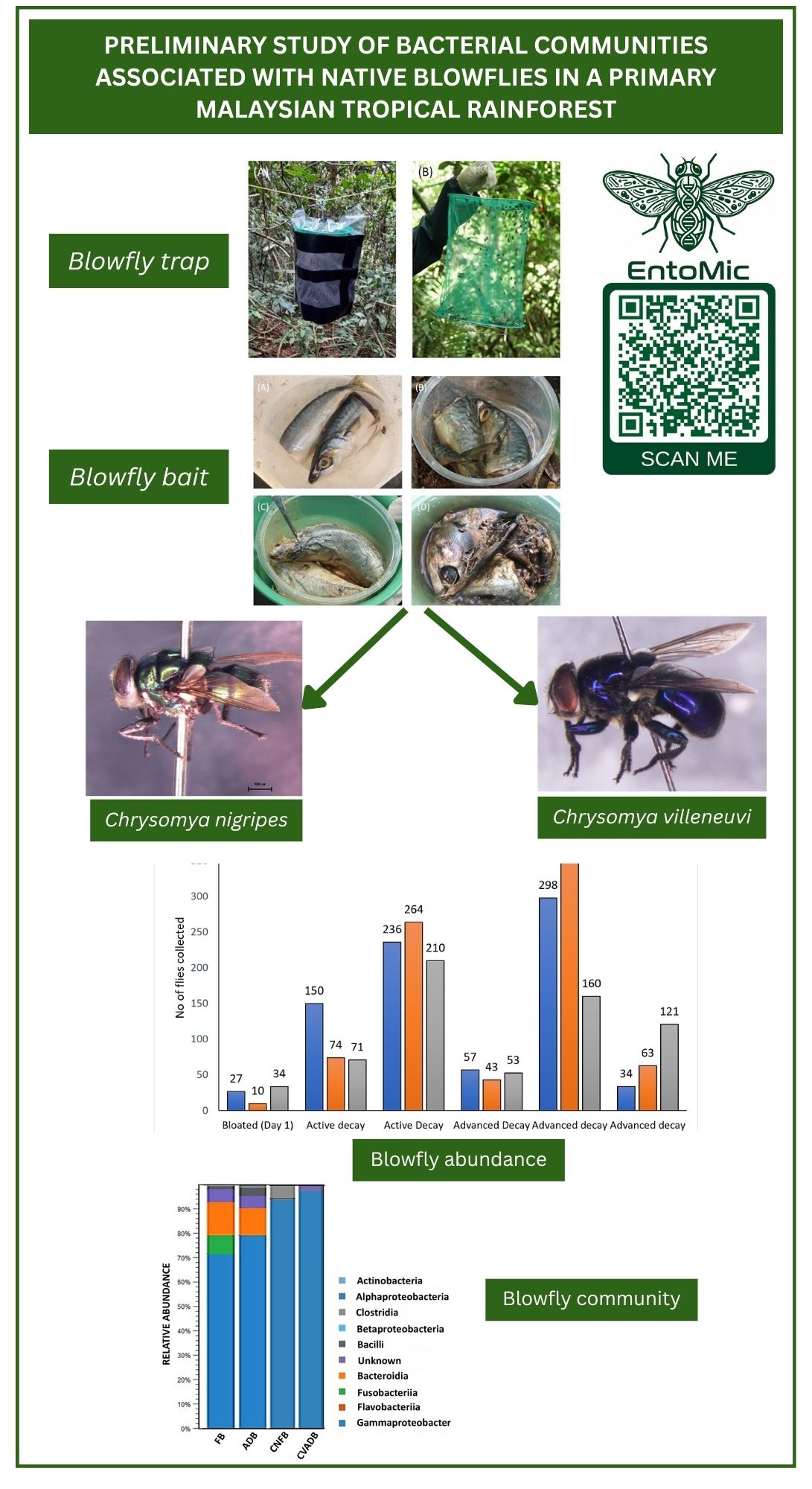
Blowflies (Diptera: Calliphoridae) fill key ecological niches in carrion decomposition and are widely utilised as indicators in forensic investigations; however, their associations with bacterial communities remain poorly documented in tropical rainforest ecosystems. This preliminary study investigated blowfly diversity and surface-associated bacterial communities in Kuala Keniam, Pahang National Park, Malaysia. Modified minnow traps baited with fish were deployed along a forest transect over six days, yielding 2,276 adult blowflies representing eight calliphorid taxa, predominantly Chrysomya species. Bacterial communities associated with fresh and advanced-decay bait, as well as with adult Chrysomya nigripes and Chrysomya villeneuvi, were characterised using 16S rRNA gene sequencing. Distinct microbial succession patterns were observed across decomposition stages. Shewanella algae were prevalent in fresh bait and anaerobic taxa, such as Bacteroides coprosuis, becoming more abundant as decay advanced. Blowfly-associated bacterial communities differed from those of the bait and varied among species, with Providencia rettgeri dominating in Chrysomya nigripes and Klebsiella oxytoca prevalent in Chrysomya villeneuvi. These results highlight the dynamic insect–microbe interactions of carrion decomposition and provide baseline data for understanding blowfly ecology and associated microbiomes in tropical rainforest environments.
Article Details

This work is licensed under a Creative Commons Attribution-NonCommercial-NoDerivatives 4.0 International License.
References
Junqueira ACM, Ratan A, Acerbi E, Drautz-Moses DI, Premkrishnan BNV, Costea PI, et al. The microbiomes of blowflies and houseflies as bacterial transmission reservoirs. Sci Rep. 2017;7:16324.
Payne JA. A summer carrion study of the baby pig Sus scrofa Linnaeus. Ecology. 1965;46:592-602.
Pechal JL, Benbow ME. Microbial ecology of carrion decomposition and its potential application in forensic science. Appl Microbiol Biotechnol. 2016;100:3575-3585.
Greenberg B. Flies and Disease. Princeton: Princeton University Press; 1973.
Sanford MR, Tomberlin JK. Microbial communities associated with carrion insects. Microb Ecol. 2014;68:268-278.
DeVaney JA, Eddy GW, Hertzler DL. Attraction of gravid blowflies to bacterial metabolites. Ann Entomol Soc Am. 1973;66:132-136.
Hammack L. Oviposition cues of blowflies from bacterial sources. J Chem Ecol. 1987;13:829-841.
Chaudhury MF, Skoda SR, Sagel A. Volatile attractants from bacteria influencing oviposition in blowflies. J Med Entomol. 2010;47:140-147.
Chaudhury MF, Skoda SR, Sagel A, Welch JB. Volatiles emitted from eight wound-isolated bacteria differentially attract gravid screwworms. J Med Entomol. 2016;47:349-354.
Barnes KM, Gennard DE, Dixon RA. Persistence of Proteus mirabilis in blowflies. Microb Ecol. 2010;60:304-311.
Singh B, Crippen TL, Zheng L, Fields AT, Yu Z, Ma Q, et al. A metagenomic approach to characterise the microbial communities associated with larvae of the blow fly Cochliomyia macellaria. PLoS One. 2015;10:e0118210.
Chaiwong T, Srivoramas T, Sanford MR, Sukontason K, Sukontason KL. Blow fly species composition and pathogen carriage. Parasitol Res. 2014;113:2123-2130.
Thompson CR, Brogan RS, Scheifele LZ, Rivers DB. Bacterial communities associated with blowfly larvae and their implications in forensic entomology. Forensic Sci Int. 2013;231:444-449.
Thomas T, Gilbert J, Meyer F. Metagenomics—A guide from sampling to data analysis. Microb Inform Exp. 2012;2:3.
Abellan-Schneyder I, Matchado MS, Reitmeier S, Sommer A, Sewald Z, Baumbach J, et al. Primer, pipelines, parameters: Issues in 16S rRNA gene sequencing. mSphere. 2021;6:e01202-e01220.
Kurahashi H, Benjaphong N, Omar B. Blow flies (Insecta: Diptera: Calliphoridae) of Malaysia and Singapore. Raffles Bull Zool. 1997;5:1-88.
DeSantis TZ, Hugenholtz P, Larsen N, Rojas M, Brodie EL, Keller K, et al. Greengenes, a chimaera-checked 16S rRNA gene database. Appl Environ Microbiol. 2006;72:5069-5072.
Wallace JR, Merritt RW. Decomposition processes and arthropod succession. Forensic Entomology. 2020;2:29-46.
Monum T, Tarone AM, Belk MC. Blowfly succession patterns during decomposition. Forensic Sci Int. 2017;278:66-73.
Tomberlin JK, Benbow ME, Tarone AM, Mohr R. Basic research in forensic entomology. Forensic Entomology. Boca Raton: CRC Press; 2017.
Metcalf JL, Xu ZZ, Weiss S, Lax S, Van Treuren W, Hyde ER, et al. Microbial community assembly and metabolic function during mammalian corpse decomposition. Science. 2016;351(6269):158-162.
Adrus M, Rahim AA. Blowfly succession on carrion in Malaysia. Trop Biomed. 2018;35:134-145.
Kotzé Z, Viljoen A, Steyn A, van der Linde T. Volatile organic compounds mediating blowfly attraction. Forensic Sci Int. 2021;320:110706.
Holt HM, Søgaard P, Gahrn-Hansen B. Shewanella algae and human disease. Clin Microbiol Infect. 2005;11:247-250.
Yang Y, Yu K, Xia Y, Lau FTK, Tang DTW, Fung WC, et al. Metagenomic analysis of bacterial community succession during decomposition. Environ Sci Technol. 2012;46:7138-7145.
Foti M, Giacopello C, Bottari T, Fisichella V, Rinaldo D, Mammina C. Antibiotic resistance of Providencia spp. J Appl Microbiol. 2007;102:352-360.
Sharma D, Sharma P, Soni P. Providencia rettgeri as a cause of neonatal sepsis. J Clin Diagn Res. 2017;11:DR01-2.
Singh L, Cariappa MP, Kaur M. Klebsiella oxytoca: an emerging pathogen. Med J Armed Forces India. 2016;72:59-63.
Lobb B, Kurtz ZD, Bittinger K, Ursell LK, Honda K, Clark M, et al. Development of the gut microbiome during decomposition. ISME J. 2020;14:2039-2052.
Verheggen FJ, Fagel Q, Heuskin S, Lognay G, Haubruge E. Odour-mediated insect–microbe interactions. Chemoecology. 2017;27:105-113.
