
Novel Azo Sulfonamide Derivatives of 5-Sulfosalicylic Acid: Synthesis, Biological Evaluation, and Computational Profiling
Article Sidebar
Main Article Content
Abstract
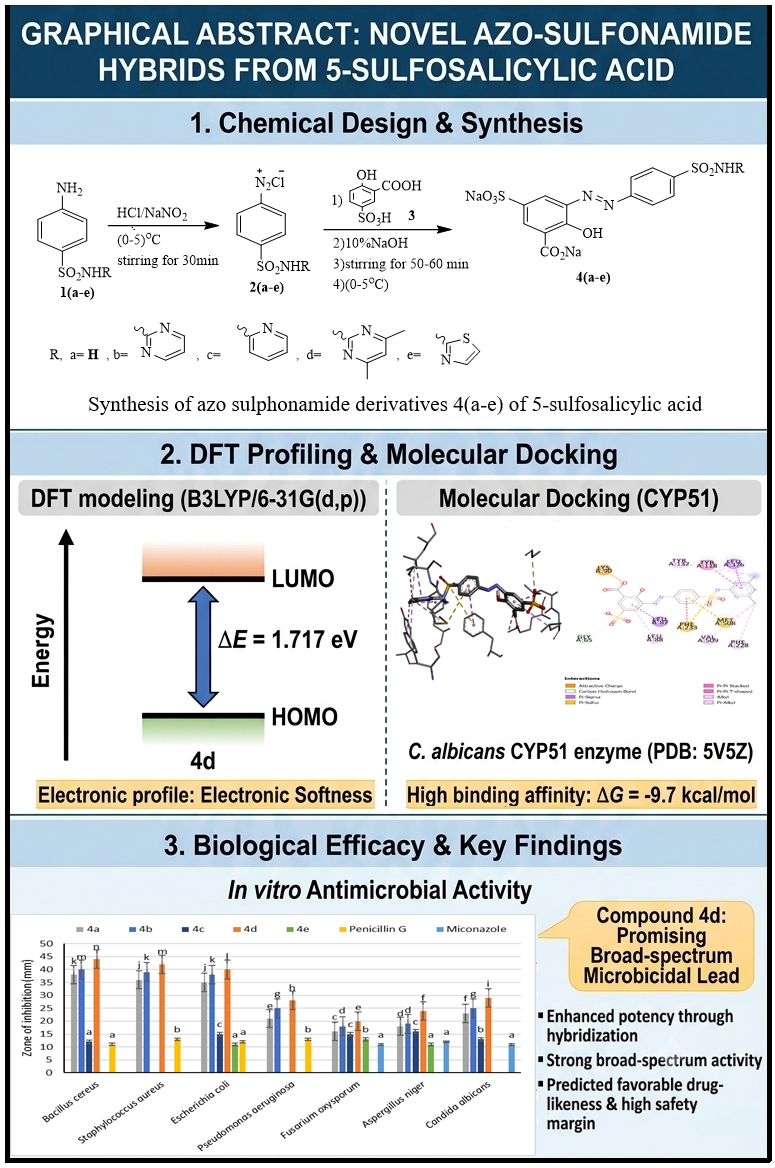
The escalating crisis of multi-drug-resistant pathogens necessitates the development of novel therapeutic scaffolds with enhanced membrane permeability and multi-target inhibitory potential. This study describes the design, synthesis, and mechanistic evaluation of five novel azo-sulfonamide hybrids (4a–e) derived from a 5-sulfosalicylic acid scaffold. Structural integrity was elucidated via comprehensive spectroscopic techniques. Biological efficacy was evaluated against a diverse panel of clinical pathogens, including Staphylococcus aureus, Pseudomonas aeruginosa, and Candida albicans, using standardized Clinical and Laboratory Standards Institute protocols for minimum inhibitory concentration and minimum microbicidal concentration determination alongside B3LYP/6-31G(d,p) DFT modeling and molecular docking. Molecular hybridization significantly enhanced biocidal potency, with lead compound 4d, incorporating a 4,6-dimethylpyrimidinyl moiety, exhibiting robust broad-spectrum activity (e.g., a zone of inhibition of 44 mm against Bacillus cereus), showing strong correlation with high electronic softness and a high binding affinity (ΔG = -9.7 kcal/mol) against lanosterol 14-α-demethylase. Density functional theory profiling revealed a direct correlation between high electronic softness and superior antimicrobial performance. Molecular docking validated these results, identifying 4d as a high-affinity inhibitor of Candida albicans lanosterol 14-α-demethylase through strategic pi–pi stacking and electrostatic salt bridges. These findings suggest that compound 4d represents a promising lead with favorable predicted pharmacokinetic and safety profiles, offering a potential platform for next-generation antimicrobial drug discovery.
Article Details

This work is licensed under a Creative Commons Attribution-NonCommercial-NoDerivatives 4.0 International License.
References
Amaratunga K, Tarasuk J, Tsegaye L, Archibald CP. Advancing surveillance of antimicrobial resistance: Summary of the 2015 CIDSC Report. Can Commun Dis Rep. 2016;42(11):232-237.
Gautam A, Sasmal PK. Eradication of antibiotic-resistant Gram-positive bacteria and biofilms by rationally designed AIE-active iridium(III) complexes derived from cyclometalating 2-phenylquinoline and ancillary bipyridyl ligands. Inorg Chem. 2025;64(6):2905–2918.
Belay WY, Getachew M, Tegegne BA, Teffera ZH, Dagne A, Zeleke TK, et al. Mechanism of antibacterial resistance, strategies and next-generation antimicrobials to contain antimicrobial resistance: A review. Front Pharmacol. 2024;15:1444781.
Samuel Y, Garg A, Mulugeta E. Synthesis, DFT analysis, and evaluation of antibacterial and antioxidant activities of sulfathiazole derivatives combined with in silico molecular docking and ADMET predictions. Biochem Res Int. 2021;2021:7534561.
Thakral S, Singh V. Recent development on importance of heterocyclic amides as potential bioactive molecules: A review. Curr Bioact Compd. 2019;15(3):316–336.
Martínez-Montiel M, Arrighi G, Begines P, González-Bakker A, Puerta A, Merino-Montiel P, Montiel-Smith S, Nocentini A, Supuran CT, Padrón JM, Fernández-Bolaños JG, López O. Multifaceted sulfonamide-derived thiosemicarbazones: Combining metal chelation and carbonic anhydrases inhibition in anticancer therapy. Int J Mol Sci. 2025;26(3):1225.
Lipskikh OI, Korotkova EI, Khristunova YP, Barek J, Kratochvil B. Sensors for voltammetric determination of food azo dyes - A critical review. Electrochim Acta. 2018;260:974–985.
Gümüş M, Sert Y, Koca I. Synthesis, characterization and theoretical studies of novel sulfonamide-aldehydes derivatives having tautomeric forms. Org Commun. 2019;12(4):176–187.
Yadav A, Kaushik CP. Synthesis and antibacterial evaluation of sulfonamide bridged disubstituted 1,2,3-triazoles. Synth Commun. 2022;52(24):2261–2275.
Zahran MK, Gaffer HES, Mashaly HM. Dyeing and antibacterial properties of some newly synthesized sulfonamide reactive dyes. Macromol Symp. 2019;384(1):1800166.
Alfare K, Lee D, Scharrer E, Van Arman SA. Preparation of azo dyes from sulfanilamide. Chem Educ. 2004;9(2):89-90.
AL-Muhsin AA, Ali AA. Preparation, characterization, applications and analytical studies of some new azo dyes derived from sulfanilamide. Bull Pharm Sci Assiut University. 2024;48(1):319-333.
Becke AD. Density-functional exchange-energy approximation with correct asymptotic behavior. Phys Rev A Gen Phys. 1988;38(6):3098–3100.
Clinical and Laboratory Standards Institute (CLSI). Performance standards for antimicrobial susceptibility testing. 27th ed. Wayne (PA): Clinical and Laboratory Standards Institute; 2017.
Elshikiby L, Baka Z, El-Zahed M. Antimicrobial activity of biosynthesized selenium nanoparticles using Pseudomonas aeruginosa isolate. Scientific Journal for Damietta Faculty of Science. 2025;15(2):94-106.
Fayed RM, Baka ZAM, Farouk BH, El-Zahed MM. Antibacterial and cytotoxic activities of a newly green synthesized ZnO/Se nanocomposite combined with Washingtonia robusta H. Wendl fruit extract. Biocatal Agric Biotechnol. 2025;64:103500.
Li HJ, Li X, Liu N, Zhang H, Truglio JJ, Mishra S, et al. Mechanism of the intramolecular Claisen condensation reaction catalyzed by MenB, a crotonase superfamily member. Biochemistry. 2011;50(44):9532–9544.
Selvaraj V, Swarna Karthika T, Mansiya C, Alagar M. An overview on recently developed techniques, mechanisms and intermediate involved in the advanced azo dye degradation for industrial applications. J Mol Struct. 2021;1224.
Chen Y, Dral PO. AIQM2: organic reaction simulations beyond DFT. Chem Sci. 2025;16(35):15901-15912.
El-Rahman MA, Omar AZ, Kandeel AR, Hamed EA, El-Atawy MA, Keshk RM. Synthesis, characterization, and polyester dyeing performance of azo barbituric and thiobarbituric acid disperse dyes. Sci Rep. 2025;15(1):13410.
Khadikar PV, Joshi S, Kashkhedikar SG, Heda BD. Metal-complexes of 5-sulfosalicylic acid and their antimicrobial activity. Indian J Pharm Sci. 1984;46(6):209–211.
Verma V, Joshi CP, Agarwal A, Soni S, Kataria U. A review on pharmacological aspects of pyrimidine derivatives. J Drug Deliv Ther. 2020;10(5):358–361.
Onur R, Özden M, Orhan I, Kalkan A, Semercioz A. Incidence of bacteraemia after urodynamic study. J Hosp Infect. 2004;57(3):241–244.
Storozhenko S, Navarrete O, Ravanel S, De Brouwer V, Chaerle P, Zhang GF, et al. Cytosolic hydroxymethyldihydropterin pyrophosphokinase/dihydropteroate synthase from Arabidopsis thaliana: A specific role in early development and stress response. J Biol Chem. 2007;282(14):10749–10761.
Essghaier B, Naouar A, Abdelhak J, Faouzi Zid M, Sadfi-Zouaoui N. Synthesis, crystal structure and potential antimicrobial activities of di (4-sulfamoyl-phenyl-ammonium) sulphate. Microbiol Res. 2014;169(7):504–510.
Bondock S, Rabie R, Etman HA, Fadda AA. Synthesis and antimicrobial activity of some new heterocycles incorporating antipyrine moiety. Eur J Med Chem. 2008;43(10):2122–2129.
Marinescu M, Popa C-V. Pyridine compounds with antimicrobial and antiviral activities. Int J Mol Sci. 2022;23(10):5659.
El-Fallal AA, El-Dein MMN, El-Esseily SR, Mansour NM, El-Zahed MM. Antimicrobial, antibiofilm, DNA binding, and antioxidant activities of green synthesized zinc oxide nanoparticles using the wild mushroom Lepista sordida (Schumach) singer EGDA2. Microb Cell Fact. 2026;25:90.
Abou-Dobara MI, Kamel MA, El-Sayed AKA, El-Zahed MM. Antibacterial activity of extracellular biosynthesized iron oxide nanoparticles against locally isolated β-lactamase-producing Escherichia coli from Egypt. Discov Appl Sci. 2024;6(3):113.
Keniya MV, Sabherwal M, Wilson RK, Woods MA, Sagatova AA, Tyndall JDA, et al. Crystal structures of full-length lanosterol 14α-demethylases of prominent fungal pathogens Candida albicans and Candida glabrata provide tools for antifungal discovery. Antimicrob Agents Chemother. 2018;62(11):1110-1128.
Yousif MNM, El-Gazzar A-RBA, Hafez HN, Fayed AA, ElRashedy A, Yousif NM. Recent advances in the chemistry and biological activity of sulfonamide derivatives. Mini Rev Org Chem. 2022;19(6):695–707.
