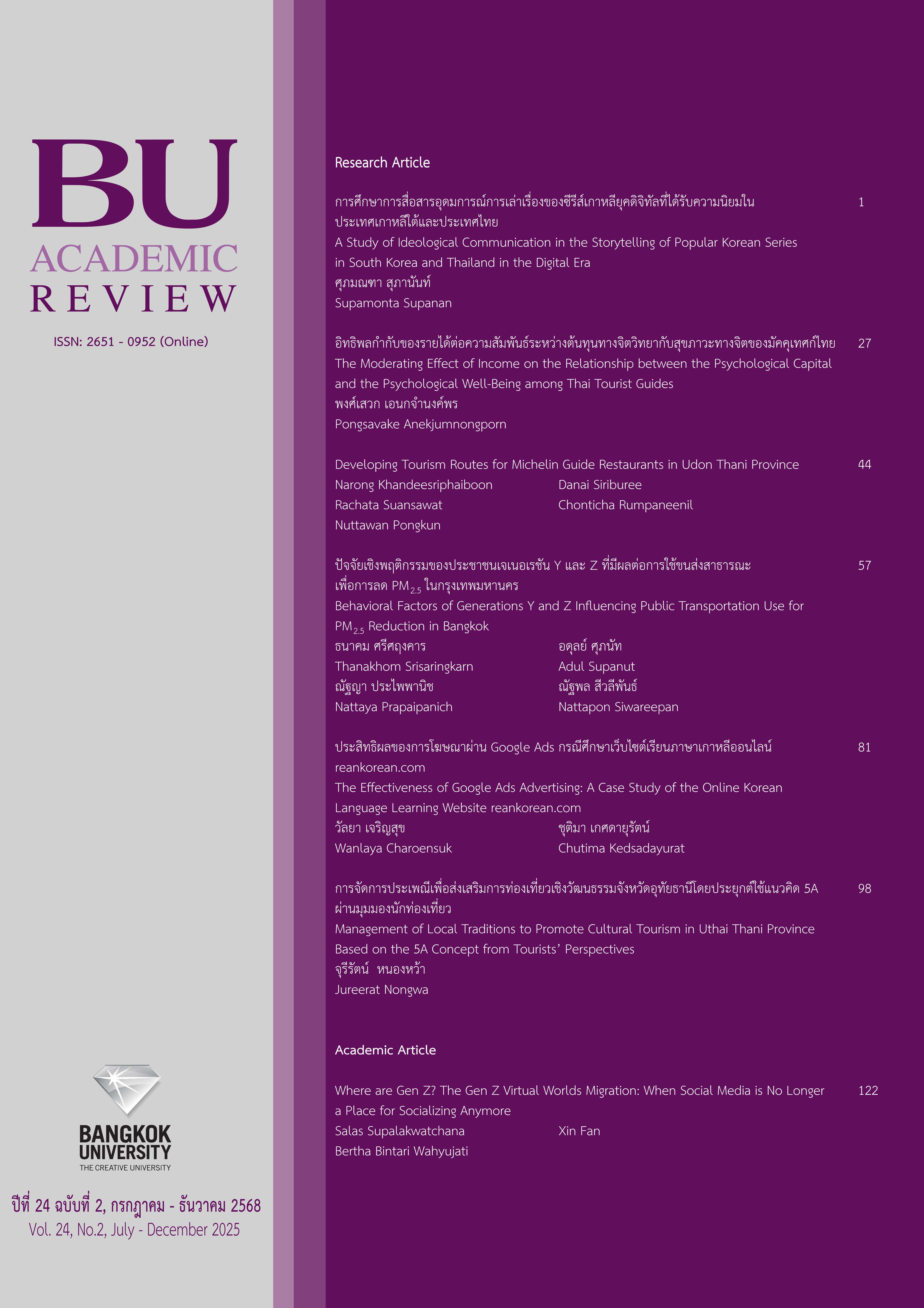
The Moderating Effect of Income on the Relationship between the Psychological Capital and the Psychological Well-Being among Thai Tourist Guides
Article Sidebar
Main Article Content
Abstract
This research article aims to investigate the income as moderating variable which effect on the relationship between the psychological capital and the psychological well-being among Thai tourist guides. The purposive sampling technique was employed to select the research sample. The questionnaires were collected from 216 Thai tourist guides. The data were analyzed by frequency, percentage, mean, standard deviation and multiple linear regression analysis. The research result revealed that the effect of the psychological capital on the psychological well-being was moderated by income. The interaction between the psychological capital and income affected the psychological well-being of Thai tourist guides in high-income group and low-income group (p < 0.01). In contrast, psychological capital had no influences on psychological well-being among Thai tourist guides in moderate-income group.
Article Details

This work is licensed under a Creative Commons Attribution-NonCommercial-NoDerivatives 4.0 International License.
The manuscript submitted for publication must be the original version, submitted only to this particular journal with no prior acceptance for publication elsewhere in other academic journals. The manuscript must also not violate the copyright issue by means of plagiarism.
References
กิ่งแก้ว ทรัพย์พระวงศ์. (2554). จิตวิทยาเพื่อพัฒนาคุณภาพชีวิต. สำนักพิมพ์มหาวิทยาลัยกรุงเทพ.
กิ่งแก้ว ทรัพย์พระวงศ์. (2555). สุขภาวะทางจิตของผู้สูงอายุไทย. BU Academic Review, 11(2), 99-110.
กรมการท่องเที่ยว. (2565). จำนวนใบอนุญาตประกอบธุรกิจนำเที่ยว ใบอนุญาตเป็นมัคคุเทศก์ และการขึ้นทะเบียนเป็นผู้นำเที่ยว. https://www.dot.go.th/chart-stat/detail/2
พงษ์ศักดิ์ ซิมมอนด์ส. (2560). การทดสอบข้อตกลงเบื้องต้นของการวิเคราะห์การถดถอยเชิงเส้นตรง. วารสารวิจัยและพัฒนาหลักสูตร, 7(2), 20-37.
พระราชบัญญัติคุ้มครองแรงงาน พ.ศ. 2541. (2541, 20 กุมภาพันธ์). ราชกิจจานุเบกษา. เล่ม 115 ตอนที่ 8ก. หน้า 1-44.
พระราชบัญญัติธุรกิจนำเที่ยวและมัคคุเทศก์ พ.ศ. 2551. (2551, 6 กุมภาพันธ์). ราชกิจจานุเบกษา. เล่ม 125 ตอนที่ 29ก. หน้า 1-27.
ราชบัณฑิตยสถาน. (2556). พจนานุกรมฉบับราชบัณฑิตยสถาน พ.ศ. 2556. บริษัท นานมีบุ๊คส์ พับลิเคชั่นส์.
ศูนย์วิจัยกสิกรไทย. (2567, 3 พฤษภาคม). 4 เดือนแรกปี 2567 รายได้จากนักท่องเที่ยวต่างชาติอยู่ที่ 5.8 แสนล้านบาท เพิ่มขึ้น 37.9% YoY. https://www.kasikornresearch.com/th/analysis/k-social-media/Pages/Tourism-info67-FB-03-05-2024.aspx#:~:text=4เดือนแรกปี,บาทเพิ่มขึ้น37.9%YoY
Abbas, M., & Raja, U. (2015). Impact of psychological capital on innovative performance and job stress. Canadian Journal of Administrative Sciences, 32(2), 128-138. https://doi.org/10.1002/cjas.1314
Ariza-Montes, A., Hernández-Perlines, F., Han, H., & Law, R. (2019). Human dimension of the hospitality industry: Working conditions and psychological well-being among European servers. Journal of Hospitality and Tourism Management, 41, 138-147. https://doi.org/10.1016/j.jhtm.2019.10.013
Ashmawy, I. K. I. (2024). The influence of peer support on employee psychological capital during the COVID-19 pandemic. International Journal of Public Administration, 47(2), 130-140.
Best, J. W. (1970). Consumer behavior (2nd ed.). Prentice-Hall.
Chakrapani, C. (2011). Statistical reasoning vs. magical thinking: Shamanism as statistical knowledge: Is a sample size of 30 all you need? http://www.chuckchakrapani.com/articles/pdf/0411chakrapani.pdf
Chauhan, R., Jishtu, H., Shaktan, A., & Kumar, A. (2024). Employees’ psychological well-being in a pandemic: A case study during the peak of the COVID-19 wave in India. International Journal of Indian Culture and Business Management, 31(1), 58-75. https://doi.org/10.1504/IJICBM.2024.136591
Cohen, J. (1988). Statistical power analysis for the behavioral sciences (2nd ed). Lawrence Erlbaum Associates.
Cronbach, L. J. (1990). Essential of psychological testing. Harper & Row.
Darvishmotevali, M., & Ali, F. (2020). Job insecurity, subjective well-Being and job performance: The moderating role of psychological capital. International Journal of Hospitality Management, 87, 102462. https://doi.org/10.1016/j.ijhm.2020.102462
Deb, S. K., Kuri, B. C., & Nafi, S. M. (2024). Application of knowledge management in tourism and hospitality industry: A sustainable approach. In M. Valeri (Ed.), Knowledge management and knowledge sharing: Business strategies and an emerging theoretical field (pp. 99-116). Springer Nature Switzerland.
Ergun, G. S., Bozkurt, H. O., Arslan, E., Kendir, H., & Yayla, O. (2023). Psychological capital as a moderator in the relationship between job Insecurity, job stress, and hotel employees' turnover intention during the Russia-Ukraine war. International Journal of Hospitality Management, 111, 103475.
https://doi.org/10.1016/j.ijhm.2023.103475
Faul, F., Erdfelder, E., Buchner, A., & Lang, A. G. (2009). Statistical power analyses using G* Power 3.1: Tests for correlation and regression analyses. Behavior Research Methods, 41(4), 1149-1160. https://doi.org/10.3758/BRM.41.4.1149
Gavriilidis, G., & Metaxas, T. (2024). The impact of COVID-19 on attitudes towards growth capacity of tourism firms: Evidence from Greece. Sustainability, 16(6), 2371.
https://doi.org/10.3390/su16062371
Hameed, Z., Garavan, T. N., Naeem, R. M., Burhan, M., Moin, M. F., & McCabe, T. (2024). Subjective well-being, COVID-19 and financial strain following job loss: Stretching the role of human resource management to focus on human sustainability beyond the workplace. Asia Pacific Journal of Human Resources, 62(1), e12384. https://doi.org/10.1111/1744-7941.12384
Heman, O. U., Olabode, O. O., & Amram, A. (2024). Work condition factors and employee engagement: The mediating role of psychological capital. Jurnal Manajemen dan Kewirausahaan, 26(1), 1-12. https://doi.org/10.9744/jmk.26.1.1-12
Huppert, F. A. (2009). Psychological well-being: Evidence regarding its causes and consequences. Applied Psychology: Health and Well-Being, 1(2), 137-164.
https://doi.org/10.1111/j.1758-0854.2009.01008.x
Jin, D., & Qi, R. (2024). The impact of suburbanization on job-related outcomes in hospitality: Understanding employee solidarity and work mobility. Journal of Hospitality and Tourism Management, 58, 28-38. https://doi.org/10.1016/j.jhtm.2023.11.011
Kwak, S. G., & Park, S. H. (2019). Normality test in clinical research. Journal of Rheumatic Diseases, 26(1), 5-11.
Likert, R. A. (1932). A technique for measurement of attitudes. Archives Psychological, 140, 5-55.
Lilliefors, H. W. (1967). On the kolmogorov-smirnov test for normality with mean and variance unknown. Journal of the American Statistical Association, 62(318), 399-402.
https://doi.org/10.2307/2283970
Luthans, F., Youssef, C. M., & Avolio, B. J. (2007). Psychological capital: Developing the human competitive edge. Oxford University Press.
Mahipalan, M., & Garg, N. (2024). Does workplace toxicity undermine psychological capital (PsyCap) of the employees? Exploring the moderating role of gratitude. International Journal of Organizational Analysis, 32(3), 476-503. https://doi.org/10.1108/IJOA-12-2022-3543
Maslow, A. H. (1943). A theory of human motivation. Psychological Review, 50(4), 370-396. https://doi.org/10.1037/h0054346
Mishra, H., & Venkatesan, M. (2023). Psychological well-being of employees, its precedents and outcomes: A literature review and proposed framework. Management and Labour Studies, 48(1), 7-41. https://doi.org/10.1177/0258042X221117960
Pathak, D., & Joshi, G. (2021). Impact of psychological capital and life satisfaction on organizational resilience during COVID-19: Indian tourism insights. Current Issues in Tourism, 24(17), 2398-2415.
https://doi.org/10.1080/13683500.2020.1844643
Rovinelli, R. J., & Hambleton, R. K. (1977). On the use of content specialists in the assessment of criterion-referenced test item validity. Tijdschrift Voor Onderwijs Research, 2, 49-60.
Ryff, C. D., & Keyes, C. L. M. (1995). The structure of psychological well-being revisited. Journal of Personality and Social Psychology, 69(4), 719-727. https://doi.org/10.1037/0022-3514.69.4.719
Singh, S., & Mansi, G. J. (2009). Psychological capital as predictor of psychological well-being. Journal of the Indian Academy of Applied Psychology, 35(2), 233–238.
Sumalrot, T., Suwanwong, C., Pimthong, S., Surakarn, A., Chiangkhong, A., & Khunakorncharatphong, A. (2023). The development and effectiveness of web-based psychological capital intervention on the mental well-being of tourism workers during the COVID-19 pandemic. BMC Psychology, 11(1), 1-8. https://doi.org/10.1186/s40359-023-01189-0
Teng, C. C., Chih, C., Liu, C. H., & Ko, W. H. (2024). How does psychosocial safety climate address hotel employees’ job embeddedness and organizational commitment during crisis? Journal of Quality Assurance in Hospitality & Tourism, 2024, 1-32. https://doi.org/10.1080/1528008X.2024.2302359
The World Bank. (2024). World bank country and lending groups. https://datahelpdesk.worldbank.org/knowledgebase/articles/906519-world-bank-country-and-lending-groups
Tsaur, S. H., Hsu, F. S., & Lin, H. (2019). Workplace fun and work engagement in tourism and hospitality: The role of psychological capital. International Journal of Hospitality Management, 81, 131-140. https://doi.org/10.1016/j.ijhm.2019.03.016
Vyas-Doorgapersad, S. (2024). Employee wellness programmes for improved performance. International Journal of Educational Review, Law and Social Sciences (IJERLAS), 4(1), 1-12.
Yorulmaz, M., & Basol, F. S. (2024). Yacht crews’ perceptions of ethical climate, safety climate, psychological capital and psychological well-being in Türkiye. Maritime Business Review, 9(1), 113-127. https://doi.org/10.1108/MABR-07-2023-0057
Zamorano García, M., Santamaría, G., Seco-Casares, M., Celorrio San Miguel, A. M., Lantarón-Caeiro, E., García, J. F., & Fernández-Lázaro, D. (2024). A cross-sectional observational pilot study of the main risk factors related to lower back pain in Spanish hospitality workers. Safety, 10(1), 1-19.
