
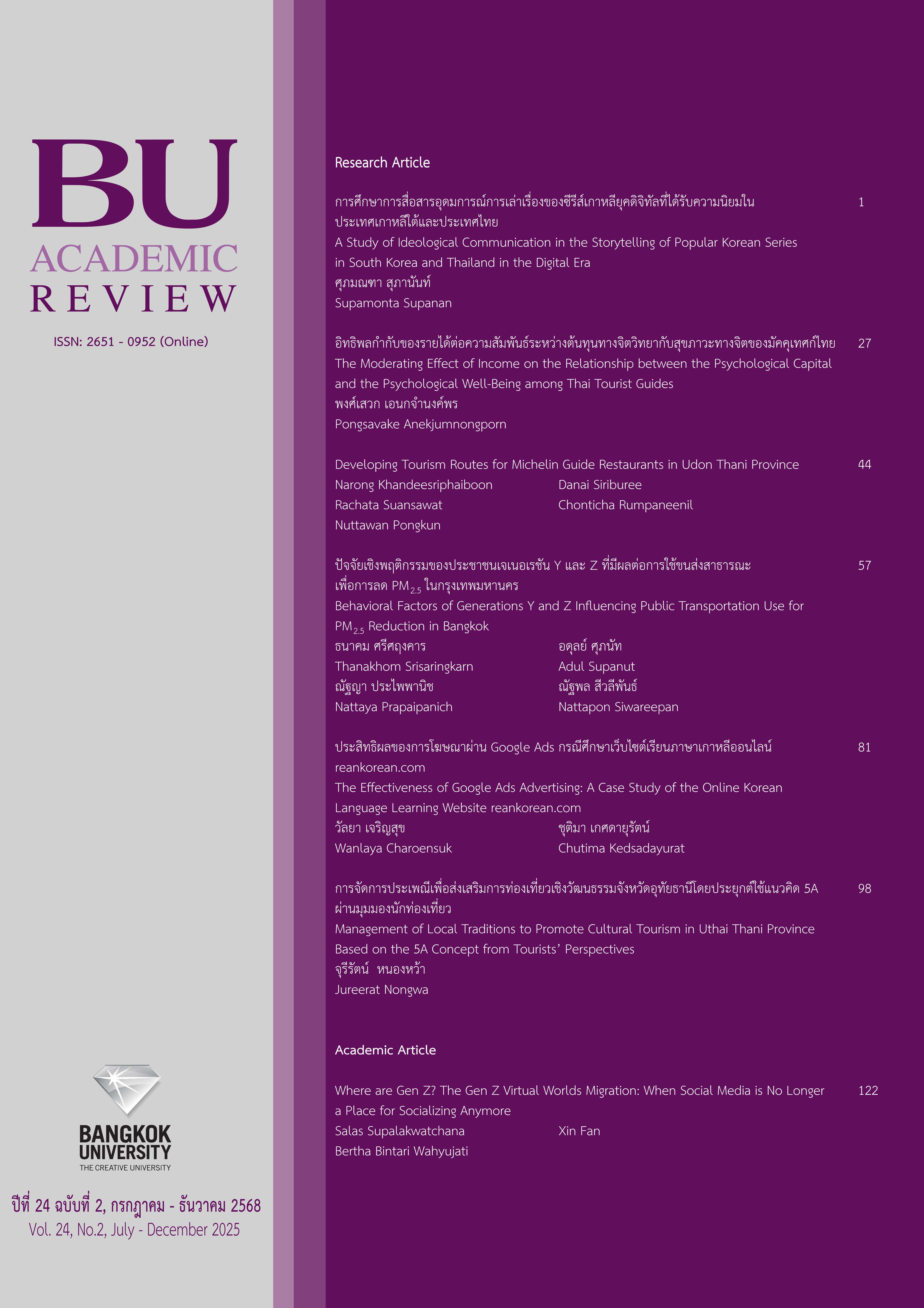
Where are Gen Z? The Gen Z Virtual Worlds Migration: When Social Media is No Longer a Place for Socializing Anymore
Article Sidebar
Main Article Content
บทคัดย่อ
The widespread influence of social media has long positioned it as the central digital space for human connection. However, this conceptual article investigates a notable divergence in Generation Z’s (born 1997–2012) digital behavior, focusing on their shifting social interaction patterns away from traditional social media platforms. Gen Z, as digital natives, exhibits a nuanced relationship with online environments, prioritizing authentic engagement and immersive experiences, while highly valuing personalized interactions and unique brand encounters. Drawing upon previous studies and recent industry insights from GEEIQ's SXSW 2025 presentation and We Are Social Thailand’s Digital 2025 reports, this paper argues that traditional social media platforms are increasingly serving as content consumption channels rather than primary social hubs for Gen Z. Instead, immersive virtual worlds and gaming environments are emerging as the new preferred spaces for socialization. This migration is analyzed through three key communication frameworks: Uses and Gratifications Theory (UGT), which explains the pursuit of richer social experiences and identity expression; Social Presence Theory, which links virtual worlds’ 3D nature to a higher sense of Embodied Social Presence that drives deeper engagement (e.g., 11 minutes vs. 1.3 seconds); and Community of Practice (CoP), which illuminates the formation of strong, shared-purpose subcultures within these environments. This analysis provides a timely theoretical understanding of Gen Z's digital choices, emphasizing the critical need for communication scholars and brands to pivot their focus from broad social networks to specialized, immersive virtual communities.
Article Details

อนุญาตภายใต้เงื่อนไข Creative Commons Attribution-NonCommercial-NoDerivatives 4.0 International License.
บทความที่นำมาสมัครลงตีพิมพ์ในวารสารต้องไม่เคยได้รับการตีพิมพ์เผยแพร่มาก่อน และไม่ส่งต้นฉบับบทความซ้ำซ้อนกับวารสารอื่น รวมทั้งผู้เขียนบทความต้องไม่ละเมิดหรือคัดลอกผลงานของผู้อื่น
เอกสารอ้างอิง
Anubha, A., & Islam, J. U. (2022). Unveiling key gratifications and stimuli to engage generation z with multiplayer online games. Journal of Internet Commerce, 22(4), 480–508. https://doi.org/10.1080/15332861.2022.2088037
Arghashi, V., & Gunalay, Y. (2025). Exploring the metaverse: What drives millennials and gen z to embrace virtual worlds? Journal of Islamic Marketing, 2025. https://doi.org/10.1108/jima-12-2024-0574
Blumler, J. G., & Katz, E. (1974). The uses of mass communications: Current perspectives on gratifications research. Sage Publications.
Bulu, S. T. (2012). Place presence, social presence, co-presence, and satisfaction in virtual worlds. Computers & Education, 58(1), 154–161. https://doi.org/10.1016/j.compedu.2011.08.024
Dailynews Online. (2025, May 11). We Are Social pœ̄t rāingān khon Thai len kēm māk ʻandap sām khō̜ng lōk ["We are social”opens report: Thais play games third most in the world]. https://www.dailynews.co.th/news/4697331/
Garrison, D. R., Anderson, T., & Archer, W. (2010). The first decade of the community of inquiry framework: A retrospective. The Internet and Higher Education, 13(1-2), 5-9. https://doi.org/10.1016/j.iheduc.2009.10.003
GEEIQ. (2025a). Social media marketing Is dead - long live gaming. https://geeiq.com/sxsw-2025-social-media-marketing-is-dead/
GEEIQ. (2025b). The state of brands in gaming & virtual worlds. https://geeiq.com/state-of-brands-in-gaming/
GEEIQ. (2025c, March 8). London calling: Bringing the BBC to roblox. https://schedule.sxsw.com/2025/events/OE45686
Gentina, E. (2020). Generation z in Asia: A research agenda. In E. Gentina & E. Parry (Eds.), The new generation z in Asia: Dynamics, differences, digitalisation (pp. 3-19). Emerald Publishing Limited.
Jasrotia, S. S., Kamila, M. K., Chib, S., & Mishra, H. G. (2022). Role of engagement in online gaming: A study of generation Z customers. Digital Creativity, 33(1), 64-76. https://doi.org/10.1080/14626268.2022.2033272
Kaplan, A. M., & Haenlein, M. (2010). Users of the world, unite! the challenges and opportunities of social media. Business Horizons, 53(1), 59-68. https://doi.org/10.1016/j.bushor.2009.09.003
Kathuria, V. (2023). Gen Z’s engagement with the metaverse: Mediated role of symbolic gratification and desired enhancement of reality and moderated role of gender. Metamorphosis: A Journal of Management Research, 22(2), 133-145. https://doi.org/10.1177/09726225231218055
Lave, J., & Wenger, E. (1991). Situated learning: Legitimate peripheral participation. Cambridge University Press.
Levak, T., & Barić-Šelmić, S. (2018). Escaping the “virtual promenade”–New trends in use of social networks by members of generation “Z”. Media, Culture and Public Relations, 9(1–2), 37–55. https://doi.org/10.32914/mcpr.9.1-2.3
Li, Y. -M., & Jhang-Li, J. -H. (2010). Knowledge sharing in communities of practice: A game theoretic analysis. European Journal of Operational Research, 207(2), 1052–1064. https://doi.org/10.1016/j.ejor.2010.05.033
Lin, Q., Ng, S. I., Basha, N. K., Luo, X., & Li, Y. (2024). Impact of virtual influencers on customer engagement of generation z consumers: A presence perspective. Young Consumers: Insight and Ideas for Responsible Marketers, 25(6), 851–868. https://doi.org/10.1108/yc-01-2024-1958
Magpanthong, C., & McDaniel, D. (2015). Online expression of emotions and personal viewpoints: A case study of Facebook usage among Thai and US students. BU Academic Review, 14(2), 83-99.
Marlatt, R. (2020). Capitalizing on the craze of fortnite: Toward a conceptual framework for understanding how gamers construct communities of practice. Journal of Education, 200(1), 3–11. https://doi.org/10.1177/0022057419864531
Mennecke, B. E., Triplett, J. L., Hassall, L. M., Jordán Conde, Z., & Heer, R. (2011). An examination of a theory of embodied social presence in virtual worlds. Decision Sciences, 42(2), 413–450. https://doi.org/10.1111/j.1540-5915.2011.00317.x
O’Carroll, R., & Rooney, T., (2020). Uses and gratifications of Generation Z within social networks: A dialectical investigation into the Facebook domain. Journal of Promotional Communications, 8(1), 1-27.
Pang, S., Zhang, Z., & Wang, X. (2025). Well-being in gaming communities: the relationship between online gaming participation, social capital, and life satisfaction. Current Psychology, 44(7), 5734-5743. https://doi.org/10.1007/s12144-025-07575-8
Rohman, M. (2024, April 7). One big reason gen z is still on Facebook: To save money. The New York Times. https://www.nytimes.com/2024/03/14/business/gen-z-facebook-marketplace.html
Rubin, A. M. (1994). Media uses and effects: A uses-and-gratifications perspective. In J. Bryant & D. Zillmann (Eds.), Media effects: Advances in theory and research (pp. 417–436). Lawrence Erlbaum Associates.
Rubin, A. M. (2009). The uses-and-gratifications perspective of media effects. In J. Bryant & M. B. Oliver (Eds.), Media effects (pp. 181–200). Routledge.
Salam, K. N., Singkeruang, A. W. T. F., Husni, M. F., Baharuddin, B., & A. R, D. P. (2024). Gen-z marketing strategies: Understanding consumer preferences and building sustainable relationships. Golden Ratio of Mapping Idea and Literature Format, 4(1), 53–77. https://doi.org/10.52970/grmilf.v4i1.351
Sayyed, B. J. W., & Gupta, R. (2020). Social media impact: Generation z and millenial on the cathedra of social media. In 2020 8th International Conference on Reliability, Infocom Technologies and Optimization (Trends and Future Directions) (ICRITO) (pp.595–600). Institute of Electrical and Electronics Engineers (IEEE).
Schott, G., & Hodgetts, D. (2006). Health and digital gaming: The benefits of a community of practice. Journal of Health Psychology, 11(2), 309–316. https://doi.org/10.1177/1359105306061189
Short, J., Williams, E., & Christie, B. (1976). The social psychology of telecommunications. John Wiley and Sons.
Srivastava, S. C., & Chandra, S. (2018). Social presence in virtual world collaboration: An uncertainty reduction perspective using a mixed methods approach. MIS Quarterly, 42(3), 779–803. https://doi.org/10.25300/MISQ/2018/11914
Supalakwatchana, S. (2023). The move forward party (MFP) political communication and its effects on voters’ perceived political ideology, attitude homophily, and the 2023 Thailand general election decision: Comparing four Thai generations [Master’s thesis, Bangkok University].
Supalakwatchana, S., Punnahitanond, R., & Kesaprakorn, P. (2024). Exposure to the move forward party’s political communication, attitude homophily, voters’ perceived political ideology, and 2023 Thailand general election decision: Comparing four Thai generations. BU Academic Review, 23(1), 106-126.
The Nation. (2025, May 12). Thais are heavily hooked on gaming: We are social. https://www.nationthailand.com/blogs/business/trade/40049856
We Are Social Thailand. (2025a, April 23). Digital 2025 April global statshot report. https://wearesocial.com/th/blog/2025/04/digital-2025-april-global-statshot-report/
We Are Social Thailand. (2025b). We are social gaming: We create ideas worth talking about. https://wearesocial.com/th/gaming/
Wenger, E. (1998). Communities of practice: Learning, meaning, and identity. Cambridge University Press.
Whiting, A., & Williams, D. (2013). Why people use social media: A uses and gratifications approach. Qualitative Market Research: An International Journal, 16(4), 362–369.
https://doi.org/10.1108/qmr-06-2013-0041
Yücebalkan, B., & Aksu, B. (2018). An application on the use of Facebook by generation z in the context of social network as a means of virtual communication. International Journal of Eurasia Social Sciences, 9(34), 2194-2217.
