
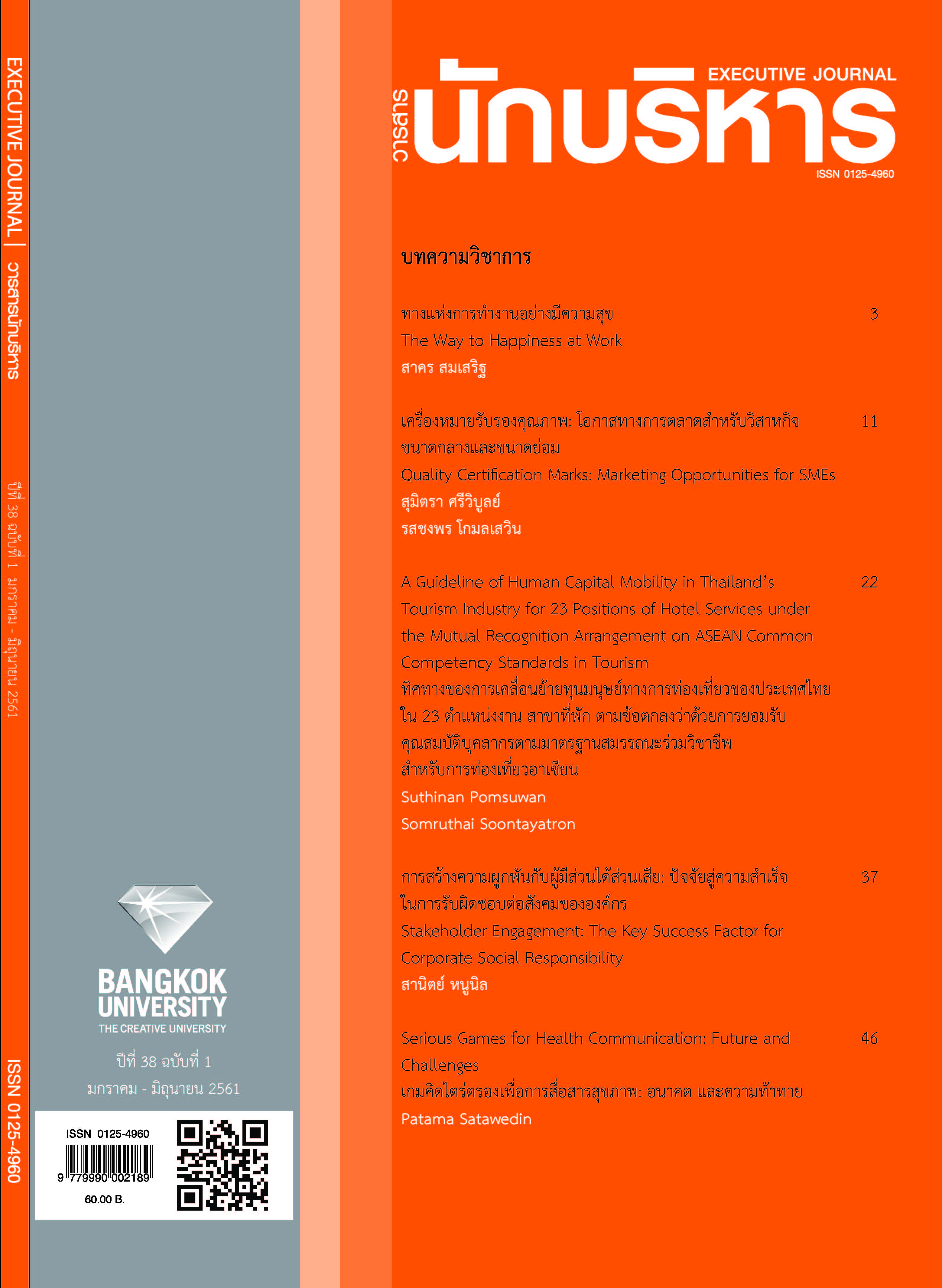
เครื่องหมายรับรองคุณภาพ: โอกาสทางการตลาด สำหรับวิสาหกิจขนาดกลางและขนาดย่อม
Article Sidebar
Main Article Content
บทคัดย่อ
การแข่งขันทางการตลาดนับตั้งแต่ทศวรรษ 1990 เป็นต้นมา ได้ปรับเปลี่ยนสู่การตลาดที่เน้นการสร้างความแตกต่างและการสร้างผลตอบแทนที่สูงขึ้น โดยอาศัยความเชื่อมโยงกับคุณลักษณะบางประการ หรือการรับรองคุณภาพโดยหน่วยงานที่เชื่อถือได้ ปัจจุบันนี้ การส่งออกสินค้าไปยังประเทศคู่ค้าจะต้องมีการรับรองคุณภาพในด้านต่างๆ โดยใช้เครื่องหมายรับรองเพื่อแสดงคุณลักษณะเฉพาะ เพื่อการส่งเสริมการขาย รวมถึงเพื่อให้ความคุ้มครองแก่สินค้าและบริการที่มีเครื่องหมายรับรองนั้นปรากฏอยู่
บทความนี้มีวัตถุประสงค์เพื่อให้ข้อมูลเกี่ยวกับการรับรองคุณภาพสินค้า/บริการในรูปแบบต่างๆ เพื่อเป็นข้อมูลทางเลือกสำหรับ SMEs ของไทย และสร้างความตระหนักรู้ถึงประโยชน์และโอกาสที่ผู้ประกอบการหรือชุมชนจะได้รับ โดยการเลือกใช้รูปแบบของเครื่องหมายรับรองที่มีความแตกต่างกัน ขึ้นอยู่กับความต้องการของผู้ประกอบการเพื่อให้สอดคล้องกับสินค้าและบริการของตน ทั้งนี้ การรับรองคุณภาพที่สร้างความยั่งยืนและประสบความสำเร็จ ส่วนใหญ่เกิดจากความเข้มแข็งของคนในชุมชนที่ต้องการปกป้องและรักษา
ภูมิปัญญาในท้องถิ่นไว้เป็นมรดกให้กับรุ่นต่อๆไป อย่างไรก็ดี การดำเนินกลยุทธ์การตลาดโดยใช้เครื่องหมายรับรองนี้ จำเป็นต้องอาศัยการสนับสนุนจากภาครัฐในการขับเคลื่อนเพื่อสร้างความเข้มแข็งในการให้ความคุ้มครอง โดยเฉพาะอย่างยิ่งการให้ความคุ้มครองในระดับนานาชาติ
Article Details
บทความที่นำมาสมัครลงตีพิมพ์ในวารสารต้องไม่เคยได้รับการตีพิมพ์เผยแพร่มาก่อน และไม่ส่งต้นฉบับบทความซ้ำซ้อนกับวารสารอื่น รวมทั้งผู้เขียนบทความต้องไม่ละเมิดหรือคัดลอกผลงานของผู้อื่น
เอกสารอ้างอิง
Agarwal, S., & Barone, M. J. (2005). Emerging issues for geographical indication branding strategies. Retrieved February 7, 2018, from https://lib.dr.iastate.edu/matric_researchpapers/5
Barjolle, D., Paus, M., & Perret, A. O. (2009). Impacts of geographical indications-Review of methods and empirical evidences. Paper presented at the 2009 International Association of Agricultural Economists Conference, August 16-22, 2009, Beijing, China. Retrieved February 7, 2018, from https://ideas.repec.org/p/ags/iaae09/51737.html
Bramley, C., Bienabe, E., & Kirsten, J. (2003). The economics of geographical indications: Towards a conceptual framework for geographical indication research in developing countries. Retrieved February 7, 2018, from https://www.wipo.int/edocs/pubdocs/en/wipo_pub_1012-chapter4.pdf
Chiarakul, T. (2557). Panhā læ nǣothāng kān prap tūa khō̜ng OTOP phư̄a phrō̜m rap kān
pœ̄t AEC [The problems and the adaptation of OTOP to AEC]. Executive Journal, 34(1), 177-191.
Cohen, E. (2012). Intellectual property protection: Options for traditional communities. Retrieved February 7, 2018, from https://iipi.org/2012/11/1749/
Department of Intellectual Property. (2018). Rāi chư̄ phū dai rap ʻanuyāt hai chai trā sanyalak sing bongchī thāng phūmisāt [List of entrepreneurs who got approval to use GI marks for their products]. Retrieved March 16, 2018, from https://www.ipthailand. go.th/th/gi-012.html
ʻI yū khưn thabīan khāo sang yot mư̄ang Phatthalung pen sinkhā čhī ʻai lǣo [EU registers “Pattalung Sung Yod Rice” as GI product]. (2016, October 13). Matichon Online. Retrieved March 16, 2018, from https://www.matichon.co.th/news/319986
Jaiborisudhi, W. (2016). Kānsưksā khrōngkān nưng tambon nưng phalittaphan (OTOP) phāitai wāt kam khwāmpen sinkhā. [A Study on One Tambon One Product (OTOP) project and the product discourse]. International Journal of East Asian Studies, 20(2). Retrieved February 7, 2018, from
https://www.tci-thaijo.org/index.php/easttu/article/view/82708/65715
Jay, T., & Taylor, M. (2013). A case of champagne: A study of geographical indications. Corporate Governance e-Journal, Special Issue. Retrieved February 7, 2018, from https://epublications.bond.edu.au/cgej/29
Komolsevin, R., Swasdisan, P., & Sriviboone, S. (2017). Mummō̜ng phūprakō̜pkān Thai
tō̜ māttrathān hālān [Perceptions of Thai entrepreneurs of Halal standards].
(Research report). Bangkok: The Thailand Research Fund.
Nak cho̜prun yao chư̄a SNS lư̄ak sư̄ sinkhā læ bō̜rikān [Young shoppers believe in SNS to purchase products and services]. (2017). Department of Intellectual Property, 23 (March 4-10). Retrieved February 7, 2018, from
https://www.ditp.go.th/contents_attach/164695/164695.pdf
Phawathaksa. (2017). GI 4.0 (EP. sām) kō̜ranī sưksā: Yīpun rēng čhotthabīan sinkhā kasēt nai tāng chāt [GI 4.0 (EP.3) Case study: Japan urging on registering agricultural products in international forum]. Retrieved March 16, 2018, from https://www.smartsme.co.th/content/64352
Ruzevicius, J. (2012). Products quality religious-ethnical requirements and certification. Economics and Management, 17(2), 761-767.
Sriviboone, S. (2011). Ok bǣp ʻō̜kbrǣn: Rabop māttrathān ʻattalak phư̄a kānsāng ʻattalak thī yangyư̄n [Design of brands: Systems of identity standards to create sustainable identity]. Bangkok: Display.
Traditional Cultural Expressions. (2018). World intellectual property. Retrieved March 16, 2018, from https://www.wipo.int/tk/en/folklore/
Wilson, J. A. J. (2012). The new wave of transformational Islamic marketing. Journal of
Islamic Marketing, 3(1), 5-11.
