
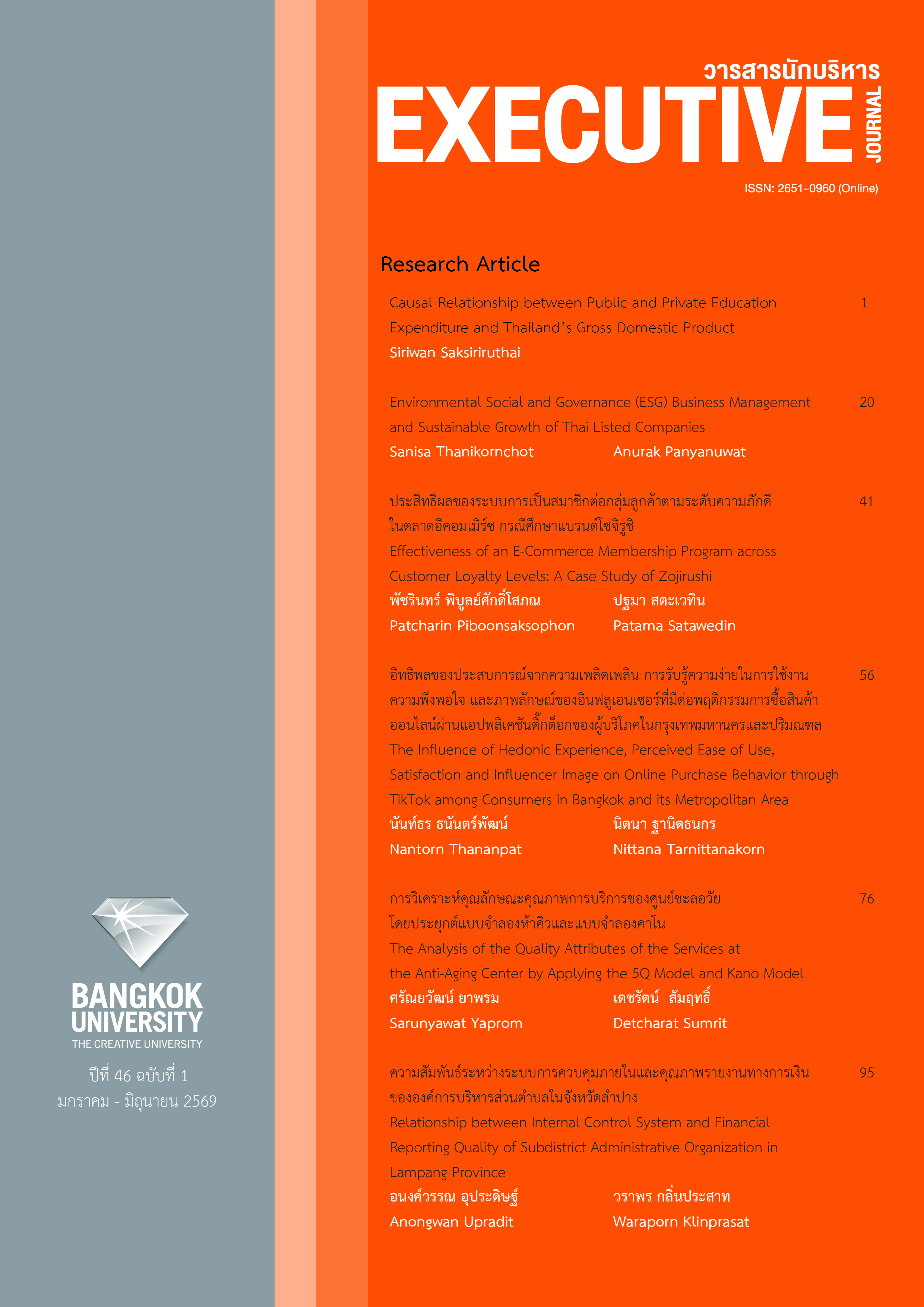
อิทธิพลของประสบการณ์จากความเพลิดเพลิน การรับรู้ความง่าย ในการใช้งาน ความพึงพอใจ และภาพลักษณ์ของอินฟลูเอนเซอร์ที่มีต่อพฤติกรรมการซื้อสินค้าออนไลน์ผ่านแอปพลิเคชันติ๊กต็อกของผู้บริโภค ในกรุงเทพมหานครและปริมณฑล
Article Sidebar
Main Article Content
บทคัดย่อ
งานวิจัยนี้มีวัตถุประสงค์เพื่อศึกษาอิทธิพลของประสบการณ์จากความเพลิดเพลิน การรับรู้ความง่ายในการใช้งาน ความพึงพอใจ และภาพลักษณ์ของอินฟลูเอนเซอร์ที่มีต่อพฤติกรรมการซื้อสินค้าออนไลน์ผ่านแอปฟลิเคซันติ๊กต็อกของผู้บริโภคในกรุงเทพมหานครและปริมณฑล โดยใช้แบบสอบถามปลายปิดในการเก็บรวบรวมข้อมูลจากกลุ่มผู้บริโภคในกรุงเทพมหานครและปริมณฑลที่เคยซื้อสินค้าออนไลน์ผ่านแอปพลิเคชันติ๊กต็อก จำนวน 404 คน และใช้การวิเคราะห์การถดถอยเชิงพหุในการทดสอบสมมติฐาน ซึ่งผลการศึกษา พบว่า ประสบการณ์จากความเพลิดเพลินมีอิทธิพลต่อพฤติกรรมการซื้อสินค้าออนไลน์ผ่านแอปฟลิเคซันติ๊กต็อกของผู้บริโภค ในกรุงเทพมหานครและปริมณฑลมากที่สุด รองลงมา ได้แก่ ภาพลักษณ์ของอินฟลูเอนเซอร์ ด้านความน่าดึงดูด การรับรู้ความง่ายในการใช้งาน ความพึงพอใจ และภาพลักษณ์ของอินฟลูเอนเซอร์ ด้านความน่าเชื่อถือ ตามลำดับ โดยประสบการณ์การใช้งานที่สนุกสนานและใช้งานง่ายช่วยส่งเสริมการยอมรับแพลตฟอร์มและสร้างความพึงพอใจ ขณะที่อินฟลูเอนเซอร์ที่มีความน่าดึงดูดและน่าเชื่อถือช่วยเสริมความไว้วางใจและกระตุ้นการตัดสินใจซื้อสินค้าออนไลน์ของผู้บริโภค
Article Details

อนุญาตภายใต้เงื่อนไข Creative Commons Attribution-NonCommercial-NoDerivatives 4.0 International License.
บทความที่นำมาสมัครลงตีพิมพ์ในวารสารต้องไม่เคยได้รับการตีพิมพ์เผยแพร่มาก่อน และไม่ส่งต้นฉบับบทความซ้ำซ้อนกับวารสารอื่น รวมทั้งผู้เขียนบทความต้องไม่ละเมิดหรือคัดลอกผลงานของผู้อื่น
เอกสารอ้างอิง
กลุ่มช่วยทำแบบสอบถามงานวิจัยเพื่อการพัฒนาที่ดียิ่งขึ้น. (ม.ป.ป.). หน้าหลัก [Facebook page]. Facebook. https://www.facebook.com/groups/477344699614054/?locale=th_TH
ซื้อขายติ๊กต็อก ไทยแลนด์ ทีเอช. (ม.ป.ป.). หน้าหลัก [Facebook page]. Facebook. https://web.facebook.com/groups/394908769025207/?_rdc=1&_rdr#
ติ๊กต็อก ฟอร์ บิซนิส. (ม.ป.ป.). รู้จักผู้ชมของคุณให้ดียิ่งขึ้นด้วย TikTok insights. https://www.tiktok.com/business/en/resources/insights
สำนักงานพัฒนาธุรกรรมทางอิเล็กทรอนิกส์. (2566). รายงานผลการสำรวจพฤติกรรมผู้ใช้อินเทอร์เน็ตในประเทศไทย ปี 2566. กระทรวงดิจิทัลเพื่อเศรษฐกิจและสังคม.
สำนักงานพัฒนาธุรกรรมทางอิเล็กทรอนิกส์. (2567). รายงานการใช้งานโซเชียลมีเดียและการเข้าถึงโฆษณาผ่านติ๊ก ต็อกในประเทศไทย: การเติบโตของการใช้งานและผลกระทบต่อกลยุทธ์การตลาด. กระทรวงดิจิทัลเพื่อเศรษฐกิจและสังคม.
สำนักงานสถิติแห่งชาติ. (2567). การสำรวจการมีการใช้เทคโนโลยีสารสนเทศและการสื่อสารในครัวเรือน พ.ศ. 2567 (ไตรมาส 2). กระทรวงดิจิทัลเพื่อเศรษฐกิจและสังคม.
Babin, B. J., Darden, W. R., & Griffin, M. (1994). Work and/or fun: Measuring hedonic and utilitarian shopping value. Journal of Consumer Research, 20(4), 644–656. http://www.jstor.org/stable/2489765
Barta, S., Belanch, D., Fernandez, A., & Flavian, M. (2023). Influencer marketing on TikTok: The effectiveness of humor and followers’ hedonic experience. Journal of Retailing and Consumer Services, 70, 103149. https://doi.org/10.1016/j.jretconser.2022.103149
Beyari, H., & Hashem, T. (2025). The role of artificial intelligence in personalizing social media marketing strategies for enhanced customer experience. Behavioral Sciences, 15(5), 700. https://doi.org/10.3390/bs15050700
Chapple, C. (2020, April). TikTok crosses 2 billion downloads after best quarter for any app ever. Sensor Tower. https://sensortower.com/blog/tiktok-downloads-2-billion
Chen, Y., Qin, Z., Yan, Y., & Huang, Y. (2024). The power of influencers: How does influencer marketing shape consumers’ purchase intentions?. Sustainability, 16(13), 5471. https://doi.org/10.3390/su16135471
Cohen, J. (1977). Statistical power analysis for the behavioral sciences. Academic Press.
Farhan, M. T., Leunufna, K., Halim, E., & Veronica. (2025). Beyond clicks and carts: The impact of perceived personalization via AI product recommendations on purchase intention in social commerce. In 8th International Conference of Computer and Informatics Engineering (IC2IE) (pp. 1-7). Depok. https://doi.org/10.1109/IC2IE67206.2025.11283305
Freberg, K., Graham, K., McGaughey, K., & Freberg, L. A. (2011). Who are the social media influencers? A study of public perceptions of personality. Public Relations Review, 37(1), 90-92. https://doi.org/10.1016/j.pubrev.2010.11.001
Haq, M., & Chiu, C. (2024). Boosting online user engagement with short video endorsement content on TikTok via the image transfer mechanism. Electronic Commerce Research and Applications, 64(3), 101379. https://doi.org/10.1016/j.elerap.2024.101379
Hidayatullah, A. A., Fidhilah, M., & Hutami, L. T. H. (2025). The influence of influencer marketing and social media marketing on purchase decisions with brand awareness as an intervening variable for TikTok shop in generation Z. Dinasti International Journal of Economics Finance & Accounting, 5(6), 5678-5692. https://doi.org/10.38035/dijefa.v5i6.3667
Holbrook, M. B., & Hirschman, E. C. (1982). The experiential aspects of consumption: Consumer fantasies, feelings, and fun. Journal of Consumer Research, 9(2), 132–140. https://www.jstor.org/stable/2489122
Jin, S. V., & Ryu, E. (2020). “I'll buy what she's #wearing: The roles of envy toward and parasocial interaction with influencers in Instagram celebrity-based brand endorsement and social commerce. Journal of Retailing and Consumer Services, 55, 102121. https://doi.org/10.1016/j.jretconser.2020.102121
Kahneman, D., Diener, E., & Schwarz, N. (1999). Well-being: The foundations of hedonic psychology. Russell Sage Foundation.
Kemp, S. (2023, January 26). Digital 2023: Global overview report. Datareportal. https://datareportal.com/reports/digital-2023-global-overview-report.
Kemp, S. (2024a). Digital 2024: Global overview report. https://datareportal.com/reports/digital-2024-global-overview-report
Kemp, S. (2024b). Digital 2024: Thailand. https://datareportal.com/reports/digital-2024-thailand
Ki, C. W., & Kim, Y. K. (2019). The mechanism by which social media influences persuade consumers: The role of consumers' desire to mimic. Psychology & Marketing, 36(10), 905-922. https://doi.org/10.1002/mar.21244
Kim, D. J., Ferrin, D. L., & Rao, H. R. (2009). Trust and satisfaction, two steppingstones for successful e-commerce Relationships: A longitudinal exploration. Information Systems Research, 20(2), 237–257. https://doi.org/10.1287/isre.1080.0188
Lou, C., & Yuan, S. (2019). Influencer marketing: How message value and credibility affect consumer trust of branded content on social media. Journal of Interactive Advertising, 19(1), 58-73. https://doi.org/10.1080/15252019.2018.1533501
Nunnally, J. C. (1978). Psychometric theory (2nd ed.). McGraw-Hill.
Pavlou, P. A. (2003). Consumer acceptance of electronic commerce: Integrating trust and risk with the technology acceptance model. International Journal of Electronic Commerce, 7(3), 101–134. https://doi.org/10.1080/10864415.2003.11044275
Sokolova, K., & Kefi, H. (2020). Instagram and YouTube bloggers promote it, why should I buy? How credibility and parasocial interaction influence purchase intentions. Journal of Retailing and Consumer Services, 53, 101742. https://doi.org/10.1016/j.jretconser.2019.01.011
Statista. (2024). Penetration of leading social networks in Thailand as of 3rd quarter 2024. https://www.statista.com/statistics/284483/thailand-social-network-penetration/?srsltid=AfmBOopzjBou7vL9k80lpFdM8Ve_-dvBLGr8S9tuVjA6-LQ4OPeOfjzP
Syakir, A., & Setiyanto, A. I. (2019). The influence of perceived ease of use, perceived usefulness and consumer satisfaction towards online purchasing behavior. Journal of Applied Accounting and Taxation, 4(2), 214-222.
Trivedi, J., & Sama, R. (2020). The effect of influencer on marketing on consumers’ brand admiration and online purchase intentions: An emerging market perspective. Journal of Internet Commerce, 19(1), 103-124. https://doi.org/10.1080/15332861.2019.1700741
Van der Waldt, D., Van Loggerenberg, M. M., & Wehmeyer, L. (2009). Celebrity endorsements versus created spokespersons in advertising: A survey among students. South African Journal of Economic and Management Sciences, 12(1), 100-114. https://doi.org/10.4102/sajems.v12i1.263
Venciute, D., Mackeviciene, I., Kuslys, M., & Correia, R. (2023). The role of influencer–follower congruence in the relationship between influencer marketing and purchase behavior. Journal of Retailing and Consumer Services, 75, 103506. https://doi.org/10.1016/j.jretconser.2023.103506
Venkatesh, V., & Bala, H. (2008). Technology acceptance model 3 and a research agenda on interventions. Decision Sciences, 39(2), 273–315. http://dx.doi.org/10.1111/j.1540-5915.2008.00192.x
Venkatesh, V., & Davis, F. D. (2000). A theoretical extension of the technology acceptance model: Four longitudinal field studies. Management Science, 46(2), 186–204. https://doi.org/10.1287/mnsc.46.2.186.11926
Venkatesh, V., Morris, M. G., Davis, G. B., & Davis, F. D. (2003). User acceptance of information technology: Toward a unified View. MIS Quarterly, 27(3), 425–478. https://doi.org/10.2307/30036540
Wang, P., Huang, Q., & Davidson, R. M. (2021). How do digital influencers affect social commerce intention? The roles of social power and satisfaction. Information Technology & People, 34(3), 1065–1086. https://doi.org/10.1108/ITP-09-2019-0490
Wang, S., Yang, D., Shehata, B., & Li, M. (2023). Exploring effects of intelligent recommendation, interactivity, and playfulness on learning engagement: An application of TikTok considering the meditation of anxiety and moderation of virtual reward. Computers in Human Behavior, 149, 107951. https://doi.org/10.1016/j.chb.2023.107951
Yuensuk, A., & Tarnittanakorn, N. (2021). Performance expectancy, hedonic motivation, perceived ease of use, social influence and perceived playfulness affecting purchase decision of gaming items from the in-app purchase of Gen Y in Bangkok. In The 8th SAU National interdisciplinary conference 2021 (pp. 400-406). Southeast Asia University Press.
Zikmund, W. G., Babin, B. J., Carr, J. C., & Griffin, M. (2013). Business research methods (9th ed.). Cengage Learning.
