
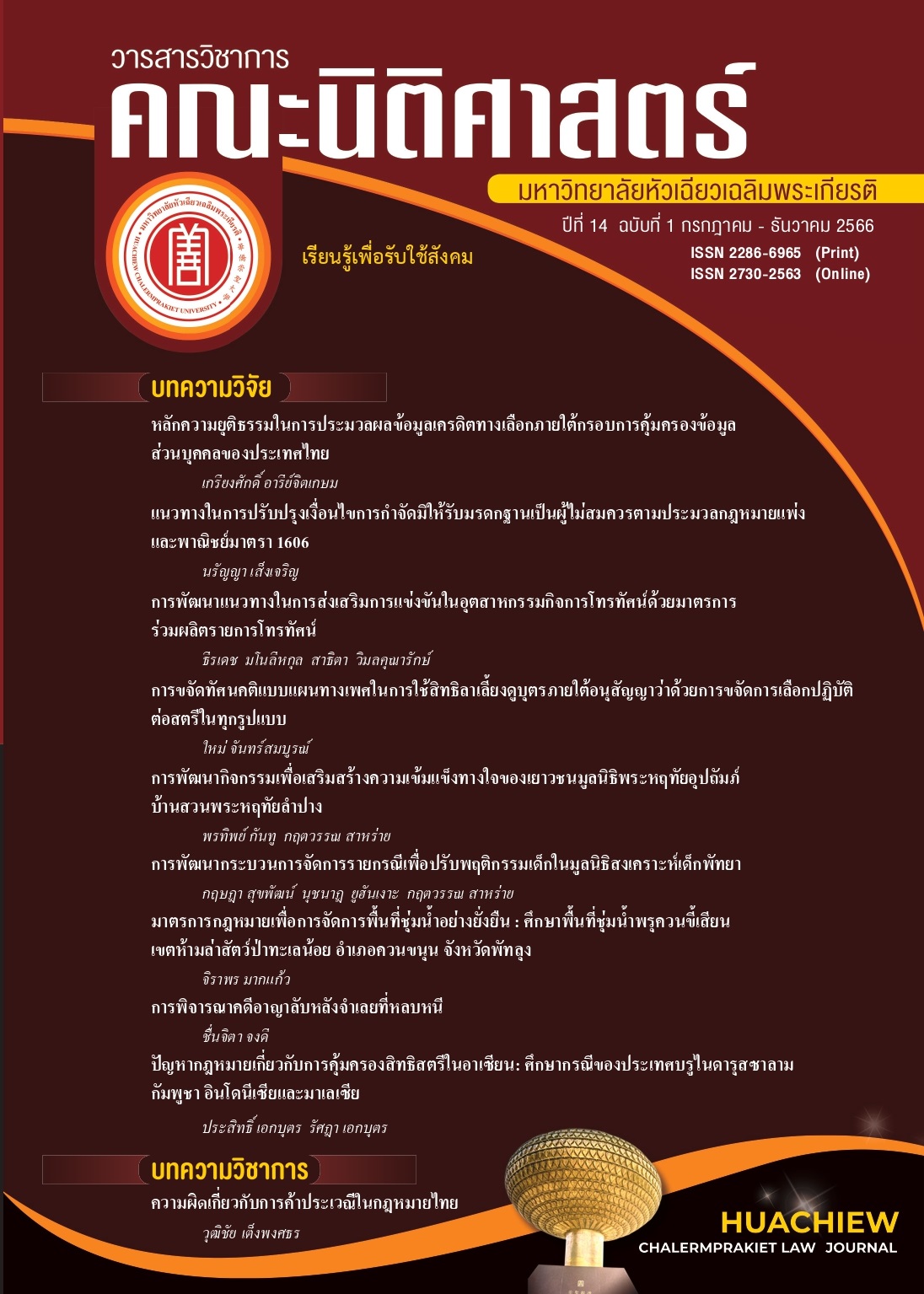
Legal Problems Concerning Women’s Rights in ASEAN: Study on Cases of Brunei Darussalam, Cambodia, Indonesia and Malaysia
Keywords:
Women Rights, , Convention on the Elimination of All Forms of Discrimination against Women (CEDAW), ASEAN Legal System, Internal Laws of ASEAN membersAbstract
Legal problems on women’s rights in ASEAN 10 members derive from many factors namely: weak structure of ASEAN Organization, weak legal mechanism, different legal systems amongst ASEAN members, different legal applications and interpretations, gaps of law and inefficiency in term of enforcement of law. In consequence, the problems on violations of women’s rights aggravate at the level of worrisome situation especially in the major tragic cases such as women trafficking, violence against women and girls, inequality between men and women, and discrimination against women and girls. Although, all members of ASEAN had already many laws for the protection of women’s rights and girls’ rights and became State Parties to the Convention on the Elimination of All Forms of Discrimination against Women (CEDAW) and the Convention on the Rights of the Child (CRC), the bad situation of women’s rights as mentioned above is still going on. Therefore, all members of ASEAN should create a new legal mechanism for the strengthening and the enhancing of ASEAN human rights organs including legal harmonization on women’s rights. Furthermore, all ASEAN members need to modernize their human rights law and women’s rights law in line with the CEDAW and the United Nations Convention on the Rights of the Child (UNCRC), and improve their legal enforcement on this matter as much as possible without further delay.
References
Aichr, History of Human Rights in ASEAN (3 August 2023) about-aichr-2 <https://aichr.org/about-aichr-2/>.
ASEAN, ASEAN Socio-Cultural Community Blueprint 2025 (Jakata: the asean secretariat, 2025).
Asean, Gender, Rights, of Women and Children (3 August 2023) Overview <https://asean.org/our-communities/asean-socio-cultural-community/gender-rights-of-women-and-children/>.
ASEAN, Projected Gender Impact of the ASEAN Economic Community (Jakata: the asean secretariat, 2016).
ASEAN, Progress on the Sustainable Development Goals: The Gender Snapshot 2022 (3 August 2023) Overview <https://asean.org/our-communities/asean-socio-cultural-community/gender-rights-of-women-and-children/>.
Britannica, Labour and taxation (3 August 2023) Countries of the World <https://www.britannica.com/place/Malaysia/Labour-and-taxation>.
Britannica, Malayan and Indonesian traditional law (3 August 2023) Law, Crime & Punishment <https://www.britannica.com/topic/adat>.
European, Institutions-law-budget (3 August 2023) Types-legislation
<https://european-union.europa.eu/institutions-law budget/law/typeslegislation_en#:~:text=A%20%22directive%22%20is%20a%20
legislative,how%20to%20reach%20these%20goals>.
Statista, Total population of the ASEAN countries from 2018 to 2028 (3 August 2023) International <https://www.statista.com/statistics/796222/totalpopulationoftheaseancountries
/#:~:text=Total%20population%20of%20the%20ASEAN%20countries%20from%202017
%20to%202027&text=In%202021%2C%20the%20total%20population,an%20estimated%
55%20million%20inhabitants>.
Unicef, UNICEF welcomes recent amendment of Indonesia’s Marriage Act (3 August 2023) New Act raises the age of marriage for girls <https://www.unicef.org/press-releases/unicef-welcomes-recent-amendmentindonesiasmarriageact#:~:text=Jakarta%2C%20September%2018%2C
%202019%20%E2%80%93,boys%2C%20which%20is%20also%2019. Date of Access: 15/7/2023>.
United Nations Human Rights, View the ratification status by country or by treaty (3 August 2023) Human Rights Bodies <https://tbinternet.ohchr.org/_layouts/15/TreatyBodyExternal/Treaty.aspx?Treaty=CEDAW&Lang=en>.
United Nations Human Rights, View the ratification status by country or by treaty (3 August 2023) Human Rights Bodies <https://tbinternet.ohchr.org/_layouts/15/TreatyBody External/Treaty.aspx?Treaty=CEDAW&Lang=en>.
World Economic Forum, Global Gender Gap Report 2023 (3 August 2023) WEF_GGGR <https://www3.weforum.org/docs/WEF_GGGR_2023.pdf?_gl=1*v93vj3*up*MQ..&gclid=CjwKCAjw_aemBhBLEiwAT98FMrCkKX7sSWZgmujfQrliH6lkeGVj8
LjI1WPQBJC_3QPlrjzfMRWxoCfUoQAvD_BwE>.
WTO, Global trade rules (3 August 2023) the wto in brief <https://www.wto.org/english/thewto_e/whatis_e/inbrief_e/inbr_e.htm>.
World Economic Forum, Global Gender Gap Report 2023 (3 August 2023) WEF_GGGR <https://www.weforum.org/reports/global-gender-gap-report-2023/economy-profiles-5932ef6d39gclid=Cj0KCQjw_O2lBhCFARIsAB0E8B8K45AQqnyQyQCJtH36RhoFAbagvObuYF7U2qbfJI
KNEDr2wSz2YaArXVEALw_wcB#report-nav>.
Downloads
Published
How to Cite
Issue
Section
License
Copyright (c) 2023 Huachiew Chalermprakiet Law Journal

This work is licensed under a Creative Commons Attribution-NonCommercial-NoDerivatives 4.0 International License.
บทความหรือข้อความคิดเห็นใด ๆ ที่ปรากฏในวารสารฉบับนี้เป็นวรรณกรรมของผู้เขียนโดยเฉพาะ คณะนิติศาสตร์มหาวิทยาลัยหัวเฉียวเฉลิมพระเกียรติ และกองบรรณาธิการไม่มีส่วนรับผิดชอบหรือไม่จำเป็นต้องเห็นด้วยกับข้อคิดเห็นนั้น แต่ประการใด




