
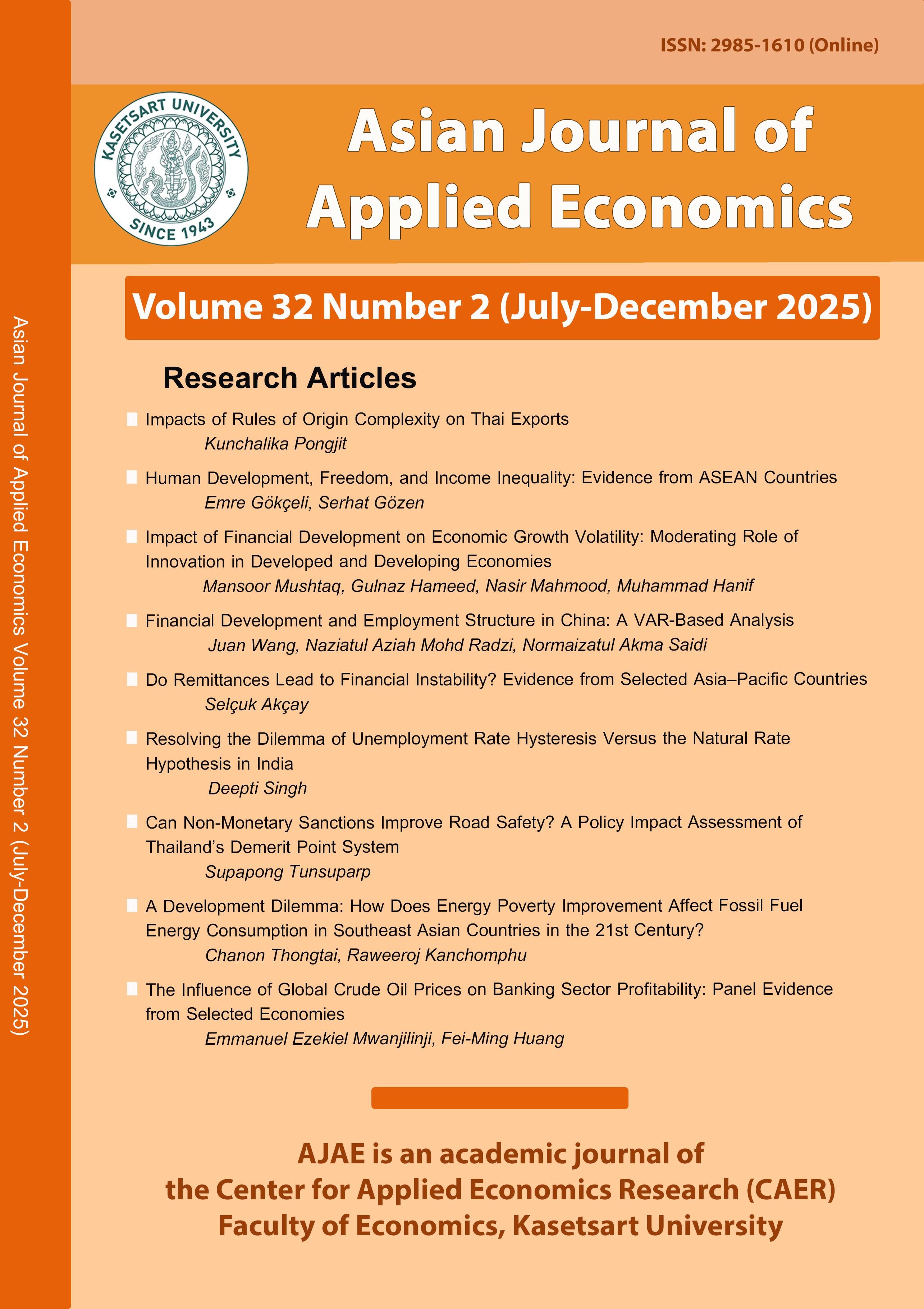
ผลกระทบของความสลับซับซ้อนของกฎว่าด้วยแหล่งกำเนิดสินค้าต่อภาคการส่งออกไทย
Article Sidebar
Main Article Content
บทคัดย่อ
งานวิจัยนี้มีวัตถุประสงค์เพื่อศึกษาเกี่ยวกับผลกระทบของความสลับซับซ้อนของกฎว่าด้วยแหล่งกำเนิดสินค้าต่อ
ภาคการส่งออกไทย ผ่านความตกลงการค้าเสรีสำคัญ 3 ฉบับ ได้แก่ ความตกลงการค้าเสรีอาเซียน – จีน(ASEAN – China Free Trade Agreement: ACFTA) ความตกลงหุ้นส่วนทางเศรษฐกิจอาเซียน – ญี่ปุ่น(ASEAN – Japan Comprehensive Economic Partnership Agreement: AJCEP) และความตกลงการค้าเสรีอาเซียน – เกาหลี (ASEAN – Republic of Korea Free Trade Agreement: AKFTA) ในช่วงปี ค.ศ. 2006 – 2020 งานวิจัยใช้กฎเฉพาะรายผลิตภัณฑ์เพื่อสร้างดัชนีวัดความสลับซับซ้อนของกฎว่าด้วยแหล่งกำเนิดสินค้า และใช้แบบจำลองแรงโน้มถ่วงและประมาณค่าด้วยเทคนิค SystemGeneralized Method of Moments (GMM) regression fixed effects ซึ่งเป็นหนึ่งในวิธีการประมาณค่าแบบ Dynamic Panel Data Model (DPD) ในการพิจารณาความสัมพันธ์ดังกล่าว ผลการศึกษาบ่งชี้ว่า กฎว่าด้วยแหล่งกำเนิดสินค้าเป็นอุปสรรคทางการค้าและส่งผลกระทบเชิงลบต่อการส่งออกไทย โดยเฉพาะอย่างยิ่งผ่านความตกลง AJCEP นอกจากนั้นแล้ว งานวิจัยนี้พบว่า ผลกระทบของความสลับซับซ้อนของกฎว่าด้วยแหล่งกำเนิดสินค้ามี
ความแตกต่างกันในแต่ละสินค้า โดยอุตสาหกรรมอาหารทะเลสดและอาหารทะเลแปรรูปมีแนวโน้มได้รับผลกระทบเชิงลบมากกว่าอุตสาหกรรมอื่นโดยเฉพาะอุตสาหกรรมเครื่องใช้ไฟฟ้าและอิเล็กทรอนิกส์ และอุตสาหกรรมยานยนต์
Article Details

อนุญาตภายใต้เงื่อนไข Creative Commons Attribution-NonCommercial-NoDerivatives 4.0 International License.
The paper is published under CC BY-NC-ND, in which the article is freely downloaded and shared in its original form non-commercially and its citation details are identified.
เอกสารอ้างอิง
Anderson, J. E., & van Wincoop, E. (2003). Gravity with gravitas: A solution to the border puzzle. American Economic Review, 93(1), 170-192.
Ansón, J., Cadot, O., Estevadeordal, A., Melo, J. D., Suwa-Eisenmann, A., & Tumurchudur, B. (2005). Rules of origin in North–South preferential trading arrangements with an application to NAFTA. Review of International Economics, 13(3), 501-517.
Arellano, M., & Bond, S. (1991). Some tests of specification for panel data: Monte Carlo evidence and an application to employment equations. The Review of Economic Studies, 58(2), 277-297.
Baier, S. L., & Bergstrand, J. H. (2007). Do free trade agreements actually increase members' international trade? Journal of International Economics, 71(1), 72-95.
Baldwin, R., & Taglioni, D. (2006). Gravity for dummies and dummies for gravity equations (NBER Working Paper No. 12516). Cambridge, MA: National Bureau of Economic Research.
Blundell, R., & Bond, S. (1998). Initial conditions and moment restrictions in dynamic panel data models. Journal of Econometrics, 87(1), 115-143.
Cadot, O., Carrere, C., de Melo, J., & Tumurchudur, B. (2006). Product–specific rules of origin in EU and US preferential trading arrangements: an assessment. World Trade Review, 5(2), 199-224.
Cadot, O., De Melo, J., Estevadeordal, A., Suwa-Eisenmann, A., & Tumurchudur, B. (2002). Assessing the effect of NAFTA's rules of origin (Research Unit Working Paper No. 0306). Laboratoire d’Économie Appliquée, INRA.
Córcoles, D., Diaz–Mora, C., & Gandoy, R. (2014). Product sophistication: A tie that binds partners in international trade. Economic Modelling, 44(S1), S33-S41.
Estevadeordal, A. (2000). Negotiating preferential market Access: The case of the North American Free Trade Agreement. Journal of World Trade, 34(1), 141-166.
Estevadeordal, A. & Suominen, K. (2006). Mapping and measuring rules of origin around the world. In O. Cadot, A. Estevadeordal, A. Suwa-Eisenmann, & T. Verdier (Eds.), The origin of goods: Rules of origin in regional trade agreements (pp. 69-113). Oxford University Press.
Falvey, R., & Reed, G. (2002). Rules of origin as commercial policy Instruments. International Economic Review, 43(2), 393-407.
Feenstra, R. C. (2004). Advanced international trade: Theory and Evidence. Princeton University Press.
Francois, J., Hoekman, B., & Manchin, M. (2006). Preference erosion and multilateral trade liberalization. The World Bank Economic Review, 20(2), 197-216.
Frankel, J., Stein, E., & Wei, S.–J. (1995). Trading blocs and the Americas: The natural, the unnatural, and the super–natural. Journal of Development Economics, 47(1), 61-95.
Gourieroux, C., Monfort, A., & Trognon, A. (1984). Pseudo maximum likelihood methods: Applications to Poisson models. Econometrica, 52(3), 701-720.
Hayakawa, K. (2014). Impact of diagonal cumulation rule on FTA utilization: Evidence from bilateral and multilateral FTAs between Japan and Thailand. Journal of the Japanese and International Economies, 32, 1-16.
Hayakawa, K., Hiratsuka, D., Shiino, K., & Sukegawa, S. (2013). Who uses free trade agreements? Asian Economic Journal, 27(3), 245-264.
Hayakawa, K., Laksanapanyakul, N., & Yoshimi, T. (2021). Tariff scheme choice. Review of World Economics, 157(2), 323-346.
Head, K., & Mayer, T. (2014). Gravity equations: Workhorse, toolkit, and cookbook. In G. Gopinath, E. Helpman, & K. Rogoff (Eds.), Handbook of international economics (Vol. 4, pp. 131-195). Elsevier.
Helpman, E., Melitz, M., & Rubinstein, Y. (2008). Estimating trade flows: Trading partners and trading volumes. The Quarterly Journal of Economics, 123(2), 441-487.
Herin, J. (1986). Rules of origin and differences between Tariff levels in EFTA and in the EC (EFTA Occasional Paper No. 13). European Free Trade Association.
Hummels, D. (2007). Transportation costs and international trade in the second era of globalization. Journal of Economic Perspectives, 21(3), 131-154.
Jongwanich, J. (2024). Free trade agreements (FTAs) and export structures: Evidence from Thailand. Journal of the Asia Pacific Economy, 30(2), 483–521.
Jongwanich, J., & Kohpaiboon, A. (2017). Exporter responses to FTA tariff preferences: Evidence from Thailand. Asian–Pacific Economic Literature, 31(1), 21-38.
Kohpaiboon, A., & Jongwanich, J. (2006, December 15-16). Does export creation exist? Evidence from Thai manufacturing. Paper presented at the Globalization and Regional Economic Development Conference, Republic of Korea.
Kohpaiboon, A., & Jongwanich, J. (2022). Restrictiveness of RCEP rules of origin: Implications for global value chains in East Asia (pp. 39-69). Economic Research Institute for ASEAN and East Asia (ERIA).
Koskinen, M., (1983). Excess documentation costs as a non–tariff measure: An empirical analysis of the effects of documentation costs. (Working Paper). Swedish School of Economics and Business Administration.
Krishna, K., & Krueger, A. (1995). Implementing free trade areas: Rules of origin and hidden protection (NBER Working Paper No. 4983). National Bureau of Economic Research.
Kuroiwa, I. 2006. Rules of origin and local content in East Asia (IDE Discussion Paper No. 78). Institute of Developing Economies, Japan External Trade Organization (JETRO).
Magee, C. S. P. (2008). New measures of trade creation and trade diversion. Journal of International Economics, 75(2), 349-362.
Ministry of Commerce (Thailand). (2018, December 24). Granting product–specific rules of origin certification under the ASEAN–China Free Trade Agreement. Bangkok, Thailand: Department of Trade Negotiations. Retrieved from https://resolution.soc.go.th/PDF_UPLOAD/2561/9933099916.pdf (in Thai)
Minondo, A. (2010). Exports' quality–adjusted productivity and economic growth. Journal of International Trade & Economic Development, 19, 257-287.
Panagariya, A. (2000). Preferential trade liberalization: The traditional theory and new developments. Journal of Economic Literature, 38(2), 287-331.
Platzer, M. D. (2017). Renegotiating NAFTA and U.S. textile manufacturing. Washington, DC: Congressional Research Service. Retrieved from ttps://www.congress.gov/crs-product/R44998
Qu, Y., & Zhang, R. (2023). Assessing the effects of ROO and tariff margin on China–ASEAN free trade agreement utilization. PLOS ONE, 18(5), e0286106.
Silva, J. M. C. S., & Tenreyro, S. (2006). The Log of Gravity. The Review of Economics and Statistics, 88(4), 641-658.
Tanaka, K., & Fukunishi, T. (2022). Rules of origin and exports in developing economies: The case of garment products. Journal of Asian Economics, 82, 101514.
The Customs Department (Thailand). (2022). International cooperation on rules of origin for preparedness under the CPTPP Framework. Retrieved from https://www.customs.go.th/data_files/8f1618f5efa2e9d563205c53bad2570e.pdf (in Thai)
Tinbergen, J. (1962). Shaping the world economy: Suggestions for international economic policy. New York, NY: Twentieth Century Fund.
Viner, J. (1950). The customs union issue. New York, NY: Carnegie Endowment for International Peace.
Wignaraja, G., Olfindo, R., Pupphavesa, W., Panpiemras, J., & Ongkittikul, S. (2010). How do FTAs affect exporting firms in Thailand? (ADBI Working Paper No. 190). Asian Development Bank Institute. Retrieved from https://www.adb.org/sites/default/files/publication/156045/adbi-wp190.pdf
Wooldridge, J. M. (2010). Econometric analysis of cross section and panel data. The MIT Press.
World Integrated Trade Solution. (2024). Product concordance. Retrieved from https://wits.worldbank.org/product_concordance.html
Yotov, Y. V., Piermartini, R., Monteiro, J.-A., & Larch, M. (2016). An advanced guide to trade policy analysis: The structural gravity model. Geneva, Switzerland: World Trade Organization.
