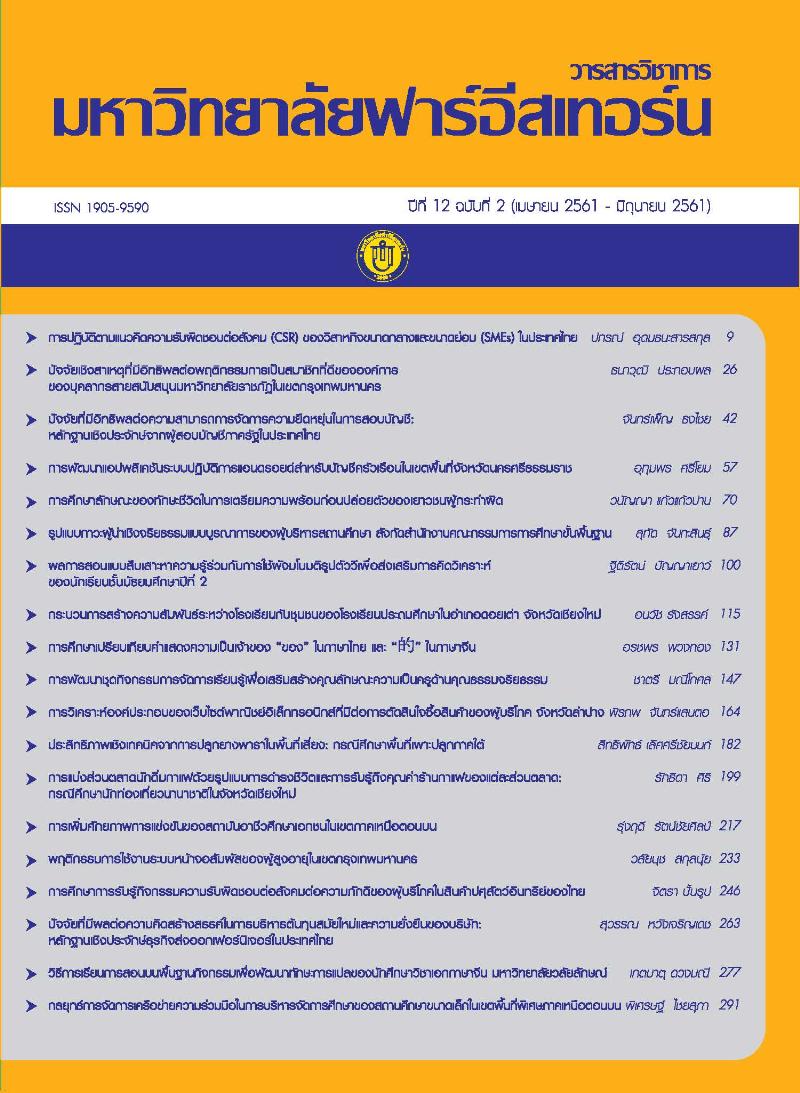
Factors Influencing Audit Flexibility Management Competency: Empirical Evidence from Governmental Auditors in Thailand
Article Sidebar
Main Article Content
Abstract
This research aims to investigate factors influencing audit flexibility management competency. The questionnaire was used as an instrument for collecting data from 528 auditors of the office of Auditor General of Thailand (OAG). Multiple regression analysis (MRA) is used to test the hypotheses by the ordinary least squares method (OLS). The results reveal that the factors that have an influence on audit flexibility management competency comprise: top management support, audit learning, audit commitment, stakeholder expectation, and environmental change. Consequently, this research provides insights for regulators and organizations to strengthen their audit department in order to enhance the management competency of flexibility auditing.
Article Details
1. Any views and comments in the Journal of Social Innovation and Lifelong Learning are the authors’ views. The editorial staff have not to agree with those views and it is not considered as the editorial’s responsibility.
2. The responsibility of content and draft check of each article belongs to each author. In case, there is any lawsuit about copyright infringement. It is considered as the authors’ sole responsibility.
3. The article copyright belonging to the authors and The Far Eastern University are copyrighted legally. Republication must be received direct permission from the authors and The Far Eastern University in written form.
References
Armstrong, J. S. & Overton, T. S. (1977). Estimating Non-Response Bias in Mail Surveys. Journal of Marketing Research, 14(3), 396-402.
Arnold, V., Collier, P. A., Leech, S. A. & Sutton, S. G. (2001). The Impact of Political Pressure on Novice Decision Makers: Are Auditors Qualified to Make Going-Concern Judgments?. Critical Perspectives on Accounting, 12(3), 323-338.
Carcello, J. V., Vanstraelen, A. & Willenborg, M. (2009). Rules Rather than Discretion in Audit Standards: Going-Concern Opinions in Belgium. The Accounting Review, 84, 1395-1428.
Chung, S. H. & Lee, D. H. (2005). Impacts of TQM Activities on Employee’s Satisfaction in The Support of Task Process, and on Business Performance in Medical Service Industry. The Korea Service Management Society, 6(1), 57-85.
Coetzer, A. & Perry, M. (2008). Factors Influencing Employee Learning in Small Businesses. Education & Training, 50(8/9), 648-660.
DeFond, M. and Zhang, J. (2014). A Review of Archival Auditing Research. Journal of Accounting and Economics, 58, 275–326.
Elbanna, S., Ali, A. J. & Dayan, M. (2011). Conflict in Strategic Decision Making: Do the Setting and Environment Matter?. International Journal of Conflict Management, 22 (3), 278-299.
Fiedler, F. E. (1967). A Theory of Leadership Effectiveness, New York: McGraw-Hill.
Hair, J.F., Black, W. C., Babin, B. J. & Anderson, R. E. (2010). Multivariate Data Analysis: A Global Perspective. New Jersey: Pearson Publishing.
Human Resources Management Office, Office of the auditor general of Thailand (OAG). Organization Chart. [Online] Available from http://www.oag.go.th/ en/government/center. [accessed 22 May 2016].
Intakhan, P. & Ussahawanitchakit, P. (2010). Role of Audit Experience and Ethical Reasoning in Audit Professionalism and Audit Effectiveness through a Moderator of Stakeholder Pressure: An Empirical Study of Tax Auditors in Thailand. Journal of Academy of Business and Economics, 10(5), 1-14.
Kutner, M. C., Nachtsheim, C. & Neter, J. (2008). Applied Linear Regression Models. 4th ed. New York: McGraw Hill.
Lee, S. M., Kim, I. J., Rhee, S. G. & Trimi, S. (2006). The Role of Exogenous Factors in Technology Acceptance: The Case of Object-Oriented Technology. Information and Management, 43(4), 469-480.
Lee, K., Craswell, J. J. & Allen, N. J. (2000). A Meta-Analytic Review of Occupational Commitment: Relations with Person and Work-Related Variables. Journal of Applied Psychology, 85(5), 799-811.
Li, H., Xu, L. C. & Zou, H. F. (2000). Corruption, Income Distribution, and Growth. Economics & Politics, 12(2), 155-182.
Nehme, R. (2013). Dynamics of Audit Quality: Behavioral Approach and Governance Framework: UK Evidence. Doctor of Philosophy, Durham University.UK.
Nunnally, J. C. & Bernstein I. H. (1994). Psychometric Theory. New York: McGraw-Hill.
Okab, R. (2013). The Expert Systems and Their Role in Developing External Auditor's Performance and Improving Audit Service's Quality in Information Technology Environment in Audit's Offices Located in The Hashemite Kingdom of Jordan. International Journal of Business and Management, 8(17), 129-141.
Palau, S. L. (2001). Ethical Evaluations, Intentions, and Orientations of Accountants: Evidence from Across-Cultural Examination. International Advance in Economic Research, 7(3), 351-364.
Phankaseam, S., (2009). Office of the Auditor General of Thailand and Creation Good Governance in Subdistrict Administration Organizations. Sripatum Chonburi Journal, 6(1): June-November.
Pinsker, R., Pennington, R. & Schafer, J.K. (2009). The Influence of Roles, Advocacy, and Adaptation to the Accounting Decision Environment. Behavioral Research in Accounting, 21(2), 91-111.
Research and Development office, Office of the Auditor General of Thailand. (2015).
Audit to Detect Fraud and Corruption: Evaluation of the Fight against Corruption and Money Laundering Country paper of Thailand. [Online]. Available from: http://www.oag.go.th/sites/default/files/files/news/ 10.2015060001.2.pdf [accessed 17 October 2016].
Ross, D. (2016). A Case Study of Municipal Government Financial Management and Effective Internal Controls. Ph.D. Dissertation, the School of Business and Technology Management. Northcentral University. Arizona. U.S.A.
Schneider, S. & Spieth, P. (2014). Business Model Innovation and Strategic Flexibility: Insights Form An Experimental Research Design. International Journal of Innovation Management, 18(6), 1-21.
Shian, S.G. & Tam, V. H. (2010). The Relationship between Corporate Strategy,
Capital Structure and Firm Performance: An Empirical Study of the Listed
Companies in Vietnam. International Research Journal of Finance and
Economics, (50), 62-73.
Singh, D., Oberoi, J. S. & Ahuja, I. J. (2013). An Empirical Investigation of Dynamic Capabilities in Managing Strategic Flexibility in Manufacturing Organizations. Management Decision, 51(7), 1442-1461.
Skaerbaek, P. (2009). Public Sector Auditor Identities in Making Efficiency Auditable: The National Audit Office of Denmark as Independent Auditor and Modernizer. Accounting, Organizations and Society, 34, 971-987.
Struweg, L. N. & Meintjes, C. (2008). The Professionalism Debate in South African Public Relations. Public Relations Review, 34(3), 224-229.
Wechsler, R. (2012). Local Government Ethics Reform. National Civic Review, 101(3), 26-30.
Westermann, K. D., Bedard, J. C. & Earley, C. E. (2015). Learning the "Craft" of Auditing: A Dynamic View of Auditors' on-The-Job Learning. Contemporary Accounting Research, 32(3), 864.
Wise, L. (2004). Bureaucratic Posture: On the Need for A Composite Theory of Bureaucratic Behavior. Public Administration Review, 64(6), 669-680.
Wittayapoom, K. & Limsuwan, S. (2012). Audit Environment Changes, Audit Knowledge, and Audit Efficiency: An Empirical Research of CPAs in Thailand. International Journal of Strategic Management, 12(1).
Wong, PSP. & Cheung, SO. (2008). An Analysis of Relationship between Learning Behavior and Performance Improvement of Contracting Organizations. International Journal of Project Management, 26, 112-123.
