
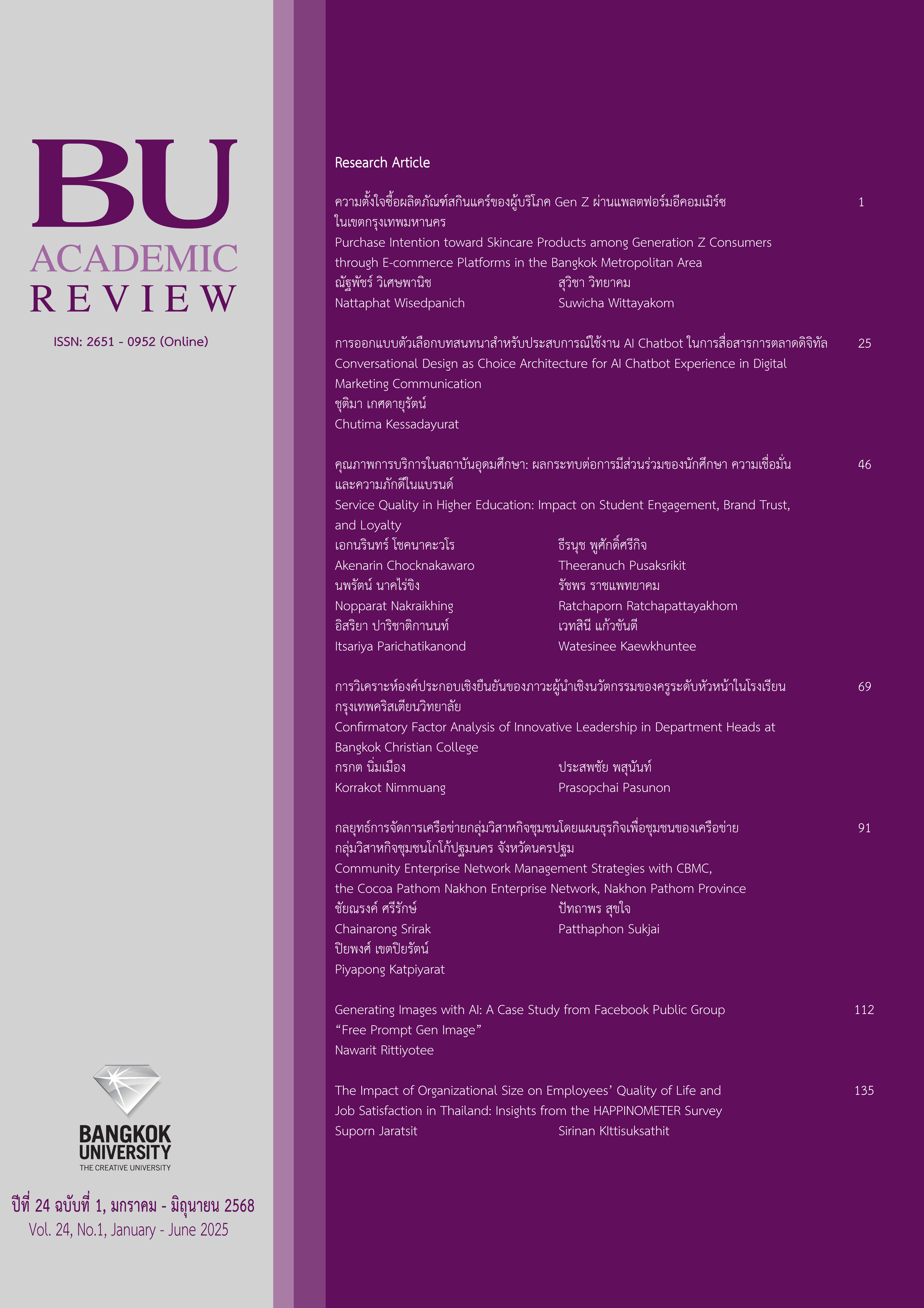
The Impact of Organizational Size on Employees’ Quality of Life and Job Satisfaction in Thailand: Insights from the HAPPINOMETER Survey
Article Sidebar
Main Article Content
บทคัดย่อ
Organizational management- in small, medium, or large organizations- comes with distinct advantages and challenges that directly impact employees' quality of life and job satisfaction. This study aims to analyze the quality of life and job satisfaction among employees in different organizational sizes, and examine job satisfaction factors that influence the quality of life in Thai organizations. The data were drawn from the 2021 HAPPINOMETER Happy Workplace Survey, involving 20,980 respondents from 365 organizations across the country.
The ANOVA results reveal that employees in medium-sized organizations reported lower quality of life and job satisfaction than those in small and large organizations. Key job satisfaction factors influencing quality of life included job challenges, communication, and size-specific elements- such as knowledge sharing in small organizations, job security in medium organizations, and employee listening in large organizations. These findings highlight the importance of adapting work environments and human resource management strategies to the specific context of organizational size in order to improve employees' quality of life and job satisfaction.
Article Details

อนุญาตภายใต้เงื่อนไข Creative Commons Attribution-NonCommercial-NoDerivatives 4.0 International License.
บทความที่นำมาสมัครลงตีพิมพ์ในวารสารต้องไม่เคยได้รับการตีพิมพ์เผยแพร่มาก่อน และไม่ส่งต้นฉบับบทความซ้ำซ้อนกับวารสารอื่น รวมทั้งผู้เขียนบทความต้องไม่ละเมิดหรือคัดลอกผลงานของผู้อื่น
เอกสารอ้างอิง
Atkinson, C. (2007). Building high performance employment relationships in small firms. Employee Relations, 29(5), 506-519. https://doi.org/10.1108/01425450710776317
Barrett, R., Claydon, T., & Rainnie, A. (2009). The paradox of happy workers in small firms: Exploring new explanations for an old issue. ILEAR. https://www.ilera-directory.org/ 15thworldcongress/files -/papers/Track_1/Wed_W3_RAINNIE.pdf
Böckerman, P., & Ilmakunnas, P. (2012). The job satisfaction-productivity nexus: A study using matched survey and register data. ILR Review, 65(2), 244-262. https://doi.org/10.1177/001979391206500203
Chaiprasit, K., & Santidhirakul, O. (2011). Happiness at work of employees in small and medium-sized enterprises, Thailand. Procedia-Social and Behavioral Sciences, 25(1), 189-200. https://doi.org/10.1016/j.sbspro.2011.10.540
Combs, J. G., Liu, Y., Hall, A., & Ketchen, D. (2006). How much do high-performance work practices matter? A meta-analysis of their effects on organizational performance. Personnel Psychology, 59(3), 501-528. https://doi.org/10.1111/j.1744-6570.2006.00045.x
Connolly, F. F., Seva, I. J., & Garling, T. (2021). The bigger the better? Business size and small-business owners’ subjective well-being. Journal of Happiness Studies, 22(3-4), 1071-1088. https://doi.org/10.1007/s10902-020-00264-2
Dugguh, A. I., & Ayaga, D. (2014). Job satisfaction theories: Traceability to employee performance in organizations. IOSR Journal of Business and Management, 16(5), 11-18.
Elrehail, H., Harazneh, I., Abuhjeeleh, M., Alzghoul, A., Alnajdawi, S., & Ibrahim, H. M. H. (2019). Employee satisfaction, human resource management practices and competitive advantage: The case of Northern Cyprus. European Journal of Management and Business Economics, 29(2), 125–149. https://doi.org/10.1108/EJMBE-01-2019-0001
Encrenaz, G., Laberon, S., Lagabrielle, C., Debruyne, G., Pouyaud, J., & Rascle, N. (2018). Psychosocial risks in small enterprises: The mediating role of perceived working conditions in the relationship between enterprise size and workers’ anxious or depressive episodes. International Journal of Occupational Safety and Ergonomics, 25(3), 485-494.
Fallowfield, L. (2009). What is quality of life? Hayward Medical Coomunications.
Ficarra, L., Rubino, M. J., & Morote, E. S. (2020). Does organizational culture affect employee happiness? Journal for Leadership and Instruction, 19(2), 38-47.
Forth J., Bewley, H., & Bryson, A. (2006). Small and medium sized enterprises: Findings from the 2004 workplace employment relations survey. Department of Trade and Industry.
Garaigordobil, M. (2015). Predictor variables of happiness and its connection with risk and protective factors for health. Frontiers in Psychology, 6, 1-10.
Grant, A. M., Christianson, M. K., & Price, R. H. (2007). Happiness, health, or relationships? Managerial
practices and employee well-being tradeoffs. Academy of Management Perspectives, 21(3), 51–63.
Hackman, J. R., & Oldham, G. R. (1976). Motivation through the design of work: Test of a theory. Organizational Behavior and Human Performance, 16(2), 250–279.
Herzberg, F., Maunser, B., & Snyderman, B. (1959). The motivation to work. John Wiley and Sons Inc.,
Idson, T., & Oi, W. (1999). Workers are more productive in large firms. American Economic Review, 89(2), 104-108.
Kaewkerd, W., Sadangharn, P., & Ingard, A. (2017). Kāndamnœ̄n ngān phư̄a sāng khwāmsuk læ khwām phūkphan khō̜ng phanakngān nai ʻongkō̜n suk phāwa tonbǣp [Approach of happiness and employee engagement in happy workplace organization model]. KKBS Journal of Business Administration and Accountancy, 1(2), 13-29.
Kooij, A. M., & Boon, C. (2017). Perceptions of HR practices, person–organisation fit, and affective commitment: The moderating role of career stage. Human Resource Management Journal, 28(1), 61-75. https://doi.org/10.1111/1748-8583.12164
Laoteng, S., & Jadesadalug, V. (2014). ʻItthiphon khō̜ng kitčhakam sāng suk nai ʻongkō̜n tām nǣothāng khwāmsuk pǣt prakān thī mī tō̜ khwāmsuk nai kā rot ngān prasitthiphāp kānthamngān læ khwāmtangčhai nai kān lāʻō̜k khō̜ng phanakngān bō̜risat ʻēkkachon [The influence of happiness activities in the organization by happy 8 model toward happiness at work, productivity of work and intention to resign of workers in a private company]. Veridian E-Journal, Silpakorn University, 7(2), 988-1006.
Laping, T., & Suveatwatanakul, C. (2021). ʻItthiphon khō̜ng khwāmsuk nai kāntham ngān tō̜ khwām thumthē mī čhai nai ngān khō̜ng phanakngān tō̜nrap bon khrư̄angbin run THAI Quality and Value (TQV)] The influence of happiness in work that affect employee engagement of Thai airway’s flight attendant (TQV). Srinakharinwirot Business Journal, 11(2), 35-48.
Li, X. (2016). Impact of firm characteristics on wages: Industry wage differentials and firm size-wage effects in Sweden [Master’s thesis, Umeå University]. Digitala Vetenskapliga Arkivet. https://www.diva-portal.org/smash/get/diva2:944802/FULLTEXT01.pdf
Mendoza-Ocasal, D., Castillo-Jiménez, R., Navarro, E., & Ramírez, J. (2021). Measuring workplace happiness as a key factor for the strategic management of organizations. Polish Journal of Management Studies, 24(2), 292-306. https://doi.org/10.17512/pjms.2021.24.2.18.
National Statistical Office. (2022). Sammanō thurakit læ ʻutsāhakam Phō̜.Sō̜. sō̜ngphanhārō̜ihoksiphā khō̜mūn phư̄nthān [The 2022 business and industrial census basic information]. National Statistical Office.
Penrose, E. (1995). The theory of the growth of the firm (3rd ed). Oxford University Press.
Requena, R. (2003). Social capital, satisfaction and quality of life in the workplace. Social Indicators Research, 61, 331-360.
The Organisation for Economic Co-operation and Development [OECD]. (2023). OECD SME and entrepreneurship outlook 2023. OECD. https://www.oecd.org/en/publications/2023/06/ oecd-sme-and-entrepreneurship-outlook-2023_c5ac21d0.html
Weiss, H. M., & Cropanzano, R. (1996). Affective events theory: A theoretical discussion of the structure, causes and consequences of affective experiences at work. In B. M. Staw & L. L. Cummings (Eds.), Research in organizational behavior: An annual series of analytical essays and critical reviews (pp. 1-74). JAI Press.
