
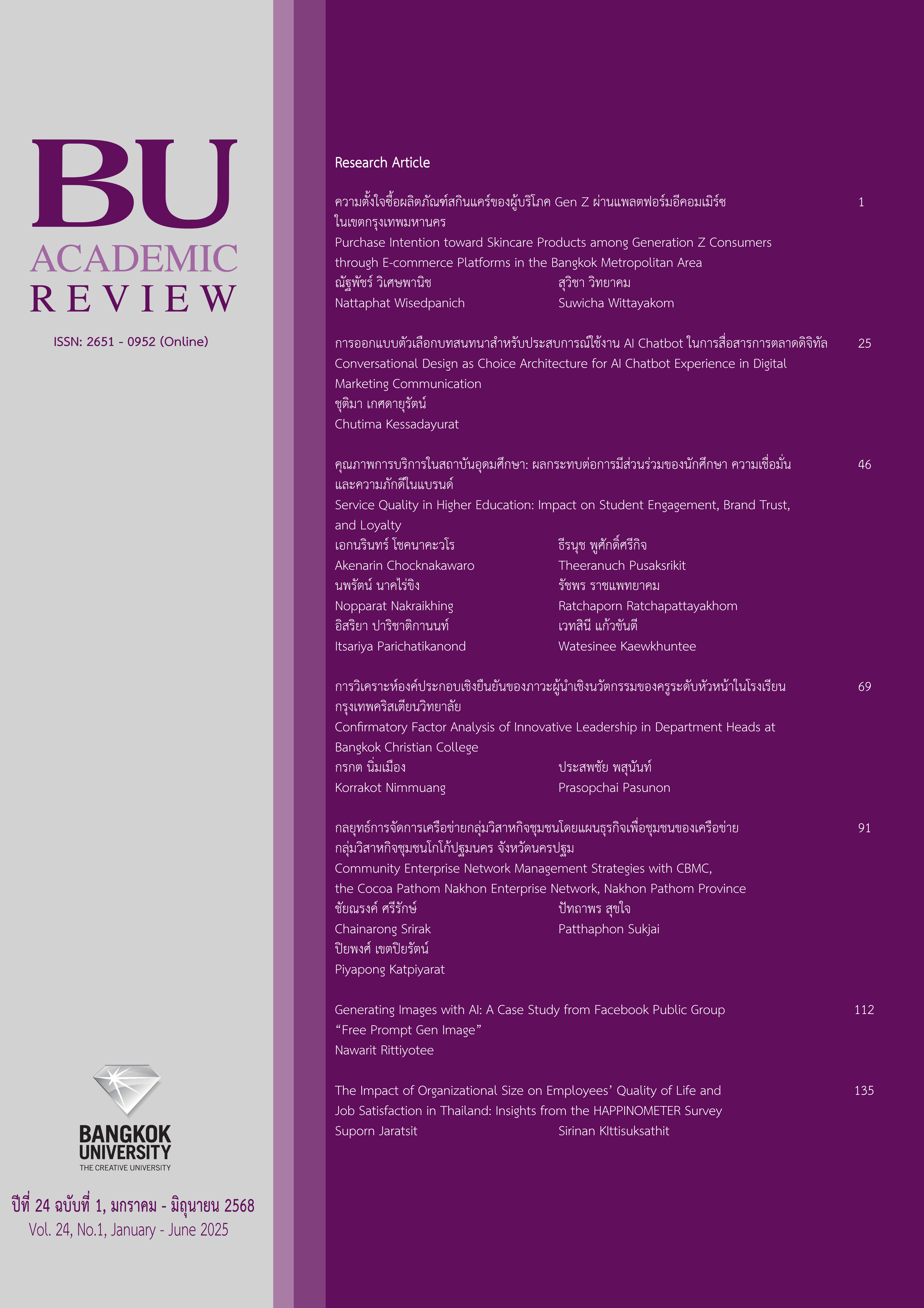
Purchase Intention toward Skincare Products among Generation Z Consumers through E-commerce Platforms in the Bangkok Metropolitan Area
Article Sidebar
Main Article Content
Abstract
This study aims to analyze the factors influencing the purchase intention of Generation Z consumers toward skincare products through e-commerce platforms in the Bangkok Metropolitan Area. A quantitative research design was employed. The sample consisted of 420 Generation Z individuals residing in Bangkok who had purchased skincare products via e-commerce platforms within the past three months. A multi-stage sampling technique was applied, and the data were analyzed using multiple regression analysis. The research instrument was an online questionnaire, and the data were examined using descriptive statistics, including frequency, percentage, mean, and standard deviation.
The findings revealed that the majority of respondents were female (50.00%), aged 20 years (39.29%), held a bachelor's degree (88.57%), and had a monthly income of less than 15,000 baht (57.38%). Additionally, 35.71% of respondents reported spending no more than 1,000 baht per month on skincare products. Hypothesis testing showed that online consumer reviews—particularly those generated by actual users (excluding influencers or sponsored content)—strongly influenced purchase intention. The influence of online consumer reviews was followed by the marketing mix, e-service quality, and perceived risk, demonstrating statistically significant effects (p < 0.05). In contrast, information quality was found to have no significant impact.
The results highlight the importance of trustworthiness in user-generated content, particularly from authentic users, in shaping consumer confidence and purchase intention—especially in contexts where consumers cannot physically inspect or try products before purchasing. Furthermore, strategic marketing, reliable e-service quality, and effective risk management also significantly influence purchase intention. These findings provide strategic insights for businesses seeking to enhance marketing communication, improve user experience on digital platforms, and design secure, trustworthy systems that reinforce Generation Z consumers’ purchase intention toward skincare products via e-commerce platforms.
Article Details

This work is licensed under a Creative Commons Attribution-NonCommercial-NoDerivatives 4.0 International License.
The manuscript submitted for publication must be the original version, submitted only to this particular journal with no prior acceptance for publication elsewhere in other academic journals. The manuscript must also not violate the copyright issue by means of plagiarism.
References
ศิริลักษณ์ โรจนกิจอำนวย. (2561). การรับรู้ความเสี่ยงและความไว้วางใจที่ส่งผลต่อการซื้อผ่านพาณิชย์อิเล็กทรอนิกส์ข้ามพรมแดน. จุฬาลงกรณ์ธุรกิจปริทัศน์, 40(157), 79-99.
ศิริวรรณ เสรีรัตน์, ศุภร เสรีรัตน์, ปณิศา มีจินดา, จิระวัฒน์ อนุวิชชานนท์ และอรทัย เลิศวรรณวิทย์. (2546). การบริหารการตลาดยุคใหม่. บริษัท ธรรมสาร จำกัด.
สำนักยุทธศาสตร์และประเมินผล. (2560). แผนการบริหารราชการกรุงเทพมหานคร พ.ศ. 2556-2560. https://thaipublica.org/wp-content/uploads/2016/07/plan-กรุงเทพฯ-2556-2560.pdf
สำนักงานมาตรฐานผลิตภัณฑ์อุตสาหกรรม. (2562). มาตรฐานอุตสาหกรรม มอก. เอส 14-2562: สบู่เหลวผสมสมุนไพร. https://www.tisi.go.th/assets/website/pdf/tiss/14-2562.pdf
สุวภาพ. (2567). อุตสาหกรรมผลิตภัณฑ์ทำความสะอาดผิวกาย. กรมส่งเสริมการค้าระหว่างประเทศhttps://www.ditp.go.th/post/171934
Ajzen, I. (1991). The theory of planned behavior. Organizational Behavior and Human Decision Processes, 50(2), 179–211. https://doi.org/10.1016/0749-5978(91)90020-T
Ajzen, I., & Fishbein, M. (1980). Understanding attitudes and predicting social behavior. Prentice-Hall.
Bauer, R. A. (1960). Consumer behavior as risk taking. In R. S. Hancock (Ed.), Dynamic Marketing for a Changing World (pp.389-398). The American Marketing Association.
Bhatnagar, A., Misra, S., & Rao, H. R. (2000). On risk, convenience, and internet shopping behavior. Communications of the ACM, 43(11), 98–105. https://doi.org/10.1145/353360.353371
Chevalier, J. A., & Mayzlin, D. (2006). The effect of word of mouth on sales: Online book reviews. Journal of Marketing Research, 43(3), 345–354. https://doi.org/10.1509/jmkr.43.3.345
Creswell, J. W. (2014). Research design: Qualitative, quantitative, and mixed methods approaches (4th ed.). SAGE Publications.
Cronbach, L. J. (1960). Essentials of psychological testing (2nd ed.). Harper.
Djafarova, E., & Bowes, T. (2021). ‘Instagram made me buy it’: Generation Z impulse purchases in fashion industry. Journal of Retailing and Consumer Services, 59, 102345. https://doi.org/ 10.1016/j.jretconser.2020.102345
Eppler, M. J., & Wittig, D. (2000). Conceptualizing information quality: A review of information quality frameworks from the last ten years. In Proceedings of the 2000 Conference on Information Quality (pp. 83–96). University of Arkansas at Little Rock.
Erkan, I., & Evans, C. (2016). The influence of eWOM in social media on consumers’ purchase intentions: An extended approach to information adoption. Computers in Human Behavior, 61, 47–55. https://doi.org/10.1016/j.chb.2016.03.003
Filieri, R., & McLeay, F. (2014). E-WOM and accommodation: An analysis of the factors that influence travelers’ adoption of information from online reviews. Journal of Travel Research, 53(1), 44–57. https://doi.org/10.1177/0047287513481274
Fishbein, M., & Ajzen, I. (1975). Belief, attitude, intention and behavior: An introduction to theory and research. Addison-Wesley.
Forsythe, S. M., & Shi, B. (2003). Consumer patronage and risk perceptions in internet shopping. Journal of Business Research, 56(11), 867–875. https://doi.org/10.1016/S0148-2963(01)00273-9
Grewal, D., Roggeveen, A. L., & Nordfält, J. (2017). The future of retailing. Journal of Retailing, 93(1), 1–6. https://doi.org/10.1016/j.jretai.2016.12.008
Han, L., Ma, Y., Addo, P. C., Liao, M., & Fang, J. (2023). The role of platform quality on consumer purchase intention in the context of cross-border e-commerce: The evidence from Africa. Behavioral Sciences, 13(5), 1-17. https://doi.org/10.3390/bs13050385
Khan, I., Rahman, Z., & Fatma, M. (2016). The role of customer brand engagement and brand experience in online banking. International Journal of Bank Marketing, 34(7), 1025–1041. https://doi.org/10.1108/IJBM-07-2015-0110
Kim, J., & Niehm, L. S. (2009). The impact of website quality on information quality, value, and loyalty intentions in apparel retailing. Journal of Interactive Marketing, 23(3), 221–233. https://doi.org/10.1016/j.intmar.2009.04.009
Kim, M., Oh, H. J., Choi, J. H., & Jung, Y. (2024). Decoding millennials and generation Z consumers' brand behaviors in the Metaverse: The relationships among avatar identification, self-presence, and psychological dynamics. Journal of Consumer Behaviour, 24(1), 44–57. https://doi.org/10.1002/cb.2405
Kotler, P., & Keller, K. L. (2016). Marketing management (15th ed.). Pearson Education.
Krejcie, R. V., & Morgan, D. W. (1970). Determining sample size for research activities. Educational and Psychological Measurement, 30(3), 607–610. https://doi.org/10.1177/001316447003000308
Kuan, H. H., Bock, G. W., & Vathanophas, V. (2008). Comparing the effects of website quality on customer initial purchase and continued purchase at e-commerce websites. Behavior & Information Technology, 27(1), 3–16. https://doi.org/10.1080/01449290600801959
Limbu, Y. B., & Ahamed, A. F. M. J. (2023). What influences green cosmetics purchase intention and behavior? A systematic review and future research agenda. Sustainability, 15(15), 1-15. https://doi.org/10.3390/su151511881
Loiacono, E. T., Watson, R. T., & Goodhue, D. L. (2007). WebQual: An instrument for consumer evaluation of websites. International Journal of Electronic Commerce, 11(3), 51–87. https://doi.org/10.2753/JEC1086-4415110302
Mitchell, V.-W. (1999). Consumer perceived risk: Conceptualizations and models. European Journal of Marketing, 33(1/2), 163–195. https://doi.org/10.1108/03090569910249229
Moslehpour, M., Chau, K. Y., Du, L., Qiu, R., Lin, C.-Y., & Batbayar, B. (2022). Predictors of green purchase intention toward eco-innovation and green products: Evidence from Taiwan. Economic Research-Ekonomska Istraživanja, 35(1), 1–23. https://doi.org/10.1080/1331677X.2022.2121934
Pornpitakpan, C. (2006). The persuasiveness of source credibility: A critical review of five decades’ evidence. Journal of Applied Social Psychology, 34(2), 243–281. https://doi.org/10.1111/j.1559-1816.2004.tb02547.x
Priporas, C. V., Stylos, N., & Fotiadis, A. K. (2017). Generation Z consumers’ expectations of interactions in smart retailing: A future agenda. Computers in Human Behavior, 77, 374–381. https://doi.org/10.1016/j.chb.2017.01.058
Reyes-Menendez, A., Saura, J. R., & Martinez-Navalon, J. G. (2019). The impact of e-WOM on hotels management reputation: Exploring TripAdvisor review credibility with the ELM model. IEEE Access, 7, 68868–68877. https://doi.org/10.1109/ACCESS.2019.2919030
Santos, J. (2003). E-service quality: A model of virtual service quality dimensions. Managing Service Quality: An International Journal, 13(3), 233–246. https://doi.org/10.1108/09604520310476490
Senecal, S., & Nantel, J. (2004). The influence of online product recommendations on consumers’ online choices. Journal of Retailing, 80(2), 159–169. https://doi.org/10.1016/j.jretai.2004.04.001
Stone, R. N., & Grønhaug, K. (1993). Perceived risk: Further considerations for the marketing discipline. European Journal of Marketing, 27(3), 39–50. https://doi.org/10.1108/03090569310026637
Sussman, S. W., & Siegal, W. S. (2003). Informational influence in organizations: An integrated approach to knowledge adoption. Information Systems Research, 14(1), 47–65. https://doi.org/10.1287/isre.14.1.47.14767
Teddlie, C., & Yu, F. (2007). Mixed methods sampling: A typology with examples. Journal of Mixed Methods Research, 1(1), 77–100. https://doi.org/10.1177/1558689806292430
Wang, R. Y., & Strong, D. M. (1996). Beyond accuracy: What data quality means to data consumers. Journal of Management Information Systems, 12(4), 5–33. https://doi.org/10.1080/07421222.1996.11518099
Wang, Y. (2016). Information adoption model: A review of the literature. Journal of Economics, Business and Management, 4(11), 618–622. https://doi.org/10.18178/joebm.2016.4.11.462
Xie, H., Zhang, Z., & Zhang, Z. (2014). The business value of online consumer reviews and management response to hotel performance. International Journal of Hospitality Management, 43, 1–12. https://doi.org/10.1016/j.ijhm.2014.07.007
Yeo, V. C. S., Goh, S.-K., & Rezaei, S. (2017). Consumer experiences, attitude and behavioral intention toward online food delivery (OFD) services. Journal of Retailing and Consumer Services, 35, 150–162. https://doi.org/10.1016/j.jretconser.2016.12.013
Zeithaml, V. A., Parasuraman, A., & Malhotra, A. (2002). Service quality delivery through web sites: A critical review of extant knowledge. Journal of the Academy of Marketing Science, 30(4), 362–375. https://doi.org/10.1177/009207002236911
Zhang, K. Z. K., Zhao, S. J., Cheung, C. M. K., & Lee, M. K. O. (2014). Examining the influence of online reviews on consumers' decision-making: A heuristic–systematic model. Decision Support Systems, 67, 78–89. https://doi.org/10.1016/j.dss.2014.08.005
Zhang, L., Adique, A., Sarkar, P., Shenai, V., Sampath, M., Lai, R., Qi, J., Wang, M., & Farage, M. A. (2020). The impact of routine skin care on the quality of life. Cosmetics, 7(3), 1–13. https://doi.org/10.3390/cosmetics7030059
