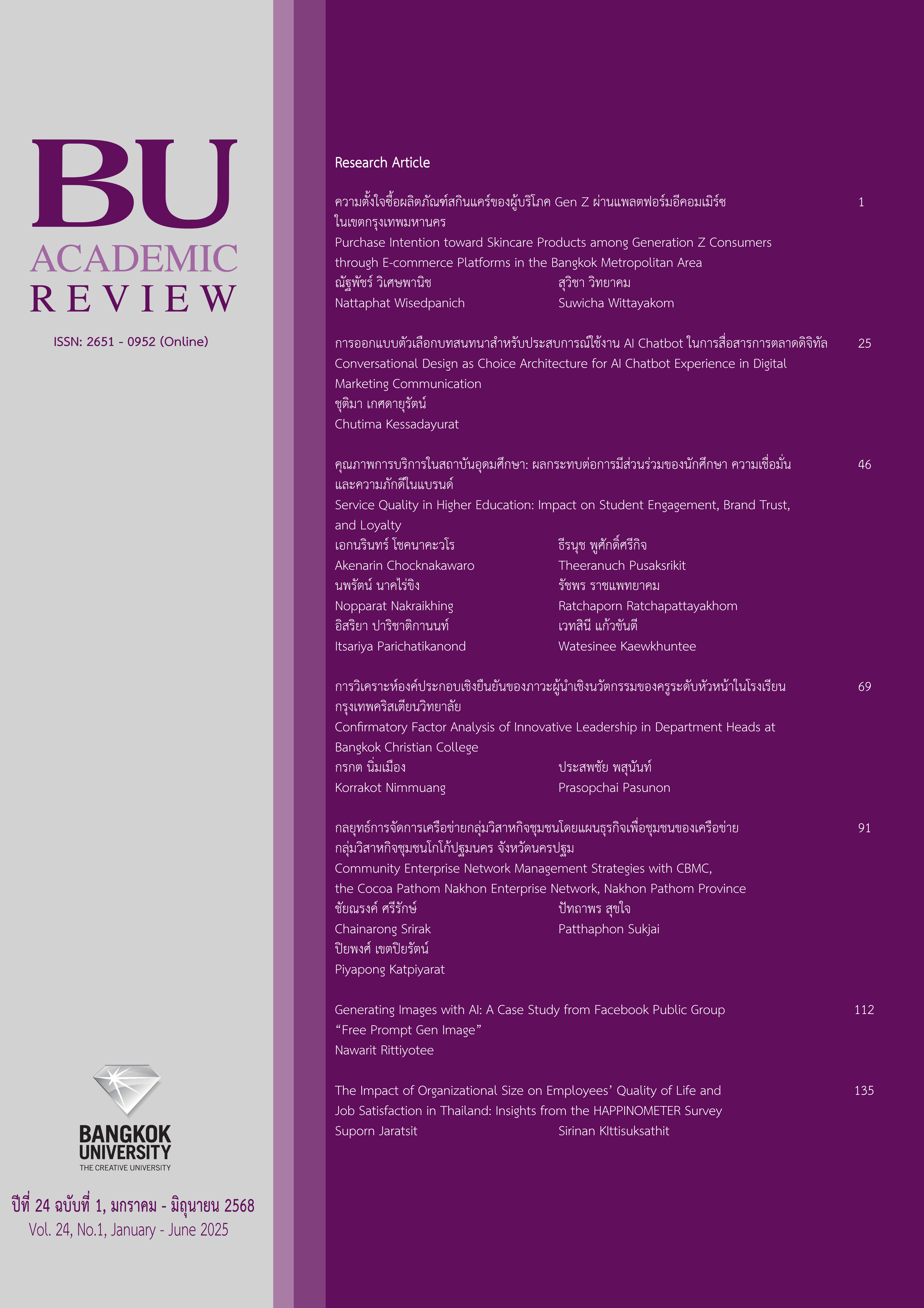
Generating Images with AI: A Case Study from Facebook Public Group “Free Prompt Gen Image”
Article Sidebar
Main Article Content
Abstract
This study investigates generating image with AI in early-stage period to artificial intelligence (AI) by examining user interactions and prompt structures on the Facebook Public Group "Free Prompt Gen Image". The research questions were what are the common patterns in prompt construction among users and what best practices can be developed for crafting prompts to optimize the outcomes of AI image generation. Drawing on a dataset of over 1,000 prompts, the research applicates Content Analysis approach and explores how specific elements—such as subject specificity, environmental context, and stylistic details—impact the quality and accuracy of AI-generated visuals. The findings found 7 distinct seven distinct groups: Animals, Food, Graphics, Humans, Imagination, Objects, and Views. Each category demonstrated unique structural patterns and user preferences in prompt composition. The research highlight the critical role of prompt design in optimizing outputs, as well as the challenges posed by technical complexity, language barriers, and ethical considerations.
The study also compares the use of web-based versus computer-based AI platforms, identifying a preference for accessible web-based tools despite their limitations in flexibility and customization. Ethical issues, including copyright concerns and data ownership, are also addressed. By emphasizing the need for improved user education and the development of intuitive interfaces, the research contributes to enhancing the usability and creativity of generative AI technologies. Future directions include refining prompt-crafting methodologies, advancing multimodal input systems, and fostering collaborative repositories of effective prompts.
Article Details

This work is licensed under a Creative Commons Attribution-NonCommercial-NoDerivatives 4.0 International License.
The manuscript submitted for publication must be the original version, submitted only to this particular journal with no prior acceptance for publication elsewhere in other academic journals. The manuscript must also not violate the copyright issue by means of plagiarism.
References
Creswell, J. W., & Poth, C. N. (2018). Qualitative inquiry and research design: Choosing among five
approaches (4th ed.). SAGE Publications.
Goodfellow, I., Pouget-Abadie, J., Mirza, M., Xu, B., Warde-Farley, D., Ozair, S., Courville, A., & Bengio, Y. (2014). Generative adversarial nets. In NIPS'14: Proceedings of the 28th International Conference on Neural Information Processing Systems (pp.2672-2680). Springer.
Ho, J., Jain, A., & Abbeel, P. (2020). Denoising diffusion probabilistic models. arXiv. https://arxiv.org/pdf/2006.11239
Krippendorff, K. (2018). Content analysis: An introduction to its methodology (4th ed.). Sage Publications.
McCormack, J., Llano, M., Krol, S., & Rajcic, N. (2024). No longer trending on artstation: Prompt analysis of generative AI art. EvoMUSART, 14633, 279-295. https://doi.org/10.1007/978-3-031-56992-0_18
Pise, M., Yadgiri, N., Gaikwad, P., Dusawar, Y., & Nandanwar, P. (2024). AI image generator. International Journal of Advanced Research in Science Communication and Technology (IJARSCT), 4(4), 768-773.
Sakirin, T., & Kusuma, S. (2023). A survey of generative artificial intelligence techniques. Babylonian
Journal of Artificial Intelligence, 2023, 10–14.
Srivastava, A. (2024). Advancements in text-to-image generation through generative AI. International
Journal of Scientific Research in Engineering and Management, 08(05), 1-5.
Yang, X., Zhang, J., & Liu, W. (2023). Prompt recommendations for AI art. Journal of Artificial Intelligence and Art, 15(3), 45-67.
Zhang, Y., & Liu, W. (2024). Boosting architectural generation via prompts: Report. Scispace. https://scispace.com/pdf/boosting-architectural-generation-via-prompts-report-2nzs41gf0r.pdf
Zhou, E., & Lee, D. (2024). Generative artificial intelligence, human creativity, and art. PNAS Nexus,
(3), 1-8.
