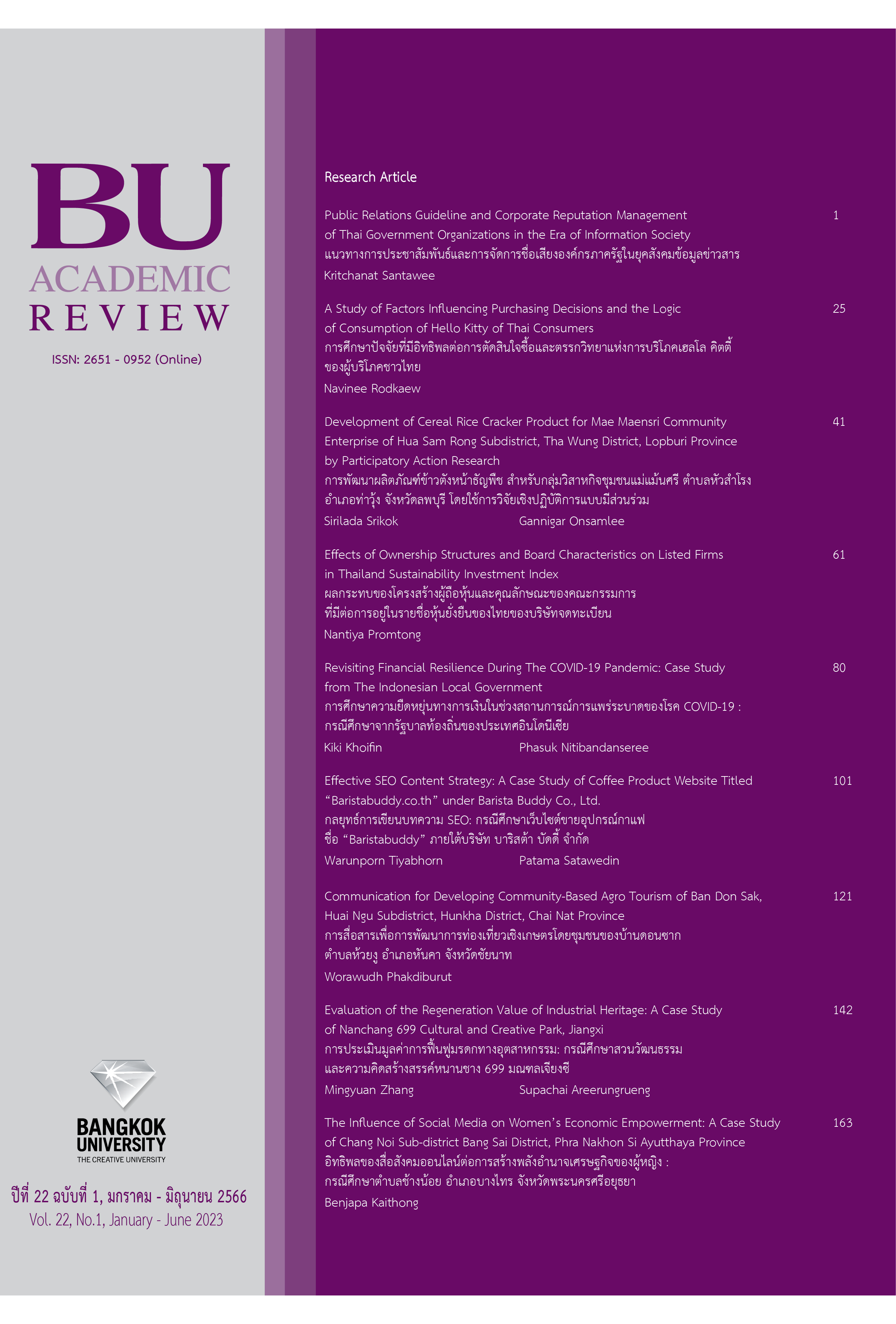
อิทธิพลของสื่อสังคมออนไลน์ต่อการสร้างพลังอำนาจเศรษฐกิจ ของผู้หญิง: กรณีศึกษาตำบลช้างน้อย อำเภอบางไทร จังหวัดพระนครศรีอยุธยา
Article Sidebar
Main Article Content
บทคัดย่อ
วัตถุประสงค์ของงานวิจัยชิ้นนี้คือ 1) เพื่อศึกษาพฤติกรรมการใช้สื่อสังคมออนไลน์และระดับอำนาจทางเศรษฐกิจของผู้หญิงในกลุ่มมิลเลนเนียล และ 2) เพื่อศึกษาอิทธิพลของพฤติกรรมการใช้สื่อสังคมออนไลน์ต่อระดับอำนาจตัดสินใจและมีส่วนร่วมทางเศรษฐกิจของผู้หญิงในกลุ่มมิลเลนเนียล ผู้วิจัยใช้การวิจัยเชิงปริมาณ เก็บข้อมูลด้วยแบบสอบถาม โดยผู้หญิงในกลุ่มมิลเลนเนียลที่มีอายุระหว่าง 22 - 40 ปี จำนวน 150 คน เป็นกลุ่มตัวอย่างวิเคราะห์ข้อมูลด้วยค่าเฉลี่ยและส่วนเบี่ยงเบนมาตรฐานเพื่อตอบวัตถุประสงค์ข้อที่ 1 และการวิเคราะห์การถดถอยพหุคูณเพื่อตอบวัตถุประสงค์ข้อที่ 2
ผลการวิจัยพบว่า ตัวแปรพฤติกรรมการใช้สื่อสังคมออนไลน์และตัวแปรอำนาจการตัดสินใจและมีส่วนร่วมทางเศรษฐกิจของผู้หญิงในกลุ่มมิลเลนเนียล โดยภาพรวมอยู่ในระดับปานกลาง (= 3.25 และ = 3.86) นอกจากนี้ ผลการวิเคราะห์ภาพรวมพบว่า ระดับการใช้เทคโนโลยีสารสนเทศและการสื่อสารมีอิทธิพลในเชิงลบต่อระดับอำนาจการตัดสินใจและมีส่วนร่วมทางเศรษฐกิจของผู้หญิงในกลุ่มมิลเลนเนียล ขณะที่ระดับการเปิดรับข้อมูลข่าวสารผ่านสื่อสังคมออนไลน์มีอิทธิพลเชิงบวกต่อระดับอำนาจตัดสินใจและมีส่วนร่วมทางเศรษฐกิจของผู้หญิงในกลุ่มมิลเลนเนียล กล่าวอีกนัยหนึ่ง เทคโนโลยีสารสนเทศและการสื่อสารเป็นเพียงช่องทางในการนำผู้รับสารให้เข้าถึงข้อมูลข่าวสาร หากแต่การเปิดรับข้อมูลข่าวสารที่เป็นประโยชน์นั้นเป็นตัวแปรที่สำคัญต่อการสร้างอำนาจตัดสินใจและมีส่วนร่วมทางด้านเศรษฐกิจของผู้หญิงในกลุ่มมิลเลนเนียล นอกจากนี้ผู้วิจัยได้พิจารณาพฤติกรรมการใช้สื่อสังคมออนไลน์ (รายด้าน) พบว่า ระดับการเปิดรับข้อมูลข่าวสารผ่านสื่อสังคมออนไลน์ ส่งผลเชิงบวกต่อระดับอำนาจตัดสินใจและมีส่วนร่วมด้านเศรษฐกิจภายในครัวเรือน การเข้าสู่ตลาดแรงงาน และการเข้าถึงแหล่งทุน รวมถึงระดับการใช้งานเพื่อวัตถุประสงค์ด้านการสื่อสารและหาความรู้ที่เป็นประโยชน์ส่งผลเชิงบวกต่อระดับอำนาจการตัดสินใจและมีส่วนร่วมเฉพาะด้านการเข้าสู่ตลาดแรงงาน
Article Details

อนุญาตภายใต้เงื่อนไข Creative Commons Attribution-NonCommercial-NoDerivatives 4.0 International License.
บทความที่นำมาสมัครลงตีพิมพ์ในวารสารต้องไม่เคยได้รับการตีพิมพ์เผยแพร่มาก่อน และไม่ส่งต้นฉบับบทความซ้ำซ้อนกับวารสารอื่น รวมทั้งผู้เขียนบทความต้องไม่ละเมิดหรือคัดลอกผลงานของผู้อื่น
เอกสารอ้างอิง
Burnett, R., & Marshall D. P. (2003). Web theory. London: Routlege.
Buvinic, M., O’Donnell, M., Knowlws, C. J., & Bourgault, S. (2020). Measuring women’s economic
empowerment: A compendium of selected tools. Washington, DC: Center for Global
Development.
Cummings, C., & O’Neil, T. (2015). Do digital information and communications technologies
increase the voice and influence of women and girls? A rapid review of the evidence.
London: Overseas Development Institute.
Datareportal. (2020). Digital 2021: Thailand. Retrieved August 6, 2020, from https://datareportal.com/reports/digital-2021-thailand.
Department of Women's Affairs and Family Development. (2021). Rāingān kāndamnœ̄n ngān kā
rō̜song sim khwāmsamœ̄phāk rawāng phēt khō̜ng nūaingān phāk rat pračham pī 2562 tām
yutthasāt kānphatthanā sattrī Phō̜.Sō̜. 2560-2564 [Report on the implementation of gender
equality promotion of Government agencies for the year 2019 according to the women's
development strategy 2017-2021]. Bangkok: Department of Women's Affairs and Family
Development. Ministry of Social Development and Human Security.
Etim, S. E. (2020). The utilization of social media platforms for viability of female-owned small and
medium-scale enterprises in Southeastern. AUDCE, 16(1), 99-111.
Finn, D., & Donovan, A. (2013). PwG’s nextgen: a global generational study. Retrieved August
, 2020, from https:// www.pwc.com/ gx/en/hr-management-services/pdf/pwc-nextgen-study-2013.pdf.
Golla, M. A., Malhotra, A., Nanda, P., & Mehra, R. (2011). Understanding and measuring women’s
economic empowerment: definition, framework and indicators. Washington, DC:
International Center for Research.
Gurumurthy, A., & Chami, N. (2014). Gender equality in the information society. London: DFID.
Hanpakdeeniyom, A. (2021). Rūpbǣp kān khapkhlư̄an botbāt sot rīt ʻakā raphat nā chumchon yāng
yangyư̄n nai satawat thī 21 [The model to drive women’s role toward the sustainability community development in the21st century]. Journal of Social Science and Buddhistic Anthropology, 6(4), 355-371.
Hair, J. F., Page, M., & Brunsveld, N. (2019). Essentials of business research methods (4th ed.). New
York: Routledge.
Hope, T. D., Peterman, A., & Anderson, L. (2020). Guide for measuring women’s empowerment and
economic outcomes in impact evaluation of women’s group. Washington, DC: Evidence Consortium on Women’s Groups (ECWG).
Hurley, Z. (2021). #Reimagining Arab women’s social media empowerment and the postdigital
condition. Social Media + Society, 7(2), 1-14. https://doi.org/10.1177/20563051211010169
Kaewthep, K., & Chaikhunpol, N. (2012). Khūmư̄ sư̄ mai sưksā [Guide to new media studies]. Bangkok:
Chulalongkorn University.
Kaithong, B., & Phongsiri, M., (2020). Similarities or differences: The exposure to media messages
among Thai-So women, Kusuman District, Sakon Nakhon Province, Thailand. Journal of
Community Development Research (Humanities and Social Sciences), 13(2), 55-69.
Kanchanawasi, S. (2001). Thritsadī kān thotlō̜ng bǣ bō̜dang dœ̄m [Classical test theory]. Bangkok:
Chulalongkorn University Printing House.
Kimball, G. (2019). Media empowers brave girls to be global activities. Journal of International
Women’s Studies, 20(7), 35-56.
Krejcie, R. V., & Morgan, D. W., (1970). Determining sample size for research activities. Educational and Psychological Measurement, 30, 607-610.
Office of the National Economics and Social Development Council. (2020). Thitthāng kānphatthanā
sētthakit læ sangkhom hǣng chāt chabap thī 12 (Phō̜.Sō̜. 2560-2564) [Direction of economic and social development national No. 12 (2017-2021)]. Retrieved January 27, 2022, from https://www.nesdc.go.th/main.php?filename=index.
Pantaratorn, P., & Phondon, K. (2021). Kānraprū khō̜ng nakthō̜ngthīeo Thai klum mi lō̜ lēn yon rư̄
klum čhen ʻēn nai prathēt Thai thī mī tō̜ nǣokhit kānthō̜ngthīeo yāng yang yư̄n [The perceptions of Thai millennial generation tourists on the concept of sustainable tourism]. Sripatum Review of Humanities and Social Sciences, 21(1), 89-104.
Phisanbutr, S. (2013). Kānwičhai thāngkān sưksā [Educational research]. Bangkok: Wittayapat.
Reeves, T. C., & Oh, E. J. (2007). Generation differences and educational technology research. In J.
M. Spector, M. D. Merrill, J. J. G. van Merrienboer, & M. Driscoll (Eds.), Handbook of
Research on Educational Communications and Technology (pp. 295-303). Mahwah, NJ:
Lawrence Erlbaum Associates.
Shockley, B., Lari., A. N., & El-Maghraby, A. A. E. (2020). Social media usage and support for women
in community leadership: Evidence from Qatar. Women’s Studies International, 81, 1-12.
Thipsrinimit, N. (2003). Phūying Thai kap botbāt phū nam nai sangkhom yuk mai [Thai women and
leadership roles in modern society]. Parichart Journal, 16(1), 78-83.
Weber, M. (1968). Economy and society: An outline of interpretative sociology. New York:
Bedminster Press.
