
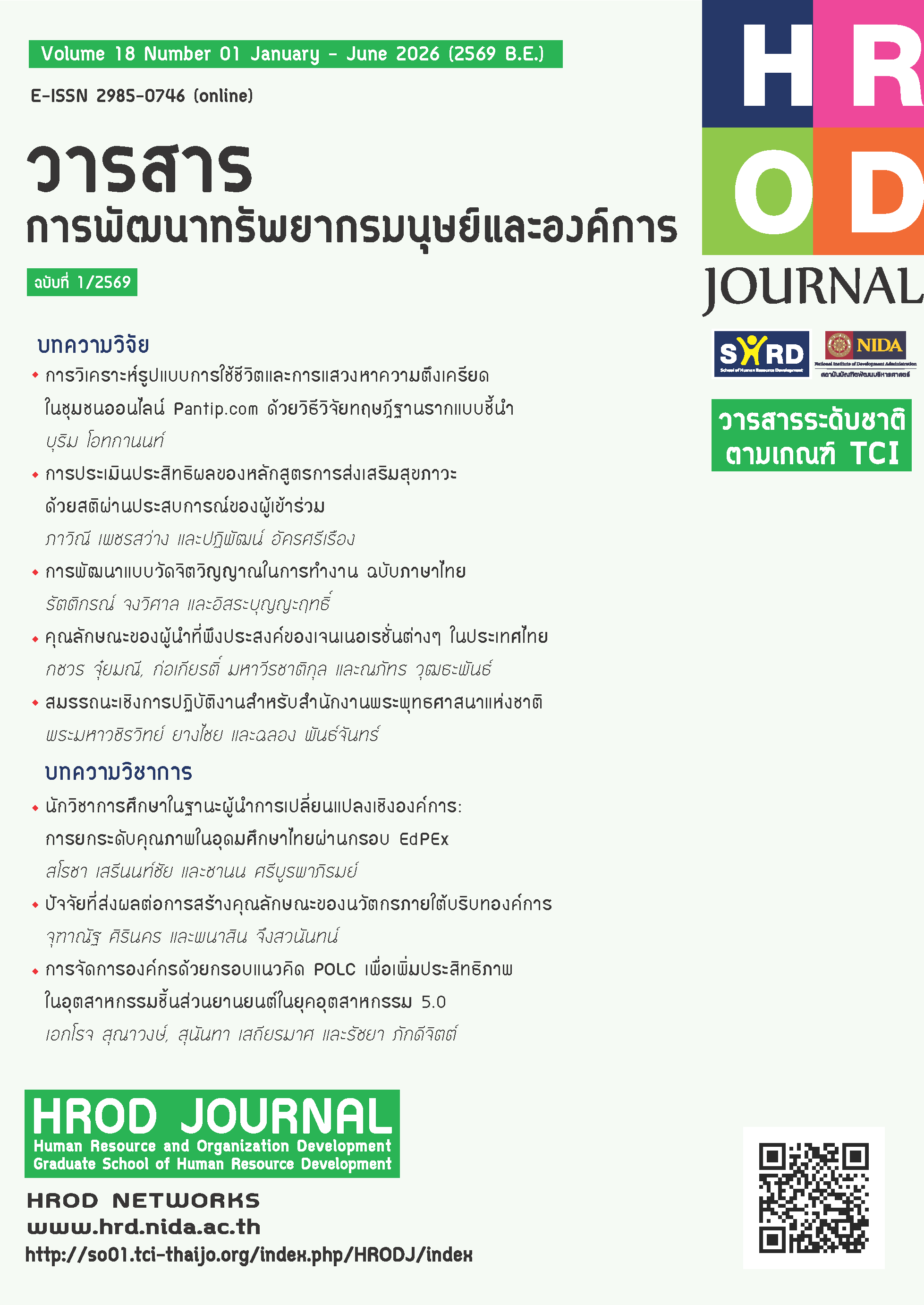
An Informed Grounded Theory Analysis of Lifestyle Patterns and the Pursuit of Tensions in the Pantip.com Online Community
Article Sidebar
Main Article Content
Abstract
This study examines the life patterns and tensions faced by urban workers in the Pantip.com online community, employing Informed Grounded Theory (IGT). This qualitative research method enables the development of new theories directly from data. A total of 425 threads related to financial, work, and relationship issues from 2019 to 2023 were analyzed. The findings reveal three main patterns of tension: the Cycle of Debt and Struggle, Occupational Burnout, and Fractures in Family Relationships. These tensions are not isolated but are intertwined and mutually reinforced in a complex manner. This study's central theoretical contribution is the core theory of "The Cycle of Vulnerability," which explains how individuals are trapped in a self-perpetuating loop of problems. The research also introduces the concept of “Seeking Tensions” to explain why users intentionally engage with stressful content online as a coping mechanism for their vulnerability. This contributes to a deeper understanding of well-being in digital-era Thailand. It also provides a theoretical foundation for designing holistic interventions and policies that address these interconnected issues.
Article Details

This work is licensed under a Creative Commons Attribution-NonCommercial-NoDerivatives 4.0 International License.
1) The content of article in HROD journal is the author’s wholly responsibility to research, analyze, summarize, compile, and reference data. The editorial department will not be responsible in anyway.
2) The submitted articles in HROD journal must be unpublished before and must not be currently under consideration for publication elsewhere. If it is detected for its repetition, the author must be responsible for infringement of copyright.
3) Authors will be asked to transfer copyright of the article to the Publisher. The article is prohibited to reproduce all or part of the text, unless allowed.
References
Aldiabat, K. M., & Le Navenec, C. L. (2018). Data saturation: The mysterious step in grounded theory methodology. The Qualitative Report, 23(1), 245–261. https://doi.org/10.46743/2160-3715/2018.2994
Association of Internet Researchers. (2012). Ethical decision-making and Internet research: Recommendations from the AoIR ethics working committee (Version 2.0). https://aoir.org/reports/ethics2.pdf
Baym, N. K. (2015). Personal connections in the digital age (2nd ed.). Polity Press.
Birks, M., & Mills, J. (2015). Grounded theory: A practical guide (2nd ed.). Sage Publications.
Blumer, H. (1954). What is wrong with social theory? American Sociological Review, 19(1), 3–10. https://doi.org/10.2307/2088165
Boeije, H. (2002). A purposeful approach to the constant comparative method in the analysis of qualitative interviews. Quality and Quantity, 36(4), 391–409. https://doi.org/10.1023/A:1020909529486
Bowen, G. A. (2006). Grounded theory and sensitizing concepts. International Journal of Qualitative Methods, 5(3), 12–23. https://doi.org/10.1177/160940690600500304
Bryant, A., & Charmaz, K. (Eds.). (2007). The SAGE handbook of grounded theory. Sage Publications. https://doi.org/10.4135/9781848607941
Bushman, B. J. (2002). Does venting anger feed or extinguish the flame? Catharsis, rumination, distraction, anger, and aggressive responding. Personality and Social Psychology Bulletin, 28(6), 724–731. https://doi.org/10.1177/0146167202289002
Cacioppo, J. T., & Patrick, W. (2008). Loneliness: Human nature and the need for social connection. W. W. Norton & Company.
Charmaz, K. (2006). Constructing grounded theory: A practical guide through qualitative analysis. Sage Publications.
Charmaz, K. (2014). Constructing grounded theory (2nd ed.). Sage Publications.
Cheong, H.-I., Lyons, A., Houghton, R., & Majumdar, A. (2023). Secondary qualitative research methodology using online data within the context of social sciences. Qualitative Research, 24(4), 1209–1228. https://doi.org/10.1177/14687941231180160
Chung, J. E. (2022). Users in crisis response and recovery: Catharsis and social learning among social media users during and after a natural disaster. Behaviour & Information Technology, 42(1), 27–42. https://doi.org/10.1080/0144929X.2021.2016968
Cohen, S., & Wills, T. A. (1985). Stress, social support, and the buffering hypothesis. Psychological Bulletin, 98(2), 310–357. https://doi.org/10.1037/0033-2909.98.2.310
Coleman, J. S. (1988). Social capital in the creation of human capital. American Journal of Sociology, 94(Suppl.), S95–S120. https://doi.org/10.1086/228943
Corbin, J., & Strauss, A. (2015). Basics of qualitative research: Techniques and procedures for developing grounded theory (4th ed.). Sage Publications.
De Choudhury, M., & De, S. (2014). Mental health discourse on Reddit: Self-disclosure, social support, and anonymity. Proceedings of the International AAAI Conference on Web and Social Media, 8(1), 71–80. https://ojs.aaai.org/index.php/ICWSM/article/view/14526
Fram, S. M. (2013). The constant comparative analysis method outside of grounded theory. The Qualitative Report, 18(1), 1–25. https://doi.org/10.46743/2160-3715/2013.1569
Gao, J., Zheng, P., Jia, Y., Chen, H., Mao, Y., Chen, S., Wang, Y., Fu, H., & Dai, J. (2020). Mental health problems and social media exposure during COVID-19 outbreak. PLOS ONE, 15(4), Article e0231924. https://doi.org/10.1371/journal.pone.0231924
Glaser, B. G. (1978). Theoretical sensitivity: Advances in the methodology of grounded theory. Sociology Press.
Glaser, B. G., & Strauss, A. L. (1967). The discovery of grounded theory: Strategies for qualitative research. Aldine Publishing Company.
Goffman, E. (1959). The presentation of self in everyday life. Doubleday.
Heaton, J. (2004). Reworking qualitative data. Sage Publications.
Heaton, J. (2008). Secondary analysis of qualitative data: An overview. Historical Social Research / Historische Sozialforschung, 33(3), 33–45. https://www.jstor.org/stable/20762299
Hinds, P. S., Vogel, R. J., & Clarke-Steffen, L. (1997). The possibilities and pitfalls of doing a secondary analysis of a qualitative data set. Qualitative Health Research, 7(3), 408–424. https://doi.org/10.1177/104973239700700306
Howe, J. (2006). The rise of crowdsourcing. Wired, 14(6), 1–4. https://www.wired.com/2006/06/crowds/
Kozinets, R. V. (2010). Netnography: Doing ethnographic research online. Sage Publications.
Lazarus, R. S., & Folkman, S. (1984). Stress, appraisal, and coping. Springer Publishing Company.
Li, S., Wang, Y., Xue, J., Zhao, N., & Zhu, T. (2020). The impact of COVID-19 epidemic declaration on psychological consequences: A study on active Weibo users. International Journal of Environmental Research and Public Health, 17(6), Article 2032. https://doi.org/10.3390/ijerph17062032
Lincoln, Y. S., & Guba, E. G. (1985). Naturalistic inquiry. Sage Publications.
Martin, R. C., Coyier, K. R., VanSistine, L. M., & Schroeder, K. L. (2013). Anger on the Internet: The perceived value of rant-sites. Cyberpsychology, Behavior, and Social Networking, 16(2), 119–122. https://doi.org/10.1089/cyber.2012.0130
Morini, V., Sansoni, M., Rossetti, G., Pedreschi, D., & Castillo, C. (2025). Participant behavior and community response in online mental health communities: Insights from Reddit. Computers in Human Behavior, 165, Article 108544. https://doi.org/10.1016/j.chb.2024.108544
Rotenstein, L. S., Torre, M., Ramos, M. A., Rosales, R. C., Guille, C., Sen, S., & Mata, D. A. (2018). Prevalence of burnout among physicians: A systematic review. JAMA, 320(11), 1131–1150. https://doi.org/10.1001/jama.2018.12777
Ruggiano, N., & Perry, T. E. (2019). Conducting secondary analysis of qualitative data: Should we, can we, and how? Qualitative Social Work, 18(1), 81–97. https://doi.org/10.1177/1473325017700701
Satici, S. A., Gocet Tekin, E., Deniz, M. E., & Satici, B. (2023). Doomscrolling scale: Its association with personality traits, psychological distress, social media use, and wellbeing. Applied Research in Quality of Life, 18, 833–847. https://doi.org/10.1007/s11482-022-10110-7
Sharma, A., Lee, S. Y., & Johnson, B. K. (2022). The dark at the end of the tunnel: Doomscrolling on social media newsfeeds. Technology, Mind, and Behavior, 3(1). https://doi.org/10.1037/tmb0000059
Strauss, A. L., & Corbin, J. (1990). Basics of qualitative research: Grounded theory procedures and techniques. Sage Publications.
Strauss, A. L., & Corbin, J. (1998). Basics of qualitative research: Techniques and procedures for developing grounded theory (2nd ed.). Sage Publications.
Suksomboon, P. (2018). Management of conflict between grandparents and their adult children in Thailand. Journal of Population and Social Studies, 26(4), 191–208. https://doi.org/10.25133/JPSSv26n4.013
Wannarit, K., Ratta-Apha, W., Pariwatcharakul, P., & Pukrittayakamee, P. (2023). Burnout study during the COVID-19 pandemic in Thailand: Psychometric evaluation of the Maslach Burnout Inventory–Human Services Survey for medical personnel. Health Psychology and Behavioral Medicine, 11(1), Article 2268694. https://doi.org/10.1080/21642850.2023.2268694
Ruengorn, C., Awiphan, R., Wongpakaran, N., Wongpakaran, T., & Nochaiwong, S. (2021). Association of job loss, income loss, and financial burden with adverse mental health outcomes during coronavirus disease 2019 pandemic in Thailand: A nationwide cross-sectional study. Depression and Anxiety, 38, 648–660. https://doi.org/10.1002/da.23155
Kerley, K. R., Xu, X., Sirisunyaluck, B., & Alley, J. M. (2010). Exposure to family violence in childhood and intimate partner perpetration or victimization in adulthood: Exploring intergenerational transmission in urban Thailand. Journal of Family Violence, 25(4), 337–347. https://doi.org/10.1007/s10896-009-9295-7
Thornberg, R. (2012). Informed grounded theory. Scandinavian Journal of Educational Research, 56(3), 243–259. https://doi.org/10.1080/00313831.2011.581686
Thornberg, R., & Charmaz, K. (2014). Grounded theory and theoretical coding. In U. Flick (Ed.), The SAGE handbook of qualitative data analysis (pp. 153–169). Sage Publications. https://doi.org/10.4135/9781446282243.n11
Wellman, B., & Gulia, M. (1999). Virtual communities as communities: Net surfers don’t ride alone. In M. A. Smith & P. Kollock (Eds.), Communities in cyberspace (pp. 167–194). Routledge.
Wills, T. A. (1981). Downward comparison principles in social psychology. Psychological Bulletin, 90(2), 245–271. https://doi.org/10.1037/0033-2909.90.2.245
World Health Organization. (2019, May 28). Burn-out an “occupational phenomenon”: International classification of diseases. https://www.who.int/news/item/28-05-2019-burn-out-an-occupational-phenomenon-international-classification-of-diseases
Ytre-Arne, B., & Moe, H. (2021). Doomscrolling, monitoring and avoiding: News use in COVID-19 pandemic lockdown. Journalism Studies, 22(13), 1739–1755. https://doi.org/10.1080/1461670X.2021.1952475
