
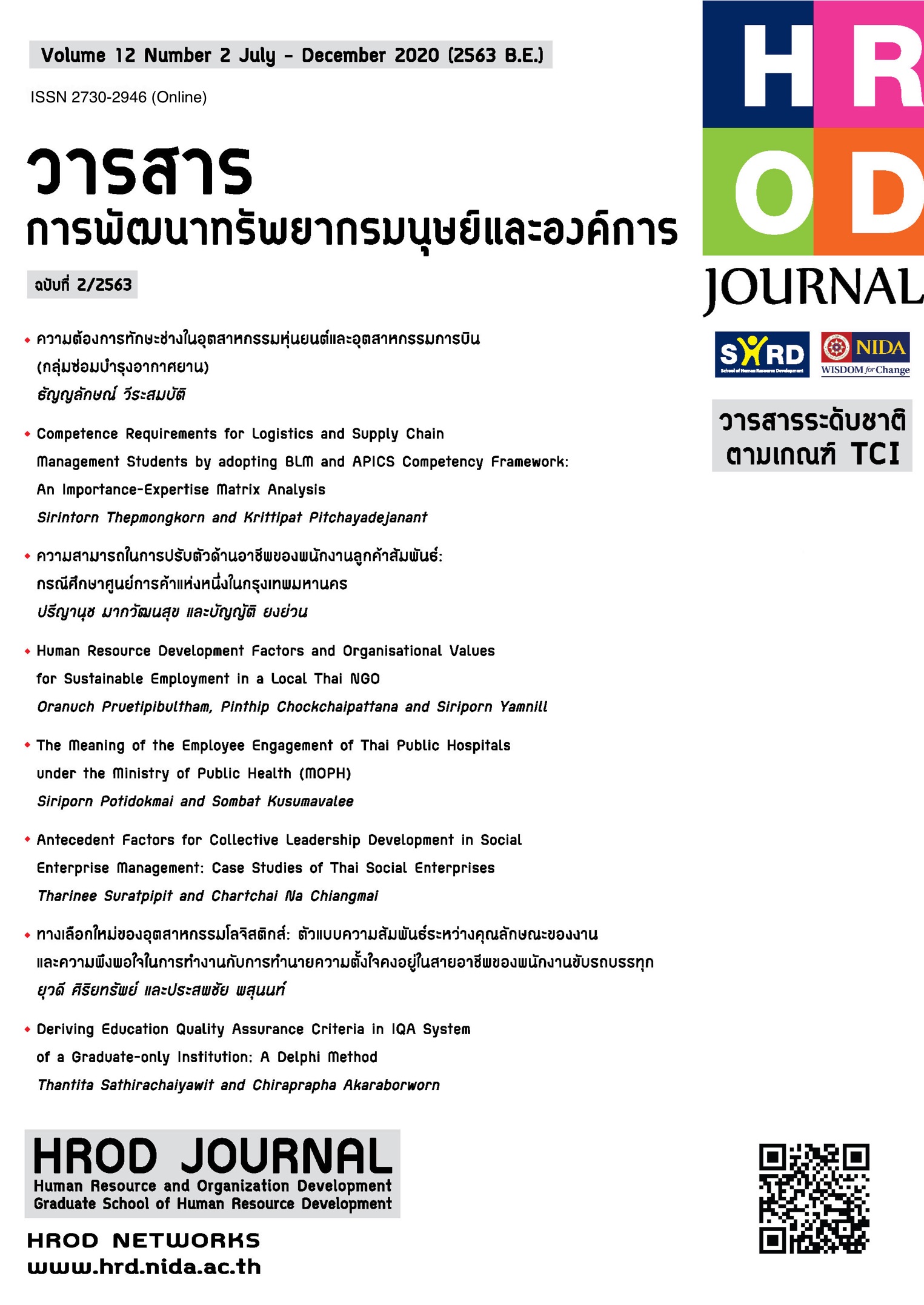
การได้มาซึ่งเกณฑ์คุณภาพการศึกษาในระบบประกันคุณภาพการศึกษาภายใน ของสถาบันการศึกษาระดับบัณฑิตศึกษา: วิธีการวิจัยแบบเดลฟาย (Delphi)
Article Sidebar
Main Article Content
บทคัดย่อ
ระบบประกันคุณภาพการศึกษาภายในฉบับล่าสุดที่พัฒนาโดยสำนักงานคณะกรรมการการอุดมศึกษา (สกอ.) เปิดโอกาสให้สถาบันการศึกษาเลือกหรือพัฒนาระบบประกันคุณภาพการศึกษาภายในของตนเองได้ เพื่อให้การจัดการการศึกษาเกิดประสิทธิผลและประสิทธิภาพอย่างต่อเนื่อง ดังนั้นสถาบันการศึกษาที่ต้องการออกแบบระบบประกันคุณภาพการศึกษาภายในของตนเองจึงต้องมีการศึกษาหลักเกณฑ์ต่างๆ อย่างระมัดระวัง เนื่องจากสิ่งนี้เป็นเครื่องมือหนึ่งที่ใช้พัฒนาองค์การให้บรรลุเป้าหมายที่ตั้งไว้ได้ การศึกษานี้มีวัตถุประสงค์เพื่อนำเสนอวิธีการในการได้มาซึ่งเกณฑ์ประกันคุณภาพการศึกษาภายใน สำหรับสถานศึกษาระดับบัณฑิตศึกษา ผู้ศึกษาเลือกสถาบันบัณฑิตพัฒนบริหารศาสตร์ (นิด้า) เป็นกรณีศึกษา วิธีการที่ผู้วิจัยนำเสนอ คือ วิธีการวิจัยแบบเดลฟาย แบบสอบถามสำหรับกระบวนการเดลฟายพัฒนาขึ้นจากการทบทวนกรอบประกันคุณภาพต่างๆ ทั้งในระดับชาติและนานาชาติ รวมทั้งใช้ข้อมูลจากการสนทนากลุ่ม และการสัมภาษณ์ ผู้เชี่ยวชาญจำนวน 35 คน ถูกคัดเลือกอย่างเจาะจงจากบุคคลที่รับผิดชอบงานประกันคุณภาพการศึกษาภายใน ค่าฐานนิยม มัธยฐาน และพิสัยควอไทล์ ถูกใช้ในการวิเคราะห์ข้อมูล ผลการศึกษาพบว่ามี 7 รายการที่ได้รับฉันทามติอย่างสมบูรณ์ 4 รายการ ถูกจัดในกลุ่มบริหารจัดการ ภายใต้หัวข้อการบริหารทรัพยากรมนุษย์ และระบบการทำงาน กลุ่มการเรียนการสอน 2 รายการ ภายใต้หัวข้อหลักสูตร และการพัฒนาและสนับสนุนการเรียนของผู้เรียน และกลุ่มบริการวิชาการ 1 รายการ จากการดำเนินการเดลฟายข้อสังเกตจากการวิจัยในครั้งนี้พบว่า กรอบประกันคุณภาพสำหรับการสร้างแบบสอบถาม และคุณสมบัติของผู้เชี่ยวชาญมีความสำคัญ
Article Details
1) เนื้อหาทั้งหมดของบทความที่ลงตีพิมพ์ในวารสารการพัฒนาทรัพยากรมนุษย์และองค์การ เจ้าของผลงานมีการคิด ค้นคว้า ทบทวนวิเคราะห์ สรุป เรียบเรียงและอ้างอิงข้อมูลโดยผู้แต่งเอง กองบรรณาธิการไม่มีส่วนร่วมรับผิดชอบ
2) บทความที่ตีพิมพ์ในวารสารนี้ ต้องไม่เคยได้รับการตีพิมพ์เผยแพร่ที่ใดมาก่อน และไม่อยู่ระหว่างการเสนอเพื่อพิจารณาตีพิมพ์ในวารสารฉบับอื่น หากตรวจพบว่า มีการตีพิมพ์ซ้ำซ้อน ถือเป็นความรับผิดชอบของผู้แต่งแต่เพียงผู้เดียวในการละเมิดลิขสิทธิ์
3) ผลงานที่ได้รับการตีพิมพ์ในวารสารวิชาการ ถือเป็นกรรมสิทธิ์ของวารสารห้ามนำข้อความทั้งหมดหรือบางส่วนไปพิมพ์ซ้ำ เว้นเสียแต่ว่าจะได้รับอนุญาตจากทางกองบรรณาธิการวารสารฯ
เอกสารอ้างอิง
References
ASEAN University Network Quality-Assurance. (2007). Manual for the implementation of the Guidelines. Retrieved on December 15, 2018, from http://www.aunsec.org/pdf/aunwebsite/02_AUNQAImplementationManual.pdf
Avella, J. (2016). Delphi panels: Research design, procedures, advantages, and challenges. International Journal of Doctoral Studies, 11(1), 305-321.
Ansah, F. (2015). A strategic quality assurance framework in an African higher education context. Quality in Higher Education, 21(2), 132-150.
Christie, C. A., & Barela, E. (2005). The Delphi technique as a method for increasing inclusion in the evaluation process. The Canadian Journal of Program Evaluation, 20(1), 105-122.
Green, D. (1994). What is quality in higher education? Concept, practice and policies. In D. Green (Ed.), What is quality in higher education? Bristol, PA: Taylor & Francis.
Hasson, F., Keeney, S., & McKenna, H. P. (2000). Research guidelines for the Delphi Survey Technique. Journal of Advanced Nursing, 32(4), 1008-1015.
Henning, J., & Jordan, H. (2016). Determinants of financial sustainability for farm credit applications; A delphi study. Sustainability, 8(1), 77-82.
Hsu, C. C., & Sandford, B. A. (2007). The Delphi technique: Making sense of consensus. Practical Assessment, Research & Evaluation, 12(10), 1-8.
Kittell-Limerick, P. (2005). Perceived barriers to completion of the academic doctorate: A Delphi study. Texas A&M University-Commerce.
Loo, R. (2002). The Delphi Method: A powerful tool for strategic management, policing. An International Journal of Police Strategies & Management, 25(4), 762 – 769.
National Education Act B.E. 2562 (2019). (2019, May 1). Rachkiccanubeksa 136 (section 57), 44-53.
Office of the Higher Education Commission OHEC). (2011). The collection of the Ministerial Regulations, Ministry of Education Announcements, Announcements, and the Resolution of the Commission on Higher Education. Bangkok: Office of the Higher Education Commission.
Office of the Higher Education Commission (OHEC). (2017). Manual for the internal Quality Assurance for Higher Education Institutions 2014: Office of the Higher Education Commission (OHEC). Bangkok: Office of the Higher Education Commission, Ministry of Education.
Office of the Higher Education Commission (OHEC). (n.d). CHE QA Online System
Version III. Retrieved on December 15, 2018, from http://www.cheqa.mua.go.th/che2556/Default2.aspx
Office of the National Education Commission. (2003). National Education Act B.E. 2542 (1999) and Amendments (Second National Education Act B.E. 2545 (2002). Bangkok: Pimdeekarnpim.
Okoli, C, & Pawlowski, S. D. (2004). The Delphi method as a research tool: An example, design considerations and applications. Information & Management, 42, 15-29.
Parkart, J. (2011). Factors that impacted the cooperation of internal quality assurance: Adopted National Institute of Development Administration – Academic year 2010 as a case study. Bangkok: National Institute of Development Administration (In Thai).
Powell, C. (2003). The Delphi technique: myths and realities. Journal of Advanced Nursing 41(4), 376–382.
Sandmaung & Khang. (2013). Quality expectations in Thai higher education institutions: Multiple stakeholder perspectives. Quality Assurance in Education, 21(3), 260-281.
Skulmoski, G., Hartman, F., & Krahn, J. (2007). The Delphi method for graduate research. Journal of Information Technology Education, 6(1), 1-21.
Supadit, T. (2014). The Development of Guideline in order to Increase the Achievement of NIDA IQA. Bangkok: National Institute of Development Administration (In Thai).
Vernon, W. (2009). A Delphi technique: A review. International Journal of Therapy and Rehabilitation, 16(2), 69-76.
