
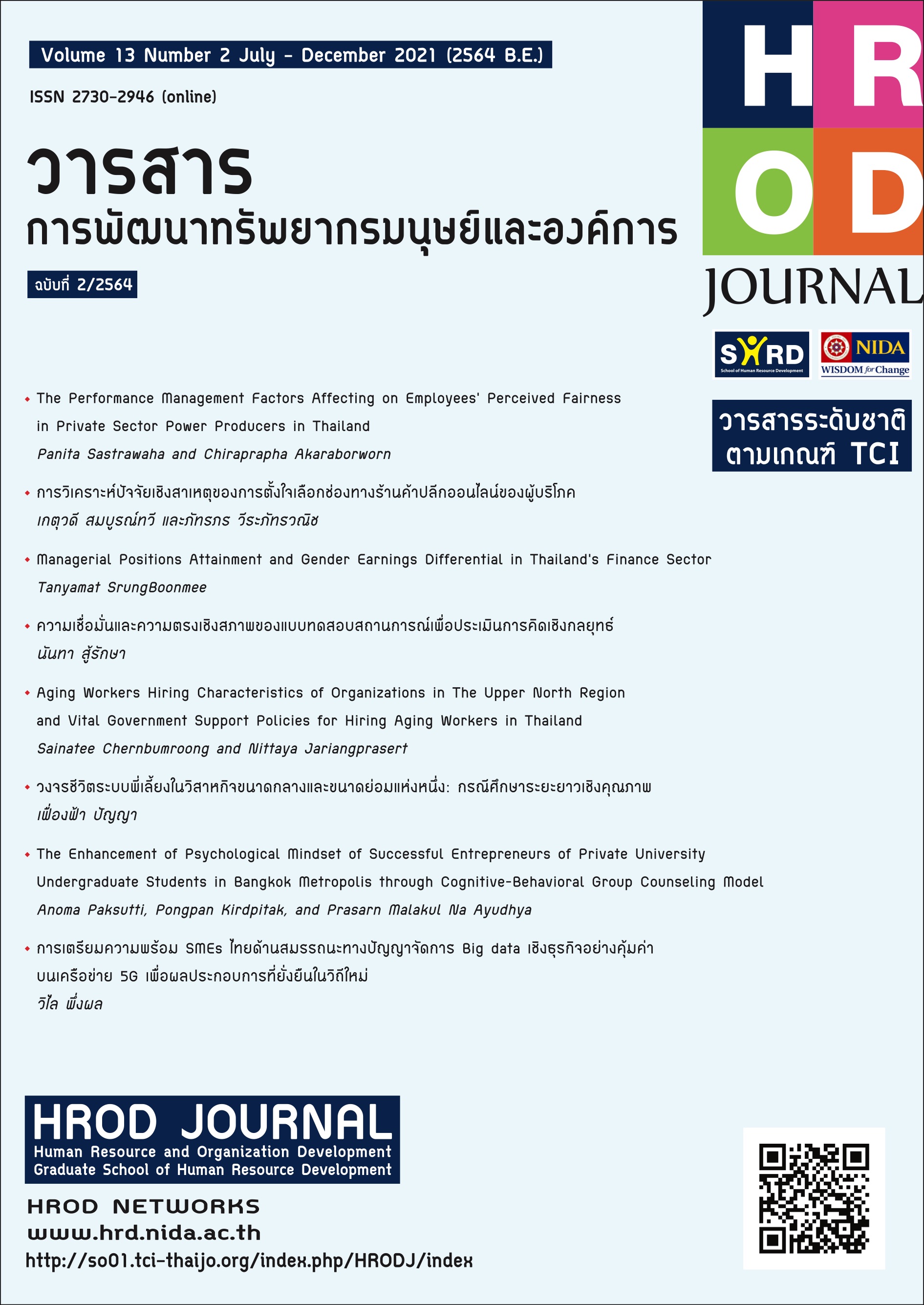
การเสริมสร้างกรอบคิดทางจิตวิทยาการเป็นผู้ประกอบการ ที่ประสบความสำเร็จของนักศึกษาระดับปริญญาตรี มหาวิทยาลัยเอกชน เขตกรุงเทพมหานครโดยรูปแบบการให้การปรึกษากลุ่มการรู้คิด-พฤติกรรม
Article Sidebar
Main Article Content
บทคัดย่อ
การวิจัยครั้งนี้มีวัตถุประสงค์เพื่อ 1) ศึกษากรอบคิดทางจิตวิทยาการเป็นผู้ประกอบการที่ ประสบความสำเร็จของนักศึกษาระดับปริญญาตรีชั้นปีที่ 3 ของมหาวิทยาลัยเอกชนแห่งหนึ่งในเขต กรุงเทพมหานคร 2) เพื่อพัฒนารูปแบบการให้การปรึกษากลุ่มการรู้คิด – พฤติกรรมเพื่อเสริมสร้าง กรอบคิดทางจิตวิทยาการเป็นผู้ประกอบการที่ประสบความสำเร็จ ของนักศึกษาที่เข้าร่วมการทดลอง 3) เพื่อประเมินประสิทธิภาพและ 4) ความพึงพอใจต่อรูปแบบการให้การปรึกษากลุ่มการรู้คิด-พฤติกรรมเพื่อเสริมสร้างกรอบคิดทางจิตวิทยาการเป็นผู้ประกอบการที่ประสบความสำเร็จ โดยกลุ่ม ตัวอย่างที่ใช้ในการศึกษากรอบคิดทางจิตวิทยาการเป็นผู้ประกอบการที่ประสบความสำเร็จประกอบด้วยนักศึกษาจำนวน 345 คน และกลุ่มตัวอย่างที่ใช้ในการทดลองได้มาจากการสุ่มตัวอย่าง ง่ายจำนวน 24 คน แบ่งเป็นกลุ่มทดลองและกลุ่มควบคุม กลุ่มละ 12 คน ผลการวิจัย พบว่ากรอบคิดทางจิตวิทยาการเป็นผู้ประกอบการที่ประสบความสำเร็จของนักศึกษาจำนวน 345 คน อยู่ในระดับปานกลาง ส่วนรูปแบบการให้การปรึกษากลุ่มการรู้คิด-พฤติกรรมที่พัฒนาขึ้นสำหรับการศึกษาครั้งนี้ มีผลในเชิงบวกโดยกรอบคิดทางจิตวิทยาการเป็นผู้ประกอบการที่ประสบความสำเร็จของกลุ่มทดลองในแต่ละด้าน ได้แก่ การมีวิสัยทัศน์และการกำหนดเป้าหมาย การมุ่งความสำเร็จ การเชื่อมั่นในความสามารถของตน การใฝ่รู้ การสร้างสรรค์และนวัตกรรม การเผชิญความเสี่ยง การสร้างเครือข่ายกับองค์กรภายนอก เพิ่มขึ้นอย่างมีนัยสำคัญทางสถิติที่ ระดับ. 01
Article Details

อนุญาตภายใต้เงื่อนไข Creative Commons Attribution-NonCommercial-NoDerivatives 4.0 International License.
1) เนื้อหาทั้งหมดของบทความที่ลงตีพิมพ์ในวารสารการพัฒนาทรัพยากรมนุษย์และองค์การ เจ้าของผลงานมีการคิด ค้นคว้า ทบทวนวิเคราะห์ สรุป เรียบเรียงและอ้างอิงข้อมูลโดยผู้แต่งเอง กองบรรณาธิการไม่มีส่วนร่วมรับผิดชอบ
2) บทความที่ตีพิมพ์ในวารสารนี้ ต้องไม่เคยได้รับการตีพิมพ์เผยแพร่ที่ใดมาก่อน และไม่อยู่ระหว่างการเสนอเพื่อพิจารณาตีพิมพ์ในวารสารฉบับอื่น หากตรวจพบว่า มีการตีพิมพ์ซ้ำซ้อน ถือเป็นความรับผิดชอบของผู้แต่งแต่เพียงผู้เดียวในการละเมิดลิขสิทธิ์
3) ผลงานที่ได้รับการตีพิมพ์ในวารสารวิชาการ ถือเป็นกรรมสิทธิ์ของวารสารห้ามนำข้อความทั้งหมดหรือบางส่วนไปพิมพ์ซ้ำ เว้นเสียแต่ว่าจะได้รับอนุญาตจากทางกองบรรณาธิการวารสารฯ
เอกสารอ้างอิง
Audretsch, D. B., Kuratko, D. F., & Link, A. N. (2016). Dynamic entrepreneurship and technology-based innovation. Journal Evolution Economic, 26, 603–620. https://doi.org/10.1007/s00191-016-0458-4
Ayala, J., & Manzano, G. (2011). Established business owners' success: Influencing factors. Journal of Developmental Entrepreneurship (JDE). 15, 263-286. https://doi.org/10.1142/S1084946710001555
Beck, J. S. (2011). Cognitive behavior therapy: Basics and beyond (2nd ed.). Guilford Press.
Blonk, R. W. B., Brenninkmeijer, V., Lagerveld, S. E., & Houtman, I. L. D. (2006). Return to work: A comparison of two cognitive behavioral interventions in cases of work-related psychological complaints among the self-employed. Work & Stress, 20(2), 129–144. https://doi.org/10.1080/02678370600856615
Borchers, A. S., & Park, S. H. (2010). Understanding entrepreneurial mindset: A study of entrepreneurial self-Efficacy, locus of control, and intent to start a business. The Journal of Engineering Entrepreneurship, 1(1), 51-62.
Brenner, O. C., Pringle, C. D., & Greenhaus, J. H. (1991). Perceived fulfillment of organizational employment versus entrepreneurship: Work values and career intentions of business college graduates. Journal of Small Business Management, 29(3), 62–74.
Busenitz, L., Shepherd, D., Nelson, T., Zacharakis, A., & Chandler, G. (2003). Entrepreneurship in emergence: Past trends and future directions. Journal of Management, 29(3), 285–308.
Campo, J. L. M. (2010). The propensity for entrepreneurship: psychological and social factors. Cuadernos Latinoamericanos de Administración, 6(10), 51-76.
Chinonye, L. M., & Akinlabi, M. (2014). Entrepreneurship curriculum and pedagogical challenges in captivating students' interest towards entrepreneurship education. Research Journal of Economics and Business Studies, 4(1), 1-11.
Cooper, N., Estes, C. A., & Allen, L. (2004). Bouncing back: How to develop resiliency through outcome-based recreation programs. Parks & Recreation, 39(4), 28-35.
Creswell, J. W. (2012). Qualitative inquiry & research design: Choosing among five approaches (4th ed.). Sage.
Davis, M., Hall, J., & Mayer, P. (2015). Developing a new measure of entrepreneurial mindset: Reliability, validity, and implications for practitioners. Consulting Psychology Journal: Practice and Research, 68. http://dx.doi.org/10.1037/cpb0000045
Déry, R. & Toulouse, J. M. (2009). Social structuration of the field of entrepreneurship: A case study. Canadian Journal of Administrative Sciences, 13(4), 285-305. https://doi.org/10.1111/j.1936-4490.1996.tb00739.x
Ekman, S. & Ekman, A. (2009). Designing an Entrepreneurial Mindset in Engineering and Management. D.S. 58-9: Proceedings of ICED 09, the 17th International Conference on Engineering Design, Vol. 9, Human Behavior in Design, 9-179. Standford University CA, USA.
Fayolle, A. (2012). Handbook of Research on Social Entrepreneurship. Edward Elgar Pub.
Fleming, P. (1994). The role of structured interventions in shaping graduate Entrepreneurship. IBAR. Journal of Irish Business and Administrative Research, 15, 146-157.
Freeman, M. A. (2015). Are Entrepreneurs "Touched with Fire"? Pre-publication manuscript. Contents. https://www.michaelafreemanmd.com/Research_files
Frese, M. (2009). Towards a psychology of entrepreneurship - An action theory perspective. Foundation and Trends in Entrepreneurship, 5(6). 437-496.
Frunzaru, V., & Cismaru, D. (2018). The impact of individual entrepreneurial orientation and education on generation Z's intention towards entrepreneurship. Kybernetes, 50(7), 1969-1981. https://doi.org/10.1108/K-05-2018-0272
Gelderen, M., & Jansen, P. (2006). Autonomy as a start-up motive. Journal of Small Business and Enterprise Development, 13(1), 23-32. http://dx.doi.org/ 10.1108/14626000610645289
Haynie, J. M., Shepherd, D., Mosakowski, E., & Earley, P. C. (2010). A situated metacognitive model of the entrepreneurial mindset. Journal of Business Venturing, 25(2), 217-229.
Haynie, J. M., & Shepherd, D. A. (2007). Exploring the entrepreneurial mindset: Feedback and adaptive decision-making. Frontiers of Entrepreneurship Research, 27(6), 1-15.
Hindle, K., & Moroz, P. (2010). Indigenous entrepreneurship as a research field: Developing a definitional framework from the emerging canon. International Entrepreneurship and Management Journal, 6(4), 357–385. https://doi.org/10.1007/s11365-009-0111-x
Hofer, A., & Delaney, A. (2010). Shooting for the moon: Good practices in local youth entrepreneurship support. OECD Local Economic and Employment Development (LEED) Working Papers. https://doi.org/10.1787/5km7rq0k8h9q-en
Holienka, M. (2014). Youth entrepreneurship in Slovakia: a GEM based perspective. Comenius Management Review, 8(2), 41-50.
Ireland, D., Hitt, M., Sirmon, D. (2003). A model of strategic entrepreneurship: The construct and its dimensions. Journal of Management, 29(6), 963-989. https://doi.org/10.1016/S0149-2063_03_00086-2
Johnson, A., & Delmar, F. (2009). The psychology of entrepreneurs: A self-regulation perspective. Historical Foundations of Entrepreneurship Research. https://dx.doi.org/10.2139/ssrn.1752103
Johnson-Laird, P. N. (2006). How we reason. Oxford University Press.
Jones, P., Pickernell, D., Fisher, R., & Netana, C. (2017). A tale of two universities: Graduates perceived value of entrepreneurship education. Education Training, 59(7/8), 689-705. https://doi.org/10.1108/ET-06-2017-0079
Kerr, S., Kerr, W., & Xu, T. (2018). Personality Traits of entrepreneurs: A review of recent literature. Foundations and Trends® in Entrepreneurship. 14(3), 279-356. http://dx.doi.org/10.1561/0300000080
Kew, J., Herrington, M., Litovsky, Y., & Gale, S. (2013). Generation entrepreneur? The state of global youth entrepreneurship. https://www.youthbusiness.org/wp-content/uploads/2013/09/GenerationEntrepreneur.pdf
Kolvereid, L., & Moen, Øystein. (1997). Entrepreneurship among business graduates: Does a major in entrepreneurship make a difference. Journal of European Industrial Training, 21, 154-160. http://dx.doi.org/10.1108/03090599710171404
Kouakou, K. K. E., & Li, C., Akolgo, I., & Tchamekwen, A. (2019). Evolution view of entrepreneurial mindset theory. International Journal of Business and Social Science, 10(6), 116-129. http://dx.doi.org/10.30845/ijbss.v10n6p13
Krueger, N. F. (2015). Entrepreneurial education in practice: Part1, the entrepreneurial mindset. Retrieved from www.oecd.org/cfe/leed/Entrepreneurial-Education-Practice-pt
Leon, R. D. (2017). University-a knowledge incubator for developing entrepreneurial skills. In A. Zbuchea (Ed.), Entrepreneurs. entrepreneurship: Challenges and opportunities for the 21st century (pp. 135-147). Tritonic.
London, M. (1993). Relationship between career motivation, empowerment and support for career development. Journal of Occupational & Organizational Psychology, 66(1), 55-69.
Low, M. & MacMillan, I. (1988). Entrepreneurship: Past Research and Future Challenges. Journal of Management. Journal of Management, 14(2), 139-161. http://dx.doi.org/10.1177/014920638801400202.
McGrath, R. G., & MacMillan, I. C. (2000). The entrepreneurial mindset: Strategies for continuously creating opportunity in an age of uncertainty. Harvard Business School Press.
Mills, G. E., & Gay, L. R. (2016) Education research: Competencies for analysis and applications. Pearson Education.
Mitchell, R. K., Busenitz, L. W., Bird, B., Marie G. C., McMullen, J. S., Morse, E. A., & Smith, J. B. (2007). The central question in entrepreneurial cognition research 2007. Entrepreneurship Theory and Practice, 31(1), 1–27. https://doi.org/10.1111/j.1540-6520.2007.00161.x
National Innovation Agency. (2020). Youth entrepreneur. Retrieved from https://www.nia.or.th/Teenpreneurs.
Passaro, R., Quinto, I., & Thomas, A. (2018). The impact of higher education on entrepreneurial intention and human capital. Journal of Intellectual Capital, 19(1), 135-156. https://doi.org/10.1108/JIC-04-2017-0056
Pizarro, N. (2014). An institutional and pedagogical model that fosters entrepreneurial mindset among college students. Journal Entrepreneurship Education, 17, 143–162.
Prochaska, M. (2014). Statistically speaking: Evaluation of the becoming a man (B.A.M.) program in Chicago. Children's Legal Rights Journal, 34(3). https://lawecommons.luc.edu/clrj/vol34/iss3/11
Putta, S. S. (2014). Entrepreneurial mindset crisis in Enterprises. Journal of Commerce and Management Thought, 5(1), 70-75. https://doi.org/10.5958/j.0976-478X.5.1.006
Reed, J., & Stoltz, P. G. (2011). Put your mindset to work. Penguin.
Saraf, P., Rahman, T., & Jamison, J. (2019). Group based cognitive behavioral therapy (CBT) training improves mental health of SME entrepreneurs: Experimental evidence from conflict-affected areas of Pakistan (English). Policy Research Working Paper, 8872. World Bank Group.
Schildt, H., & Sillanpää, A. (2004). The field of entrepreneurship: A bibliometric assessment. Working Paper, 2004/1. https://www.researchgate.net/publication/228792613_The_Field_of_Entrepreneurship_A_Bibliometric_Assessment
Schindehutte, M., Morris, M., & Allen, J. (2006). Beyond achievement: Entrepreneurship as extreme experience. Small Business Economic, 27, 349–368. https://doi.org/10.1007/s11187-005-0643-6
Shane, S., & Venkataraman, S. (2000). The promise of entrepreneurship as a field of research.
Academy of Management ReviewVol. 25(1), 217–226. https://doi.org/10.5465/amr.2000.2791611
Valerio, A., Parton, B., & Robb, A. (2014). Entrepreneurship education and training programs around the world: Dimensions for success. World Bank. https://doi.org/10.1596/978-1-4648-0202-7
Welter, F., & Lasch, F. (2008). Entrepreneurship research in Europe: Taking stock and looking forward. Entrepreneurship Theory and Practice, 32, 241–8.
Windle, G., Bennett, K., & Noyes, J. (2011). A methodological review of resilience measurement scales. Health and Quality of Life Outcomes, 9(8). https://doi.org/10.1186/1477-7525-9-8
World Economic Forum. (2019). In Indonesia, over a third of young people want to be entrepreneurs. Retrieved from https://www.weforum.org/agenda/2019 /08/indonesia-young-people-entrepreneur/
Zellweger, T., Sieger, P., & Halter, F. (2011). Should I stay or should I go: Career choice intentions of students with family business background. Journal of Business Venturing, 26(5), 365-377. http://dx.doi.org/10.1016/j.jbusvent.2010.04.001
