
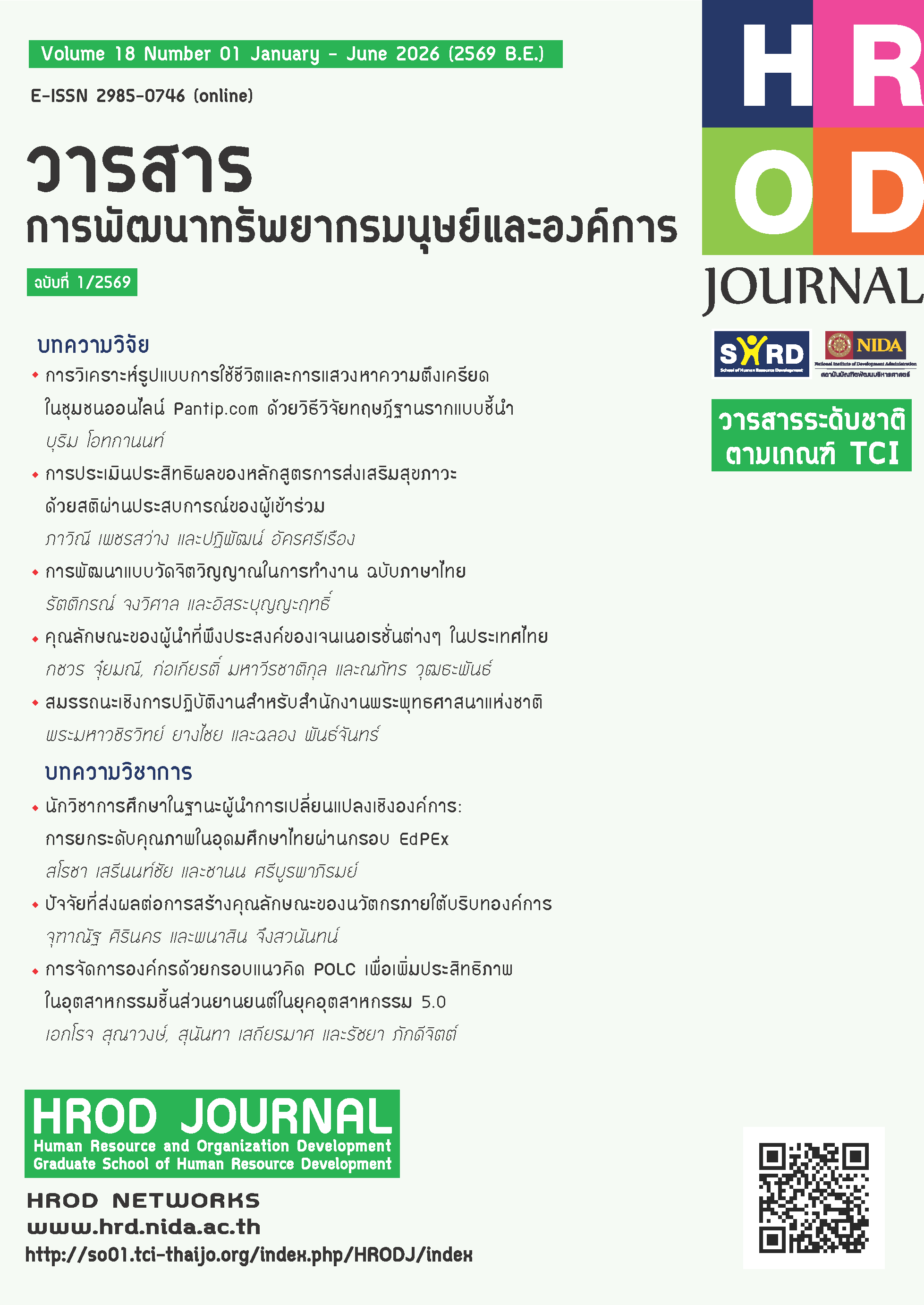
นักวิชาการศึกษาในฐานะผู้นำการเปลี่ยนแปลงเชิงองค์การ: การยกระดับคุณภาพในอุดมศึกษาไทยผ่านกรอบ EdPEx
Article Sidebar
Main Article Content
บทคัดย่อ
ในระบบอุดมศึกษาไทย การยกระดับคุณภาพองค์การตามเกณฑ์คุณภาพการศึกษาเพื่อการดำเนินการที่เป็นเลิศ (EdPEx) เป็นกลไกสำคัญในการพัฒนาทรัพยากรมนุษย์และการเปลี่ยนแปลงเชิงระบบ นักวิชาการศึกษาซึ่งทำหน้าที่สนับสนุนทางวิชาการ มีบทบาทสำคัญในการออกแบบ ติดตาม และวิเคราะห์กระบวนการด้านคุณภาพ แต่ยังไม่ได้รับการส่งเสริมอย่างเป็นระบบ บทความนี้เสนอกรอบแนวคิด “ACE Model” ซึ่งประกอบด้วย 3 มิติ ได้แก่ (1) เส้นทางความก้าวหน้าและระบบประเมินค่างาน (2) การพัฒนาสมรรถนะและทักษะเฉพาะทาง และ (3) การเสริมสร้างภาวะผู้นำการเปลี่ยนแปลง โดยอิงจากแนวคิดการพัฒนาทรัพยากรมนุษย์ การพัฒนาองค์การ และภาวะผู้นำ เพื่อยกระดับบทบาทของนักวิชาการศึกษาในฐานะผู้นำเชิงระบบ การวิเคราะห์จากประสบการณ์จริง และกรอบคุณภาพ EdPEx หมวด 5–7 แสดงให้เห็นว่านักวิชาการศึกษามีศักยภาพในการเป็นกลไกขับเคลื่อนคุณภาพทั้งในระดับหน่วยงานและระดับสถาบัน บทความจึงนำเสนอข้อเสนอเชิงนโยบายใน 3 ระดับ ได้แก่ มหาวิทยาลัย หน่วยงาน และบุคคล เพื่อเสริมสร้างสมรรถนะ ความก้าวหน้า และการมีส่วนร่วมของนักวิชาการศึกษาในฐานะผู้นำการเปลี่ยนแปลงแนวนอน
Article Details

อนุญาตภายใต้เงื่อนไข Creative Commons Attribution-NonCommercial-NoDerivatives 4.0 International License.
1) เนื้อหาทั้งหมดของบทความที่ลงตีพิมพ์ในวารสารการพัฒนาทรัพยากรมนุษย์และองค์การ เจ้าของผลงานมีการคิด ค้นคว้า ทบทวนวิเคราะห์ สรุป เรียบเรียงและอ้างอิงข้อมูลโดยผู้แต่งเอง กองบรรณาธิการไม่มีส่วนร่วมรับผิดชอบ
2) บทความที่ตีพิมพ์ในวารสารนี้ ต้องไม่เคยได้รับการตีพิมพ์เผยแพร่ที่ใดมาก่อน และไม่อยู่ระหว่างการเสนอเพื่อพิจารณาตีพิมพ์ในวารสารฉบับอื่น หากตรวจพบว่า มีการตีพิมพ์ซ้ำซ้อน ถือเป็นความรับผิดชอบของผู้แต่งแต่เพียงผู้เดียวในการละเมิดลิขสิทธิ์
3) ผลงานที่ได้รับการตีพิมพ์ในวารสารวิชาการ ถือเป็นกรรมสิทธิ์ของวารสารห้ามนำข้อความทั้งหมดหรือบางส่วนไปพิมพ์ซ้ำ เว้นเสียแต่ว่าจะได้รับอนุญาตจากทางกองบรรณาธิการวารสารฯ
เอกสารอ้างอิง
Anderson, V., Poell, R., & Mohd Rasdi, R. (2024). Theorizing cultural HRD: An emancipatory structures approach. Human Resource Development International, 27(5), 649–671. https://doi.org/10.1080/13678868.2024.2409611
Battilana, J., Gilmartin, M., Sengul, M., Pache, A.-C., & Alexander, J. A. (2010). Leadership competencies for implementing planned organizational change. The Leadership Quarterly, 21(3), 422–438. https://doi.org/10.1016/j.leaqua.2010.03.007
Bierema, L. L. (2005). Women’s Networks: A Career Development Intervention or Impediment? Human Resource Development International, 8(2), 207–224. https://doi.org/10.1080/13678860500100517
Boyatzis, R. E. (1982). The competent manager: A model for effective performance. John Wiley & Sons.
Burke, W. W. (2018). Organization change: Theory and practice (5th ed.). SAGE Publications.
Cummings, T. G., & Worley, C. G. (2015). Organization development and change (10th ed.). Cengage Learning.
Chaovansunthorn, V. (2018). Creation of educational service provision standards of educators: Faculty of Social Sciences and Humanities, Mahidol University. Integrated Social Science Journal, Mahidol University, 1(2), 267–285. https://so02.tci-thaijo.org/index.php/isshmu/article/view/145998
Chonsuwat, K., & Rattanapongpinyo, T. (2019). The perception about causes of organizational changes affecting against behavior to transition state and management strategies for organizational transformation and development: A case study of Company A. Veridian E-Journal, Silpakorn University, 12(4), 1227–1243.
French, W. L., & Bell, C. H. (1999). Organization development: Behavioral science interventions for organization improvement (6th ed.). Prentice Hall.
Gemo, A., & Phrompitakkul, W. (2024). The impact of transformational leadership on the effectiveness of human resource management: The mediating role of organizational atmosphere and organizational change. Journal of Dhamma for Life, 30(4), 317–332. https://so08.tci-thaijo.org/index.php/dhammalife/article/view/3081
Jabareen, Y. (2009). Building a conceptual framework: Philosophy, definitions, and procedure. International Journal of Qualitative Methods, 8(4), 49–62. https://doi.org/10.1177/160940690900800406
Kotter, J. P. (1996). Leading change. Harvard Business Review Press.
Kuchinke, K. P., & Lee, M. M. (2024). Dynamics of transformation and change in actual practice: Examples and insights for transforming HRD. Human Resource Development International, 27(5), 741–755. https://doi.org/10.1080/13678868.2024.2408031
Lewin, K. (1947). Frontiers in group dynamics. Human Relations, 1(1), 5–41.
Ministry of Higher Education, Science, Research and Innovation [MHESI]. (2024). Education Criteria for Performance Excellence (2024–2027). Retrieved March 23, 2025, http://www.edpex.org/2024/02/edpex-2567-2570.html
Northouse, P. G. (2021). Leadership: Theory and practice (9th ed.). SAGE Publications.
Office of the Civil Service Commission. (2021). khūmư̄ nǣothāng kānphatthanā samatthana rāi bukkhon khō̜ng khārātchakān phonlarư̄an [Individual competency development manual for civil service personnel]. Office of the Civil Service Commission (Thailand).
Phattharasasuntorn, P. K. (2022). Human resources development in the new normal era. Journal of MCU Buddhist Review, 6(3), 262–275. https://so06.tci-thaijo.org/index.php/jmb/article/view/260199
Poell, R. F., Anderson, V., Carbery, R., Cho, Y., Kuchinke, K. P., Lundgren, H., & McLean, G. N. (2024). Transformation of HRD: Change is coming! Human Resource Development International, 27(5), 641–648. https://doi.org/10.1080/13678868.2024.2414143
Rattanarat, P., Milaehman, N., & Thongkanluang, S. (2023). Organizational culture change model to increase the effectiveness of the schools under Suratthani Primary Educational Service Area Office 3. Journal of Education and Innovation, 26(3), 318–331. https://so06.tci-thaijo.org/index.php/edujournal_nu/article/view/268782
Sanamthong, E. (2019). Human resource development: Approaches to achieving organizational success. Kasem Bundit Journal, 20(1), 64–77. https://so04.tci-thaijo.org/index.php/jkbu/article/view/190409
Suthamdee, C., & Suthamdee, J. (2017). A conceptual framework for human resource development in 21st-century organizations. Yala Rajabhat University Journal, 12(Special Issue), 168–184. https://so04.tci-thaijo.org/index.php/yru_human/article/view/133839
Swanson, R. A., & Holton, E. F. (2009). Foundations of human resource development (2nd ed.). Berrett-Koehler Publishers.
Thawornsin, J., Sathakajorn, S., & Wachasataya, T. (2021). Leadership competencies for change agent of school administrator in Sakaeo province. Pathumthani University Academic Journal, 13(2), 32–44. https://so05.tci-thaijo.org/index.php/ptujournal/article/view/250006
Tirataradol, Y., & Wongwiwattana, S. (2021). The current competencies and desirable competencies of the educators from the perspectives of Mahidol University’s faculty level executives. Journal of Multidisciplinary in Humanities and Social Sciences, 4(3), 1123–1140. https://so04.tci-thaijo.org/index.php/jmhs1_s/article/view/253799
Whetten, D. A. (1989). What constitutes a theoretical contribution? Academy of Management Review, 14(4), 490–495. https://doi.org/10.5465/amr.1989.4308371
