
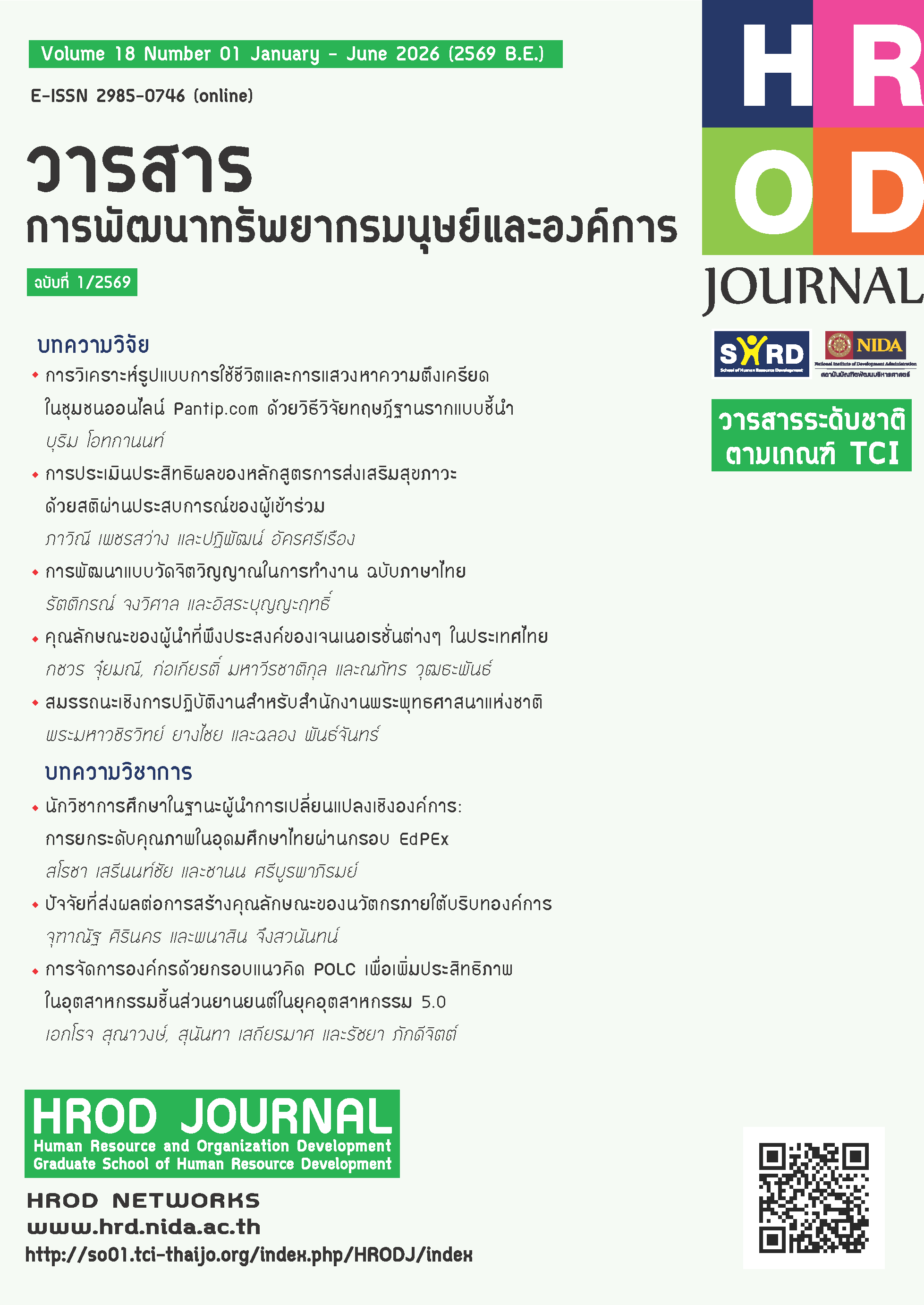
การจัดการองค์กรด้วยกรอบแนวคิด POLC เพื่อเพิ่มประสิทธิภาพในอุตสาหกรรมชิ้นส่วนยานยนต์ในยุค อุตสาหกรรม 5.0
Article Sidebar
Main Article Content
บทคัดย่อ
อุตสาหกรรมชิ้นส่วนยานยนต์ไทยมีบทบาทสำคัญต่อเศรษฐกิจ โดยเฉพาะในยุคอุตสาหกรรม 5.0 ที่มุ่งผสานเทคโนโลยีกับศักยภาพมนุษย์เพื่อสร้างความยั่งยืน งานวิจัยนี้นำเสนอกรอบการจัดการแบบ POLC (การวางแผน การจัดองค์กร การนำ และการควบคุม) เพื่อยกระดับประสิทธิภาพและขีดความสามารถในการแข่งขัน ท่ามกลางสภาพแวดล้อมที่เปลี่ยนแปลงรวดเร็วและแรงกดดันระดับโลก การศึกษาอ้างอิงจากทฤษฎีการจัดการอุตสาหกรรมยานยนต์ และกรณีศึกษานานาชาติ เช่น บริษัท โรเบิร์ต บ๊อช จำกัด (เยอรมนี) ที่ใช้ดิจิทัลทวิน และ AI ลดการปล่อยคาร์บอน, โตโยต้า (ญี่ปุ่น) ผสานลีนกับหุ่นยนต์ที่มุ่งเน้นมนุษย์, บริษัท ฮุนได โมบิส (เกาหลีใต้) ที่ใช้หุ่นยนต์ทำงานร่วมกับมนุษย์ (Cobot) และเครือข่ายของอุปกรณ์ที่ฝังเซนเซอร์ ซอฟต์แวร์ และระบบเชื่อมต่อ เพื่อเก็บข้อมูล ส่งต่อ และอินเทอร์เน็ตของสรรพสิ่ง บริษัท บีวายดี (จีน) ใช้ AI ตรวจสอบคุณภาพยานยนต์ไฟฟ้าแบบเรียลไทม์ และบริษัท วอลโว่ (สวีเดน) ผลิตโดยใช้วัสดุรีไซเคิลเกือบทั้งหมดตามแนวคิดเศรษฐกิจหมุนเวียน โดยกรอบ POLC ช่วยยกระดับอุตสาหกรรมไทยได้ผ่าน 4 องค์ประกอบ ได้แก่ 1) การวางแผน เน้นการเปลี่ยนผ่านสู่ดิจิทัล การผลิตสีเขียว และเศรษฐกิจหมุนเวียน 2) การจัดองค์กร ปรับโครงสร้างแบบคล่องตัว พร้อมบูรณาการโรงงานอัจฉริยะ AI IoT และโคบอท 3) การนำ พัฒนาภาวะผู้นำดิจิทัล ส่งเสริมความร่วมมือมนุษย์–AI และวัฒนธรรมการเรียนรู้อย่างต่อเนื่อง 4) การควบคุม ใช้ชุดข้อมูลขนาดใหญ่และซับซ้อน และ AI ตรวจสอบคุณภาพแบบเรียลไทม์ พร้อมกำหนดตัวชี้วัดด้านสิ่งแวดล้อม
ข้อเสนอแนะเชิงนโยบายคือ การขับเคลื่อนอุตสาหกรรมไทยในยุค 5.0 ต้องบูรณาการ POLC กับเทคโนโลยีอัจฉริยะและความยั่งยืน โดยรัฐต้องมีนโยบายเทคโนโลยีและสิ่งแวดล้อมที่ชัดเจน เพื่อเพิ่มขีดความสามารถในการแข่งขันและสร้างการเติบโตระยะยาวอย่างยั่งยืน
Article Details

อนุญาตภายใต้เงื่อนไข Creative Commons Attribution-NonCommercial-NoDerivatives 4.0 International License.
1) เนื้อหาทั้งหมดของบทความที่ลงตีพิมพ์ในวารสารการพัฒนาทรัพยากรมนุษย์และองค์การ เจ้าของผลงานมีการคิด ค้นคว้า ทบทวนวิเคราะห์ สรุป เรียบเรียงและอ้างอิงข้อมูลโดยผู้แต่งเอง กองบรรณาธิการไม่มีส่วนร่วมรับผิดชอบ
2) บทความที่ตีพิมพ์ในวารสารนี้ ต้องไม่เคยได้รับการตีพิมพ์เผยแพร่ที่ใดมาก่อน และไม่อยู่ระหว่างการเสนอเพื่อพิจารณาตีพิมพ์ในวารสารฉบับอื่น หากตรวจพบว่า มีการตีพิมพ์ซ้ำซ้อน ถือเป็นความรับผิดชอบของผู้แต่งแต่เพียงผู้เดียวในการละเมิดลิขสิทธิ์
3) ผลงานที่ได้รับการตีพิมพ์ในวารสารวิชาการ ถือเป็นกรรมสิทธิ์ของวารสารห้ามนำข้อความทั้งหมดหรือบางส่วนไปพิมพ์ซ้ำ เว้นเสียแต่ว่าจะได้รับอนุญาตจากทางกองบรรณาธิการวารสารฯ
เอกสารอ้างอิง
จุฑารัตน์ สิริเลาหวัฒนกุล และ จักรพันธ์ กิตตินรรัตน์. (2567). การบริหารจัดการตามกระบวนการจัดการ POCCC ที่ส่งผลต่อคุณภาพชีวิตการทำงานของข้าราชการในสังกัดกรมหม่อนไหม. วารสารวิชาการ วิจัย และนวัตกรรม มสธ. (มนุษยศาสตร์และสังคมศาสตร์), 4(1), 124–139. https://so04.tci-thaijo.org/index.php/InnovationStou/article/view/267122
ณรงค์ศักดิ์ ทั่งทอง, พงศ์พัฒน์ จิตตานุรักษ์, และ สุริยา รักษาเมือง. (2566). ประสิทธิภาพการบริหารงานตามหลักพุทธธรรมของอุตสาหกรรมยานยนต์จังหวัดนนทบุรีในชีวิตวิถีใหม่. วารสารสหวิทยาการนวัตกรรมปริทรรศน์, 6(4), 13–27. https://so04.tci-thaijo.org/index.php/jidir/article/view/261617
ต้องหทัย กุวานนท์. (2567, 15 มิถุนายน). อุตสาหกรรม 5.0 (Industry 5.0) อนาคตใกล้กว่าที่คิด. กรุงเทพธุรกิจ. https://www.bangkokbiznews.com/tech/innovation/1131456
ทิพวรรณ หล่อสุวรรณรัตน์. (2547). ทฤษฎีองค์การสมัยใหม่. แซทโฟร์ พริ้นติ้ง.
ธชกร แผ้วพลสง, และ ธีทัต ตรีศิริโชติ. (2563). องค์ประกอบของทางรอดของอุตสาหกรรมชิ้นส่วนยานยนต์ไทยในเขตเศรษฐกิจพิเศษภาคตะวันออก. วารสารวิทยาลัยพาณิชยศาสตร์บูรพาปริทัศน์, 15(2), 44–59. https://buuir.buu.ac.th/bitstream/1234567890/4673/1/mba15n2p44-59.pdf
นันท์นภัส สำราญรื่น, และ สายพิณ ปั้นทอง. (2565). ปัจจัยที่มีอิทธิพลต่อการตัดสินใจซื้อสินค้าผ่านแอปพลิเคชันเดลิเวอรี่จากร้านสะดวกซื้อในกรุงเทพมหานคร. วารสารสุทธิปริทัศน์, 36(1), 61–79. https://so05.tci-thaijo.org/index.php/DPUSuthiparithatJournal/article/view/256724
พชรพล สร้อยทอง. (2563). ภาวะผู้นำกับความสำเร็จขององค์การ. วารสารการบริหารท้องถิ่น, 13(3), 303–317. https://so04.tci-thaijo.org/index.php/colakkujournals/article/view/240409
วีระยา ทองเสือ. (2566). ทรัพยากรทางเศรษฐกิจและการวิเคราะห์ตลาดของอุตสาหกรรมชิ้นส่วนยานยนต์ไทย. Krungthai COMPASS.
ศุภวัฒน์ โชคสวัสดิ์ไพศาล. (2567, 10 กรกฎาคม). แนวโน้มธุรกิจ/อุตสาหกรรม ปี 2567–2569: อุตสาหกรรมรถยนต์ไฟฟ้า. ธนาคารกรุงศรีอยุธยา. https://www.krungsri.com/th/research/industry/industry-outlook/hi-tech-industries/electric-vehicle/io/electric-vehicle-2024
สถาบันเพิ่มผลผลิตแห่งชาติ. (2564). Lean production system. https://piu.ftpi.or.th/industry-5-0-%E0%B9%80%E0%B8%95%E0%B8%A3%E0%B8%B5%E0%B8%A2%E0%B8%A1%E0%B8%9E%E0%B8%A3%E0%B9%89%E0%B8%AD%E0%B8%A1%E0%B8%AA%E0%B8%B9%E0%B9%88%E0%B8%A2%E0%B8%B8%E0%B8%84-cobots-%E0%B8%81%E0%B9%89/
สมาคมผู้ผลิตชิ้นส่วนยานยนต์ไทย. (2567). Thailand auto parts performance (Jan–Dec 2024). https://www.thaiautoparts.or.th/images/pdf/Thailand_Auto_Parts_Performance_Jan_to_Dec_2024.pdf
สำนักงานเศรษฐกิจอุตสาหกรรม. (2566). รายงานภาวะเศรษฐกิจอุตสาหกรรม ไตรมาสที่ 3/2566 และแนวโน้มไตรมาสที่ 4/2566. กระทรวงอุตสาหกรรม. https://www.oie.go.th/assets/portals/1/fileups/2/files/Industry%20conditions/Q3-2023(2566).pdf
Abatan, A., Jacks, B. S., Ugwuanyi, E. D., Nwokediegwu, Z. Q. S., Obaigbena, A., Daraojimba, A. I., & Lottu, O. A. (2024). The role of environmental health and safety practices in the automotive manufacturing industry. Engineering Science & Technology Journal, 5(2), 531–542. https://doi.org/10.51594/estj.v5i2.830
Allen, L. A. (1958). Management and organization. McGraw-Hill.
Cronbach, L. J. (1951). Coefficient alpha and the internal structure of tests. Psychometrika, 16(3), 297–334. https://doi.org/10.1007/BF02310555
de Souza, R. O., Ferenhof, H. A., & Forcellini, F. A. (2022). Industry 4.0 and Industry 5.0 from the Lean perspective. International Journal of Management, Knowledge and Learning, 11, 145–155. https://toknowpress.net/submission/index.php/ijmkl/article/view/72
Fayol, H. (1949). General and industrial management (C. Storrs, Trans.). Pitman. (Original work published 1916)
HREX.asia. (2019, June 26). ทฤษฎี POCCC คืออะไร? แนวคิดการบริหารจัดการของ Henri Fayol สำคัญอย่างไร. https://th.hrnote.asia/orgdevelopment/190626-poccc-henri-fayol/
Hyundai Motor Group. (2025, July 14). Uniting humans and robots: Hyundai Motor Group and Boston Dynamics’ vision for the future of work and HR evolution. https://www.hyundai.com/worldwide/en/newsroom/detail/uniting-humans-and-robots--hyundai-motor-group-and-boston-dynamics%E2%80%99-vision-for-the-future-of-work-and-hr-evolution-0000000983
Ivanov, D., Dolgui, A., & Sokolov, B. (2019). The impact of digital technology and Industry 4.0 on the ripple effect and supply chain risk analytics. International Journal of Production Research, 57(3), 829–846. https://doi.org/10.1080/00207543.2018.1488086
Jackson, A. (2025, October 8). How China’s BYD is using AI to scale global EV manufacturing. Technology Magazine. https://technologymagazine.com/news/how-chinas-byd-is-using-ai-to-scale-global-ev-manufacturing
Jiang, J. (2024). Challenges and innovations in metal additive manufacturing for the automotive industry under the framework of Industry 5.0. IET Conference Proceedings, 2024(24), 382–388. https://doi.org/10.1049/icp.2024.4532
Katz, D., & Kahn, R. L. (1978). The social psychology of organizations (2nd ed.). Wiley.
Khan, W. U., Ihsan, A., Nguyen, T. N., Ali, Z., & Javed, M. A. (2022). NOMA-enabled backscatter communications for green transportation in automotive-Industry 5.0. IEEE Transactions on Industrial Informatics, 18(11), 7862–7874. https://doi.org/10.1109/TII.2022.3161029
Kenphanan, S. (2021). The factors influencing the success of operating a construction industry business during the coronavirus epidemic (COVID-19). วารสารวิชาการสถาบันวิทยาการจัดการแห่งแปซิฟิค, 8(2), 341–349. https://so05.tci-thaijo.org/index.php/pacific/article/view/260132
Kotter, J. P. (1990). A force for change: How leadership differs from management. Free Press.
Krungsri Research. (2023, March 1). Industry outlook 2023–2025: Auto parts industry. Bank of Ayudhya. https://www.krungsri.com/en/research/industry/industry-outlook/hi-tech-industries/auto-parts/io/auto-parts-2023-2025
KPMG International. (2023). 23rd annual global automotive executive survey. https://assets.kpmg.com/content/dam/kpmg/be/pdf/annual-global-automotive-executive-survey-report.pdf
Lai, N. Y. G., Foo, W. C., Tan, C. S., Kang, M. S., Kang, H. S., Wong, K. H., Yu, L. J., Sun, X., & Tan, N. M. L. (2022). Understanding learning intention complexities in lean manufacturing training for innovation on the production floor. Journal of Open Innovation: Technology, Market, and Complexity, 8(3), Article 110. https://doi.org/10.3390/joitmc8030110
Lander, E., & Liker, J. K. (2007). The Toyota production system and art: Making highly customized and creative products the Toyota way. International Journal of Production Research, 45(16), 3681–3698. https://doi.org/10.1080/00207540701223519
Alam, A., Ullah, R., & Anwar, M. S. (2022). RL/DRL meets vehicular task offloading using edge and vehicular cloudlet: A survey. IEEE Access, 10, 31185–31203. https://doi.org/10.1109/ACCESS.2022.3155667
MarkLines Co., Ltd. (2025). Automotive sales in Thailand by month, 2024. https://www.marklines.com/en/statistics/flash_sales/automotive-sales-in-thailand-by-month-2024
Material Automation (Thailand) Co., Ltd. (2024, February 6). [27 Feb 2024] Webinar “Unlock secrets to successful smart factory transformation: EP1 Digital twin”. https://www.mat.co.th/th/news/27feb24-lib-mat-smartfactory-webinar/
Massie, J. L. (1971). Essentials of management (2nd ed.). Prentice-Hall.
Organisation Internationale des Constructeurs d’Automobiles. (2022). Production statistics. https://oica.net/production-statistics/
Oztemel, E., & Gursev, S. (2020). Literature review of Industry 4.0 and related technologies. Journal of Intelligent Manufacturing, 31(1), 127–182. https://doi.org/10.1007/s10845-018-1433-8
Parker, J., & Gehrett, M. (2024). The POLC framework. Business LibreTexts. https://biz.libretexts.org/Courses/Western_Technical_College/Business_Concepts%3A_Exploring_Careers_in_Business/02%3A__The_Functions_of_Management/2.04%3A_The_POLC_Framework
Schubert, D. A. (2022). Warum Führung so wichtig ist. Innovative Verwaltung, 44(12), 37–40. https://doi.org/10.1007/s35114-022-1472-z
Serino, T. A. M. (2024). From Industry 4.0 to Industry 5.0: Evaluating digital twin impact: A case study from the automotive industry [Master’s thesis, Universidade de Lisboa]. Repositório da Universidade de Lisboa.
Sweid, A., Hammoud, B., Bekelis, K., Missios, S., Tjoumakaris, S. I., Gooch, M. R., Herial, N. A., Zarzour, H., Romo, V., DePrince, M., Rosenwasser, R. H., & Jabbour, P. (2020). Cerebral ischemic and hemorrhagic complications of coronavirus disease 2019. International Journal of Stroke, 15(7), 733–742. https://doi.org/10.1177/1747493020937189
Vacchi, M., Siligardi, C., & Settembre-Blundo, D. (2024). Driving manufacturing companies toward Industry 5.0: A strategic framework for process technological sustainability assessment (P-TSA). Sustainability, 16(2), Article 695. https://doi.org/10.3390/su16020695
Volvo Car Corporation. (2024, September 9). Volvo Cars position on sustainable materials. https://www.volvocars.com/assets/volvocm/globalpages/live/75A68447D0AC4CC882E72FA232E78B49/volvo-cars_position_on_sustainable_materials.pdf
Volvo Group. (2022). Annual and sustainability report 2022. https://www.volvogroup.com/content/dam/volvo-group/markets/master/investors/reports-and-presentations/annual-reports/AB-Volvo-Annual-Report-2022.pdf
Yun, J. H. J., Zhao, X., Koo, I., Sadoi, Y., & Pyka, A. (2025). Open innovation and digital transformation in the automotive industry: A comparative analysis of South Korea, Japan and Germany. European Journal of Innovation Management, 28(9), 4284–4304. https://doi.org/10.1108/EJIM-08-2024-0948
World Economic Forum. (2025, June 3). 8 technologies, ‘3Cs’ and one new innovation paradigm: How converging tech is redefining value chains. https://www.weforum.org/stories/2025/06/technologies-converging-to-create-new-opportunities-for-business/
Xu, L. D., Xu, E. L., & Li, L. (2018). Industry 4.0: State of the art and future trends. International Journal of Production Research, 56(8), 2941–2962. https://doi.org/10.1080/00207543.2018.1444806
