
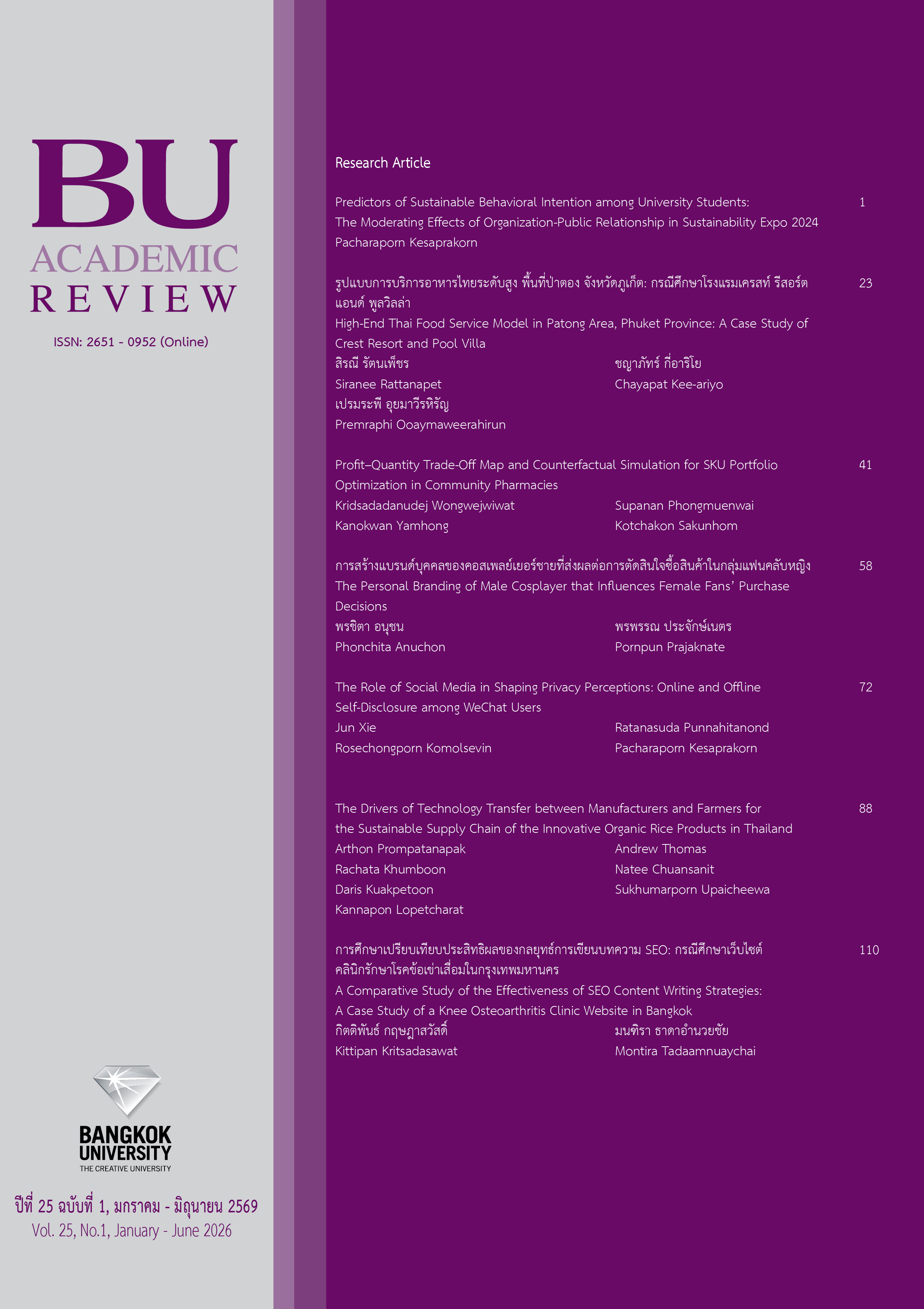
The Personal Branding of Male Cosplayer that Influences Female Fans’ Purchase Decisions
Article Sidebar
Main Article Content
Abstract
The objectives of this research are to: 1) study the personal branding factors of male cosplayers in terms of physical appearance and personality; 2) examine the use of social media that contributes to personal branding; 3) investigate the factors of knowledge and skills related to personal branding; and 4) explore the purchase decision-making process of female fans toward the products of male cosplayers. The study employs a qualitative research methodology, utilizing in-depth interviews with 10 key informants, categorized into five male cosplayers and five female fans. Data were collected in October 2025. The research’s conceptual framework integrates Aaker’s (1997) Brand Personality, del Blanco’s (2010) Personal Branding, and Schawbel’s (2011) Personal Branding Process, alongside Nicosia’s (1966) Consumer Behavior Model.
The findings reveal that the personal branding of male cosplayers emerges from the synergy of three primary dimensions: physical appearance and personality, social media usage, and knowledge and skills. While physical appearance facilitates initial awareness, personality traits—such as friendliness and showing respect to fans—play a crucial role in fostering long-term engagement and trust. Social media platforms, including Facebook, TikTok, and Instagram, serve as vital spaces for communication and facilitating interaction with fans.
When analyzed through the Nicosia Model, the results show that awareness via social media leads to the formation of attitudes and information evaluation. "Trust," developed through consistent interaction, is a key variable driving purchase decisions. Notably, the decision-making of female fans is primarily driven by emotional motivations rather than rational considerations. Furthermore, after following
a cosplayer for a certain period, fans begin to place higher value on the cosplayer’s originality, perceiving them as artists rather than mere character imitators.
Article Details

This work is licensed under a Creative Commons Attribution-NonCommercial-NoDerivatives 4.0 International License.
The manuscript submitted for publication must be the original version, submitted only to this particular journal with no prior acceptance for publication elsewhere in other academic journals. The manuscript must also not violate the copyright issue by means of plagiarism.
References
ชุลีกร วงศ์ฝั้น. (2560). การศึกษาขั้นตอนการสร้างแบรนด์บุคคล (personal branding) วิธีการสร้างและรักษาผู้ติดตามของ Youtuber และเหตุผลในการติดตาม Youtuber ของผู้บริโภค [การค้นคว้าอิสระปริญญามหาบัณฑิต, มหาวิทยาลัยธรรมศาสตร์].
สถานีวิทยุกระจายเสียงแห่งประเทศไทย จังหวัดมุกดาหาร. (2565). ส่งเสริม Soft power ไทย เพิ่มมูลค่าเศรษฐกิจสร้างสรรค์. https://radiomukdahan.prd.go.th/th/content/category/detail/id/9/iid/90397
Aaker, J. L. (1997). Dimensions of brand personality. Journal of Marketing Research, 34(3), 347–356. https://doi.org/10.1177/002224379703400304
del Blanco, R. A. (2010). The power of personal branding: Creating celebrity status with your target audience. Palgrave Macmillan.
Escarpit, R. (1975). The sociology of literature. Frank Cass Publishers.
Hinčica, V., Rezanková, H., Macias, K., & Schulzová, M. (2024). Perception of natural cosmetics among central European consumer. Central European Economic Journal, 11(58), 233-251.
https://doi.org/10.2478/ceej-2024-0016
Hodinková, D., Púchovská, O., & Račkovičová, L. (2021). The cosplay phenomenon in intentions of art marketing. Acta Ludologica, 14(2), 78-95.
Horton, D., & Wohl, R. (1956). Mass communication and para-social interaction: Observations on intimacy at a distance. Psychiatry, 19(3), 215–229. https://doi.org/10.1080/00332747.1956.11023049
Kadam, A., & Prasad, E. (2021). Cosplay costumes market (2021–2030). Allied Market Research.
https://www.alliedmarketresearch.com/cosplay-costumes-market-A13135
Nicosia, F. M. (1966). Consumer decision processes: Marketing and advertising implications. Prentice-Hall.
Schawbel, D. (2011). Me 2.0: 4 steps to building your future. Kaplan Publishing.
Sung, Y., & Tinkham, S. F. (2005). Brand personality structures in the United States and Korea: Common and culture-specific factors. Journal of Consumer Psychology, 15(4), 334-350. https://doi.org/10.1207/s15327663jcp1504_8
