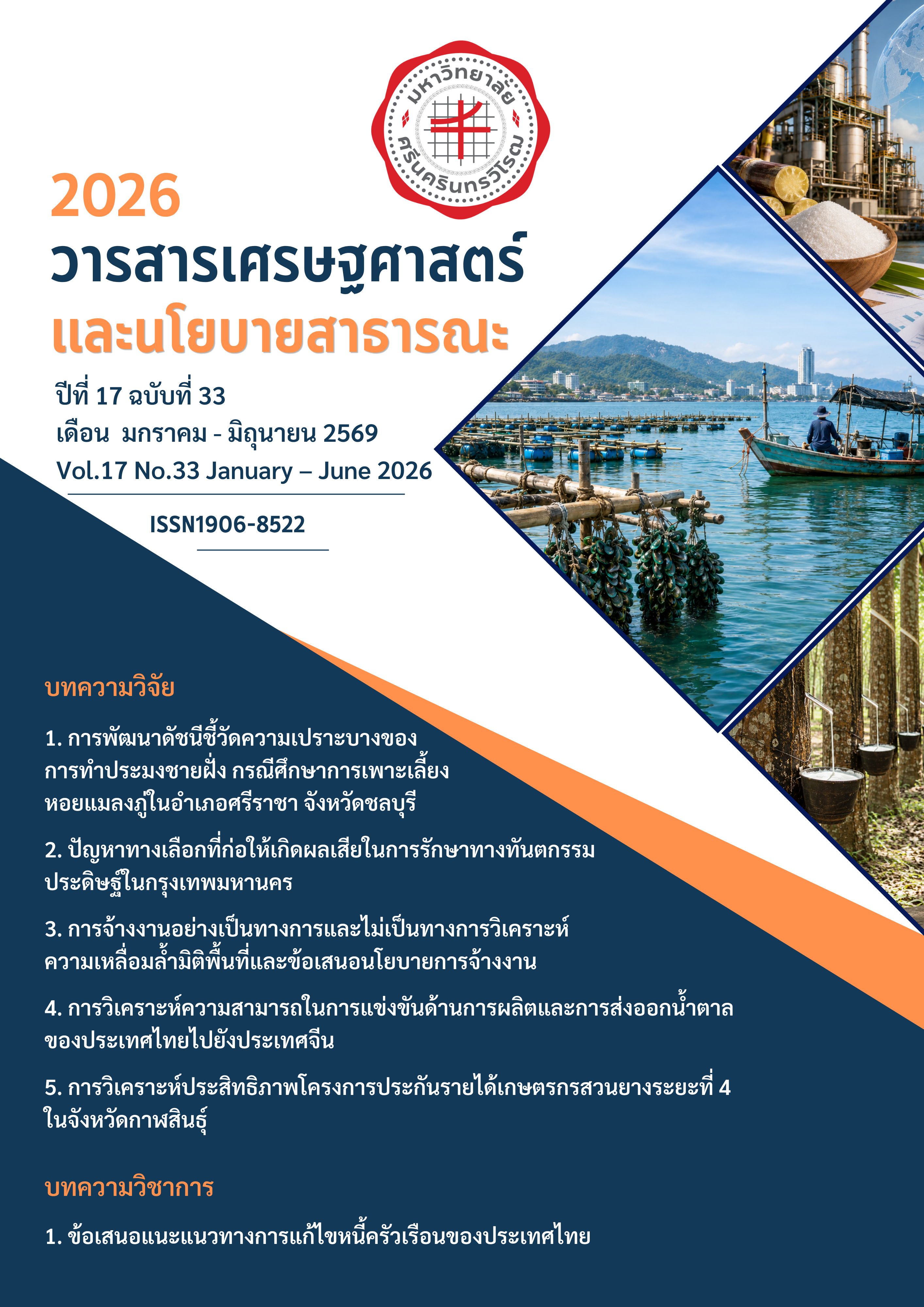
การพัฒนาดัชนีชี้วัดความเปราะบางของการทำประมงชายฝั่ง กรณีศึกษาการเพาะเลี้ยงหอยแมลงภู่ในอำเภอศรีราชา จังหวัดชลบุรี
Article Sidebar
Main Article Content
บทคัดย่อ
การเปลี่ยนแปลงสภาพภูมิอากาศเป็นปัจจัยสำคัญที่ส่งผลกระทบต่อความมั่นคงในการเพาะเลี้ยงหอยแมลงภู่ ในท้องทะเล งานวิจัยนี้จึงมีวัตถุประสงค์เพื่อพัฒนาดัชนีชี้วัดความเปราะบางของการเพาะเลี้ยงหอยแมลงภู่ โดยเลือกพื้นที่อำเภอศรีราชา จังหวัดชลบุรี เก็บข้อมูลด้วยการสัมภาษณ์เจ้าหน้าที่ประมงจังหวัด เจ้าหน้าที่สถานีวิจัยประมงศรีราชา และผู้แทนเกษตรกรในพื้นที่จำนวนรวมทั้งสิ้น 50 ครัวเรือน และใช้ข้อมูลทุติยภูมิด้านเศรษฐกิจ สังคม และสิ่งแวดล้อมรายไตรมาส ตั้งแต่ปีพ.ศ. 2553 – 2566 เพื่อวิเคราะห์ดัชนีชี้วัดความเปราะบางด้วยวิธีการสร้างดัชนีประกอบ (Composite Index) ที่สอดคล้องกับแนวคิดการพัฒนาที่ยั่งยืน ผลการศึกษาเมื่อพิจารณาดัชนีความเปราะบางพบว่าสาเหตุหลักมาจากปัจจัยด้านสิ่งแวดล้อมที่มีค่าดัชนีความเปราะบางเฉลี่ยเท่ากับ 68.89 ในขณะที่กลุ่มตัวแปรด้านสังคมมีค่าเฉลี่ยของดัชนีชี้วัดความเปราะบางเท่ากับ 72.12 และ กลุ่มตัวแปรด้านเศรษฐกิจ 73.42 ผลการศึกษาที่ได้เป็นประโยชน์ต่อหน่วยงานราชการในการประเมินความเสียหาย และสามารถจัดสรรงบประมาณให้การช่วยเหลือแก่เกษตรกรได้อย่างถูกต้องเหมาะสม และเกษตรกรสามารถนำไปพยากรณ์เพื่อให้ทราบสัญญาณล่วงหน้า (Early Warning) เพื่อการทำการเพาะเลี้ยงหอยแมลงภู่ ได้มีความแม่นยำเหมาะสมมากขึ้น
Article Details

อนุญาตภายใต้เงื่อนไข Creative Commons Attribution-NonCommercial-NoDerivatives 4.0 International License.
สงวนลิขสิทธิ์ © 2553 คณะเศรษฐศาสตร์ มหาวิทยาลัยศรีนครินทรวิโรฒ
คณะเศรษฐศาสตร์ มหาวิทยาลัยศรีนครินทรวิโรฒ จัดพิมพ์วารสารเศรษฐศาสตร์และนโยบายสาธารณะ เพื่อเผยแพร่บทความวิชาการทางเศรษฐศาสตร์ นโยบายสารธารณะ และสาขาอื่นๆที่เกี่ยวข้อง ทัศนะและข้อคิดเห็นใดๆ ที่ปรากฏในวารสารเป็นความคิดเห็นส่วนตัวของผู้เขียน โดยบทความที่ได้รับการตอบรับจะถือเป็นลิขสิทธิ์ของคณะเศรษฐศาสตร์ มหาวิทยาลัยศรีนครินทรวิโรฒ
บรรณาธิการ อาจารย์ ดร.พลพัธน์ โคตรจรัส
เอกสารอ้างอิง
Blythe, J., Flaherty, M., & Murray, G. (2014). Vulnerability of coastal livelihoods to shrimp farming: Insights from Mozambique.
Environment, Development and Sustainability, 44(4), 275–284. https://doi.org/10.1007/s10668-014-9532-5
Hinz, H., Törnroos, A., & de Juan, S. (2021). Trait-based indices to assess benthic vulnerability to trawling and model loss of ecosystem
functions. Ecological Indicators, 126, 107692.
Huang, B., Banzon, V. F., Freeman, E., Lawrimore, J., Liu, W., Peterson, T. C., … & Zhang, H. M. (2015). Extended reconstructed sea surface
temperature version 4 (ERSST.v4). Part I: Upgrades and intercomparisons. Journal of Climate, 28(3), 911–930.
https://doi.org/10.1175/JCLI-D-14-00006.1
Idrus, I. I., Ismail, A., & Amandaria, R. (2022). The vulnerability and resilience of fishermen's household livelihoods in Lae-Lae Island,
Makassar City. E3S Web of Conferences, 149, 02034. https://doi.org/10.1051/e3sconf/202214902034
Jara, H. J., Tam, J., Reguero, B. G., Ganoza, F., Castillo, G., Romero, C. Y., Gévaudan, M., & Sánchez, A. A. (2020). Current and future socio-
ecological vulnerability and adaptation of artisanal fisheries communities in Peru: The case of the Huaura province. Marine
Policy, 119, 104003. https://doi.org/10.1016/j.marpol.2020.104003
Johnson, J. E., & Welch, D. J. (2009). Marine fisheries management in a changing climate: A review of vulnerability and future options.
Reviews in Fisheries Science, 18(1), 106–124. https://doi.org/10.1080/10641260903434557
Luers, A. L., Lobell, D. B., Sklar, L. S., Addams, C. L., & Matson, P. A. (2003). A method for quantifying vulnerability, applied to the
agricultural system of the Yaqui Valley, Mexico. Global Environmental Change, 13(4), 255–267. https://doi.org/10.1016/S0959-
(03)00054-2
Moret, W. (2014). Vulnerability assessment methodologies: A review of the literature. FHI 360.
https://www.fhi360.org/resource/vulnerability-assessment-methodologies-review-literature
Morzaria-Luna, H. N., Turk-Boyer, P., & Moreno-Báez, M. (2014). Social indicators of vulnerability for fishing communities in the northern
Gulf of California, Mexico: Implications for climate change. Marine Policy, 45, 182–193.
https://doi.org/10.1016/j.marpol.2013.10.013
Naik, A. S., & Hayes, M. (2019). Bioprocessing of mussel by-products for value-added ingredients. Trends in Food Science & Technology,
, 111–121. https://doi.org/10.1016/j.tifs.2019.08.016
Noranarttragoon, P., Koolkalaya, S., Thitipongtrakul, W., Avakul, P., Phoonsawat, R., & Jutagate, T. (2023). Trawl Fisheries in the Gulf of
Thailand: Vulnerability Assessment and Trend Analysis of the Fish Landings. Fishes, 8(4), 177.
Tasnuva, A., Hossain, M. R., Salam, R., Islam, A. R. M. T., Patwary, M. M., & Ibrahim, S. M. (2021). Employing social vulnerability index to
assess household social vulnerability of natural hazards: Evidence from southwest coastal Bangladesh. Environment,
Development and Sustainability, 23, 10223–10245. https://doi.org/10.1007/s10668-020-01086-0
Zhang, W., Zhang, R., & Wang, Y. (2012). Research on the vulnerability of coastal zone system development. In Y. Luo, Y. Pan, & J. Liu
(Eds.), Advances in Computer Science, Environment, Ecoinformatics, and Education (pp. 461–469). Springer.
