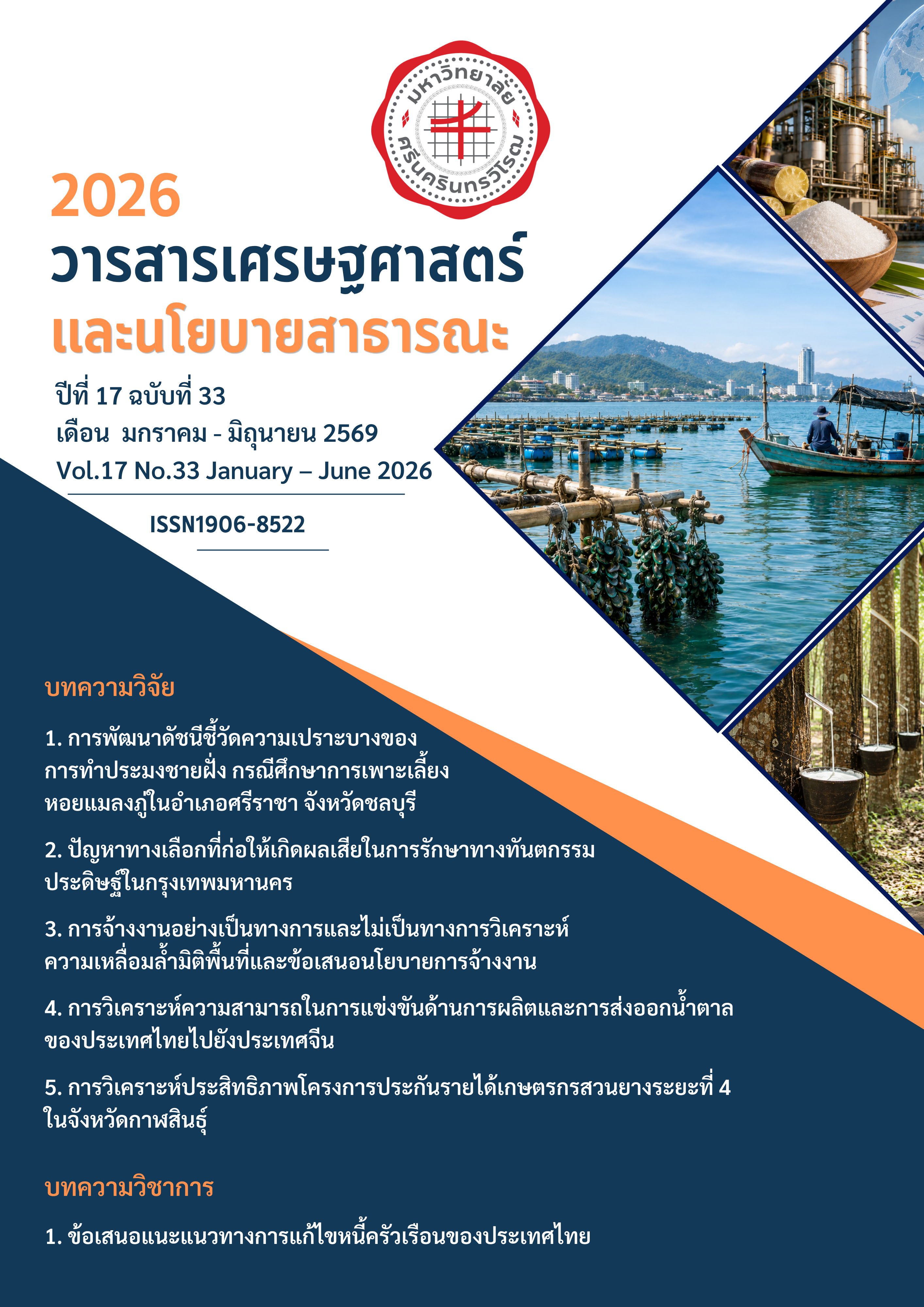
Developing a Vulnerability Index of Coastal Fisheries: A Case Study of Mussel Cultivation in Sriracha District, Chonburi
Article Sidebar
Main Article Content
Abstract
Climate change has become a critical driver influencing the sustainability of mussel aquaculture in marine environments. This study aims to develop a vulnerability index for mussel aquaculture, focusing on Si Racha District, Chonburi Province, Thailand. Primary data were collected through interviews with provincial fisheries officers, staff from the Si Racha Fisheries Research Station, and representatives of 50 farming households, complemented by secondary quarterly data on economic, social, and environmental conditions from 2010 to 2023. A Composite Index approach, aligned with the principles of sustainable development, was applied to construct the vulnerability index. The results reveal that environmental factors are the major contributors to vulnerability, with an average index score of 68.89, followed by social (72.12) and economic (73.42) dimensions. The findings provide valuable insights for government agencies in assessing potential damages and allocating resources more effectively to support aquaculture farmers. Furthermore, the index can serve as an early warning tool, enabling farmers to anticipate risks and enhance the precision and resilience of mussel aquaculture practices.
Article Details

This work is licensed under a Creative Commons Attribution-NonCommercial-NoDerivatives 4.0 International License.
สงวนลิขสิทธิ์ © 2553 คณะเศรษฐศาสตร์ มหาวิทยาลัยศรีนครินทรวิโรฒ
คณะเศรษฐศาสตร์ มหาวิทยาลัยศรีนครินทรวิโรฒ จัดพิมพ์วารสารเศรษฐศาสตร์และนโยบายสาธารณะ เพื่อเผยแพร่บทความวิชาการทางเศรษฐศาสตร์ นโยบายสารธารณะ และสาขาอื่นๆที่เกี่ยวข้อง ทัศนะและข้อคิดเห็นใดๆที่ปรากฏในวารสารเป็นความคิดเห็นส่วนตัวของผู้เขียน โดยบทความที่ได้รับการตอบรับจะถือเป็นลิขสิทธิ์ของคณะเศรษฐศาสตร์ มหาวิทยาลัยศรีนครินทรวิโรฒ
บรรณาธิการ อาจารย์ ดร.พลพัธน์ โคตรจรัส
References
Blythe, J., Flaherty, M., & Murray, G. (2014). Vulnerability of coastal livelihoods to shrimp farming: Insights from Mozambique.
Environment, Development and Sustainability, 44(4), 275–284. https://doi.org/10.1007/s10668-014-9532-5
Hinz, H., Törnroos, A., & de Juan, S. (2021). Trait-based indices to assess benthic vulnerability to trawling and model loss of ecosystem
functions. Ecological Indicators, 126, 107692.
Huang, B., Banzon, V. F., Freeman, E., Lawrimore, J., Liu, W., Peterson, T. C., … & Zhang, H. M. (2015). Extended reconstructed sea surface
temperature version 4 (ERSST.v4). Part I: Upgrades and intercomparisons. Journal of Climate, 28(3), 911–930.
https://doi.org/10.1175/JCLI-D-14-00006.1
Idrus, I. I., Ismail, A., & Amandaria, R. (2022). The vulnerability and resilience of fishermen's household livelihoods in Lae-Lae Island,
Makassar City. E3S Web of Conferences, 149, 02034. https://doi.org/10.1051/e3sconf/202214902034
Jara, H. J., Tam, J., Reguero, B. G., Ganoza, F., Castillo, G., Romero, C. Y., Gévaudan, M., & Sánchez, A. A. (2020). Current and future socio-
ecological vulnerability and adaptation of artisanal fisheries communities in Peru: The case of the Huaura province. Marine
Policy, 119, 104003. https://doi.org/10.1016/j.marpol.2020.104003
Johnson, J. E., & Welch, D. J. (2009). Marine fisheries management in a changing climate: A review of vulnerability and future options.
Reviews in Fisheries Science, 18(1), 106–124. https://doi.org/10.1080/10641260903434557
Luers, A. L., Lobell, D. B., Sklar, L. S., Addams, C. L., & Matson, P. A. (2003). A method for quantifying vulnerability, applied to the
agricultural system of the Yaqui Valley, Mexico. Global Environmental Change, 13(4), 255–267. https://doi.org/10.1016/S0959-
(03)00054-2
Moret, W. (2014). Vulnerability assessment methodologies: A review of the literature. FHI 360.
https://www.fhi360.org/resource/vulnerability-assessment-methodologies-review-literature
Morzaria-Luna, H. N., Turk-Boyer, P., & Moreno-Báez, M. (2014). Social indicators of vulnerability for fishing communities in the northern
Gulf of California, Mexico: Implications for climate change. Marine Policy, 45, 182–193.
https://doi.org/10.1016/j.marpol.2013.10.013
Naik, A. S., & Hayes, M. (2019). Bioprocessing of mussel by-products for value-added ingredients. Trends in Food Science & Technology,
, 111–121. https://doi.org/10.1016/j.tifs.2019.08.016
Noranarttragoon, P., Koolkalaya, S., Thitipongtrakul, W., Avakul, P., Phoonsawat, R., & Jutagate, T. (2023). Trawl Fisheries in the Gulf of
Thailand: Vulnerability Assessment and Trend Analysis of the Fish Landings. Fishes, 8(4), 177.
Tasnuva, A., Hossain, M. R., Salam, R., Islam, A. R. M. T., Patwary, M. M., & Ibrahim, S. M. (2021). Employing social vulnerability index to
assess household social vulnerability of natural hazards: Evidence from southwest coastal Bangladesh. Environment,
Development and Sustainability, 23, 10223–10245. https://doi.org/10.1007/s10668-020-01086-0
Zhang, W., Zhang, R., & Wang, Y. (2012). Research on the vulnerability of coastal zone system development. In Y. Luo, Y. Pan, & J. Liu
(Eds.), Advances in Computer Science, Environment, Ecoinformatics, and Education (pp. 461–469). Springer.
