
Peer Review Process
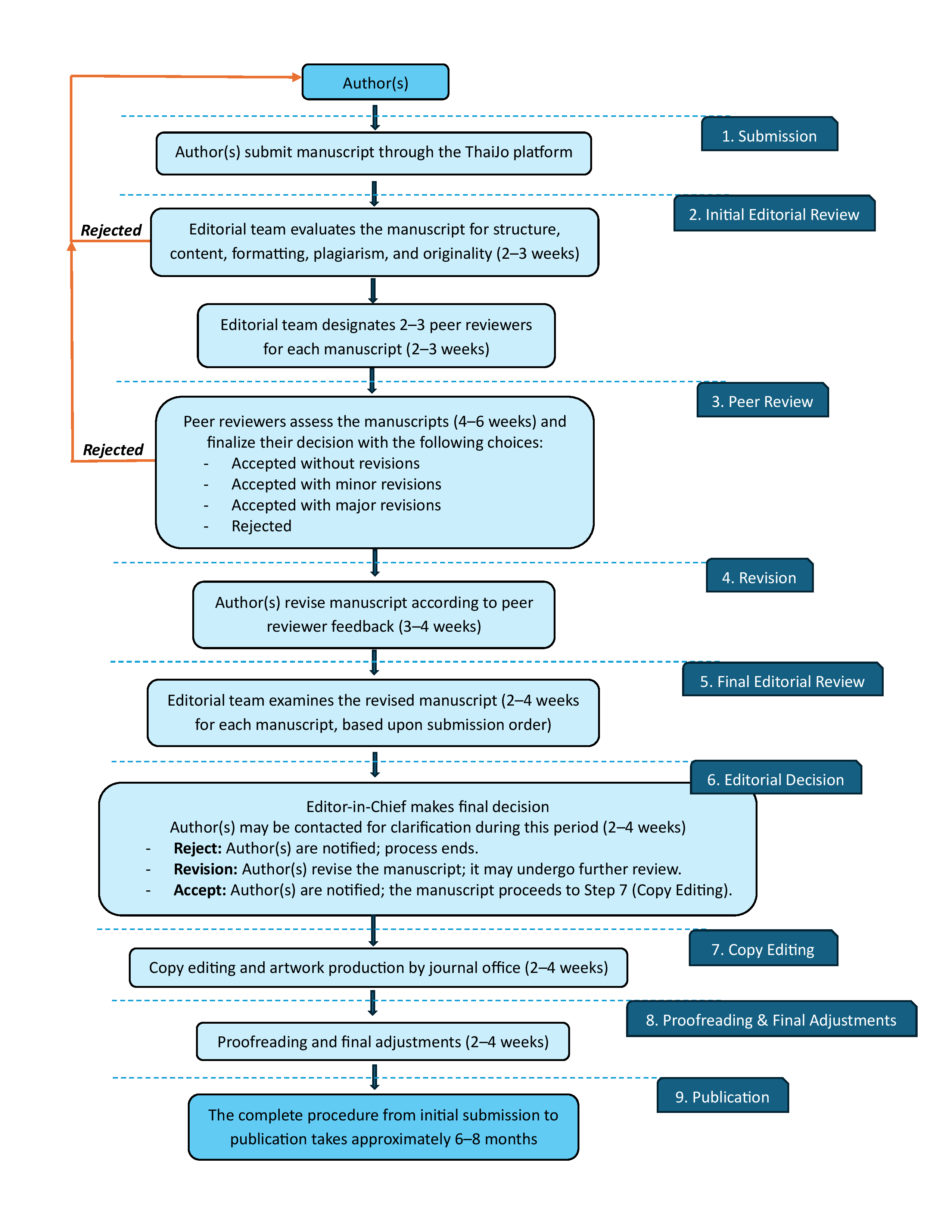
Manuscript Review Process
The manuscript review process is designed to ensure a rigorous, fair, and transparent evaluation of all submitted manuscripts, thereby upholding the quality, credibility, and academic integrity of the journal. Each submission undergoes a structured peer review procedure conducted by qualified experts in the relevant field.
The entire review process typically takes approximately 6–8 months, depending on the complexity of the manuscript and the responsiveness of reviewers and authors. The process consists of the following key steps:
1. Submission
Authors are required to submit their manuscripts through the ThaiJo online submission system (Please click here to submit), which serves as the official platform for initial processing and editorial management. All submissions must adhere to the journal’s author guidelines and formatting requirements to ensure a smooth and efficient review process.
2. Initial Editorial Review (4–6 weeks)
Upon submission, the manuscript undergoes an initial editorial review conducted by the editorial board. This stage involves a comprehensive assessment of the manuscript’s structure, academic quality, content relevance, formatting, originality, and plagiarism compliance. The purpose of this screening is to ensure that only manuscripts meeting the journal’s basic standards proceed to the peer review stage. Manuscripts that do not satisfy the journal’s requirements may be rejected at this stage without external review. For those that pass the initial screening, the editorial board assigns 2-3 qualified reviewers to conduct a double-blind peer review, which typically takes an additional 4–6 weeks.
A manuscript may be rejected during the initial editorial review for the following reasons:
2.1 Out of Scope or Limited Contribution
The manuscript does not align with the journal’s scope or lacks significant academic contribution.
2.2 Plagiarism and Lack of Originality
The manuscript demonstrates a high level of content similarity (generally exceeding 20%) or fails to present original work.
2.3 Insufficient Practical or Research Implications
The study does not provide meaningful theoretical insights or practical relevance.
2.4 Poor Presentation and Non-Compliance with Guidelines
The manuscript contains substantial issues related to formatting, language quality, clarity, or incorrect referencing style.
3. Peer Review (4–6 weeks)
At this stage, the editorial team appoints 2–3 independent peer reviewers who possess relevant expertise in the subject area of the submitted manuscript. To ensure objectivity and avoid potential conflicts of interest, all reviewers are affiliated with institutions different from those of the authors.
The journal has adopted a double-blind peer review process, whereby the identities of both authors and reviewers are kept confidential throughout the evaluation. The peer review process typically takes approximately 4–6 weeks.
During this stage, reviewers critically assess the manuscript’s academic quality, methodological rigor, originality, and contribution to the field. Based on their evaluation, one of the following decisions may be reached:
3.1 Accepted without revisions
The manuscript is considered suitable for publication in its current form. An official acceptance notification will be issued, and the publication process will proceed accordingly.
3.2 Accepted with minor revisions
The manuscript requires minor amendments, such as clarifications or small improvements, in response to reviewers’ comments. Authors are expected to revise and resubmit within a specified timeframe.
3.3 Accepted with major revisions
Substantial revisions are required due to identified weaknesses in the manuscript. The publication decision is deferred until the revised version is re-evaluated.
3.4 Rejected
The manuscript is not suitable for publication due to significant concerns, such as methodological limitations, insufficient evidence, weak argumentation, or critical technical issues. Detailed feedback from reviewers will be provided to support authors in improving their work for potential future submission.
4. Revision (3–4 weeks)
Authors are required to revise their manuscripts in accordance with the reviewers’ comments and resubmit within the specified timeframe. Manuscripts categorized as (3.2) Accepted with Minor Revisions and (3.3) Accepted with Major Revisions must be carefully revised to address all feedback provided.
Authors are also required to submit a detailed response-to-reviewers document (correction form), clearly indicating how each comment has been addressed and where the corresponding revisions have been made in the manuscript.
For manuscripts requiring major revisions, the revised version will typically be evaluated by the editorial team. However, if deemed necessary, or if specifically requested by the reviewers, the revised manuscript may be returned to the original reviewers for further assessment.
The revision process generally takes approximately 3–4 weeks, depending on the extent of the required revisions and the authors’ responsiveness.
5. Final Editorial Review (2–4 weeks)
Following the submission of the revised manuscript, the editorial team conducts a final evaluation to ensure that all reviewer comments and editorial recommendations have been thoroughly addressed. This stage focuses on verifying the completeness, consistency, and academic quality of the revised manuscript.
Manuscripts are processed in accordance with the order of submission to ensure fairness and transparency in the editorial workflow. If any issues remain unresolved, the editorial team may request additional clarification or minor revisions from the authors before proceeding to the final decision stage.
6. Editorial Decision (2–4 weeks)
At this stage, the editorial team makes the final decision regarding the manuscript, based on the reviewers’ reports, the quality of revisions, and the recommendations of the editorial board. The decision may include final acceptance, conditional acceptance, or rejection in rare cases where significant concerns persist. Authors may be contacted during this stage to provide further clarification or supporting information if necessary.
Once a manuscript is accepted, authors will receive an official acceptance notification along with information regarding the next steps in the publication process. At this stage, authors are required to confirm their agreement with the journal’s open-access policy and licensing terms under the Creative Commons Attribution-NonCommercial-NoDerivatives 4.0 International License (CC BY-NC-ND 4.0). This confirmation indicates that the authors grant the journal the right to publish and distribute the article, while allowing users to access and share the work for non-commercial purposes with proper attribution and without modification.
Authors may be asked to provide additional documentation or confirmation through the ThaiJo system for editorial records and acknowledgment.
7. Copy Editing (2–4 weeks)
Accepted manuscripts undergo professional copyediting by the journal office to enhance clarity, coherence, and consistency. This process includes correcting grammatical errors, refining academic language, ensuring adherence to the journal’s style guidelines, and standardizing references and formatting.
In addition, figures, tables, and other visual elements are reviewed and prepared for publication to ensure high-quality presentation.
8. Proofreading & Final Adjustments (2–4 weeks)
After copyediting, the final version of the manuscript (proof) is sent to the authors for review. Authors are responsible for carefully checking the document for any typographical errors, formatting issues, or minor corrections.
Only essential changes are permitted at this stage to avoid delays in publication. Authors are expected to return the corrected proofs within the specified timeframe to ensure timely processing.
9. Publication
Upon completion of all editorial, peer review, and production stages, the manuscript is formally published in the journal. The article may be released in an online issue in accordance with the journal’s publication schedule.
The entire process—from initial submission to final publication—typically takes approximately 6–8 months, depending on the complexity of the manuscript, the review process, and the responsiveness of authors and reviewers.
