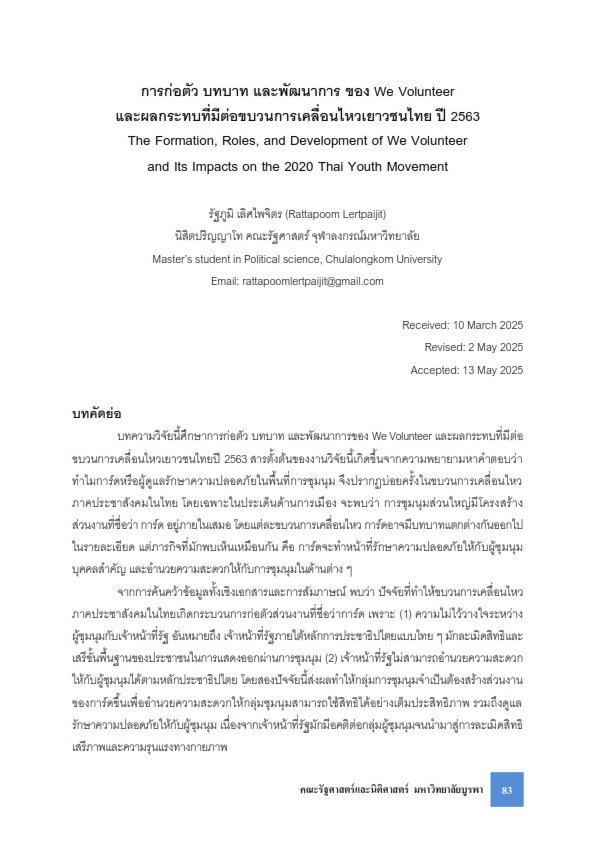
The Formation, Roles, and Development of We Volunteer and Its Impacts on the 2020 Thai Youth Movement
Keywords:
security personnel, We Volunteer, Thai Youth Movement 2020, security, social movementAbstract
This research article examines the formation, role, and development of We Volunteer and its impact on the Thai youth movement of 2020. The foundation of this study arises from the attempt to answer why “guards” or security personnel are frequently seen in protest movements, particularly within the Thai civil society movements, especially in political contexts. It is found that most protests include a section called “the guard” as part of their organizational structure. While the role of the guards may differ in various movements, their primary mission remains consistent: to ensure the safety of protesters, protect key individuals, and facilitate the smooth running of the demonstration.
Through both documentary research and interviews, it was discovered that the factors leading to the establishment of the guard section in Thai civil society movements are: (1) a lack of trust between protesters and state authorities. This refers to the fact that state officials, under the Thai democratic system, often violate the fundamental rights and freedoms of citizens in expressing themselves through protests; and (2) the inability of state authorities to facilitate protests according to democratic principles. These two factors led to the creation of a “guard” section by protest groups to ensure the effective exercise of their rights, as well as to protect the protesters, since state officials often harbor biases against protest groups, resulting in rights violations and physical violence.
In addition to exploring why civil society movements in Thailand require guards, the researcher also studied the formation, role, and development of the We Volunteer group, which acts as security for Thai youth movement in 2020. The study found that the role of We Volunteer is more dynamic than just providing security at protest sites; they also play a crucial role in supporting the effectiveness of Thai youth movement in 2020. Furthermore, the guard section plays an important role in the strategy of nonviolence, which directly affects the success or failure of the movement.
References
ภาษาไทย
กัญมณฑ์ แต้มวิโรจน์. (2566). ประจักษ์ ก้องกีรติ: ความรุนแรงอันชอบธรรมในมือรัฐ กล้าปราบ กล้าสลาย กล้ายิง ต้องกล้าก้มหน้ารับผิดชอบ. วันที่ค้นข้อมูล 27 เมษายน 2567, เข้าถึงได้จากhttps://plus.thairath.co.th/topic/politics&society/103935
ณพัทธ์ นรังศิยา. (2561). จากนักกิจกรรมนักศึกษา สู่นักการเมือง: การเมืองของการก่อตัวของ “การตอบโต้ในสาธารณะ” พ.ศ. 2556 - 2562. จุฬาลงกรณ์มหาวิทยาลัย.
ณรงค์กร มโนจันทร์เพ็ญ. (2566). ดัชนีประชาธิปไตย 2022: นอร์เวย์ครองแชมป์ ขณะที่ไทยอยู่อันดับ 55ของโลก. วันที่ค้นข้อมูล 6 สิงหาคม 2566, เข้าถึงได้จาก https://thestandard.co/world-democracy-index-2022/
ประภาส ปิ่นตบแต่ง. (2552). กรอบการวิเคราะห์การเมืองแบบทฤษฎีขบวนการทางสังคม. โครงการผลิตตำราและเอกสารการสอน, คณะรัฐศาสตร์, จุฬาลงกรณ์มหาวิทยาลัย.
ยอดเยี่ยม ยิ่งยืนยง. (2023). สันติวิธีในทางปฏิบัติ กับความเป็นไปได้ในการบรรลุเป้าหมาย ถอดรหัสความรุนแรงในสังคม. วันที่ค้นข้อมูล 25 สิงหาคม 2567, เข้าถึงได้จาก https://waymagazine.org/decoding-violence-civil-resistance/
รุ่งฤทธิ์ เพ็ชรรัตน์. (2564). เส้นทางการชุมนุม 2565 - 2564 ปรากฏการณ์การปลดแอกของประชาชนในนามราษฎร. วันที่ค้นข้อมูล 5 พฤษภาคม 2567, เข้าถึงได้จาก https://plus.thairath.co.th/topic/politics&society/100117
เศรษฐวัฒน์ โชควรกุล และวิกานดา ชัยรัตน์. (2564). หลักเสรีภาพการชุมนุมสาธารณะในบริบทประเทศไทย. สถาบันพระปกเกล้า.
สมชัย ภัทรธนานันท์. (2559). ทฤษฎีขบวนการเคลื่อนไหวทางสังคม และการประท้วงทางการเมือง. สำนักพิมพ์อินทนิล.
อุเชนทร์ เชียงเสน. (2021). เมื่อรัฐปราบหนัก : การเคลื่อนไหวแบบไม่ใช้ความรุนแรงจะเอาชนะได้อย่างไร. วันที่ค้นข้อมูล 28 เมษายน 2567, เข้าถึงได้จาก https://www.the101.world/nine-proposals-non-violent-action/
world. (2564). อำนาจรัฐ ความรุนแรง บนความเคลื่อนไหวของม็อบประชาชน กับ เบญจรัตน์ แซ่ฉั่ว. วันที่ค้นข้อมูล 11 กุมภาพันธ์ 2567, เข้าถึงได้จาก https://www.the101.world/bencharat-saechua-interview-2/
ภาษาอังกฤษ
Chenoweth, E., & Stephan, M. J. (2011). Why Civil Resistance Works: The Strategic Logic of Nonviolent Conflict. Columbia University Press.
Klandermans, K., Stekelenburg, J. V., & Walgrave, S. (2014). Comparing street demonstrations. SAGE Journals.
Lipsky, M. (1968). Protest as a political resource. American Political Science Review, 62(4), 1144-1158
Mulloy, D. J. (2005). American extremism: History, politics and the militia movement. Routeledge.
McCarthy, J. D., & Zald, M. N. (1977). Resource mobilization and social movements: A partial theory. American Journal of Sociology, 82(6), 1212-1241
Olson, M. (1965). The Logic of Collective Action. Schocken.
Snow, D. V., Soule, S. A., & Kriesi, H. (2004). The blackwell companion to social movements. Blackwell Publishing.