
Guidelines for Adaptation of the Tourism Industry to Sha Standard After Covid-19 in Maehongson Province
Article Sidebar
Main Article Content
Abstract
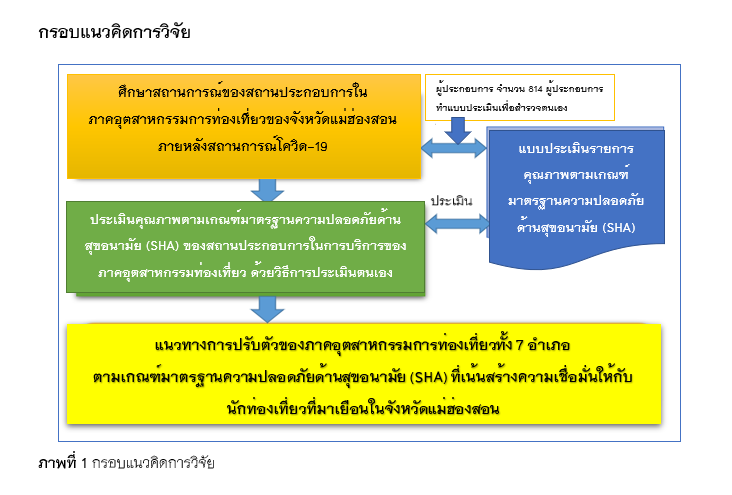
This participatory action research (PAR) aimed to: 1) study the situation of tourism industry establishments in Mae Hong Son Province after the COVID-19 pandemic, 2) assess the quality according to the Safety and Health Administration (SHA) standards in tourism industry, and 3) propose guidelines for the adaptation of the tourism industry in all 7 districts according to the Standard SHA criteria, focusing on building confidence among tourists visiting Mae Hong Son Province after the COVID-19 pandemic. The sample group consisted of tourism service operators from the 7 districts who were eligible for evaluation under the SHA standards, selected through purposive sampling, totaling 814 operators. The research tool used was a set of 12 assessment forms for evaluating establishments' preparedness towards SHA standards. The study results revealed that: 1. after the COVID-19 pandemic, the tourism industry in Mae Hong Son Province was slowly recovering. The number of tourists had not yet returned to pre-pandemic levels. Establishments had adapted by implementing hygiene measures and online marketing. The government had supported through promotion projects and financial aid, but economic impacts still caused financial problems for many businesses. 2. The quality assessment according to SHA standards found that the overall quality of establishments met the basic SHA requirements, with a compliance rate of 76.9% to 85.5%. The quality assessment across 10 types of businesses showed most complied with SHA standards, except for tour companies, sports tourism, and event organizing businesses, which did not meet the standards and need improvement. Lastly, 3. the adaptation guidelines for the tourism industry in all 7 districts according to SHA standards proposed categorizing operators into two groups: Group 1 consisted of operators who were ready to apply for SHA certification; they should be promoted and pushed to meet SHA standards promptly to build tourist confidence and revive the tourism industry and economy of Mae Hong Son Province. Group 2 included operators preparing for SHA evaluation; they should receive training and understanding of SHA standards to prepare for the program, which would help raise standards and build long-term tourist confidence.
Downloads
Article Details

This work is licensed under a Creative Commons Attribution-NonCommercial-NoDerivatives 4.0 International License.
The articles published are copyrighted by the Graduate School, Chiang Mai Rajabhat University.
The opinions expressed in each article of this academic journal are solely those of the individual authors and do not reflect the views of Chiang Mai Rajabhat University or its faculty members. The responsibility for the content of each article rests entirely with the respective authors. In the event of any errors, the authors alone are responsible for their own articles.
References
Boonprasom, N. (2018). Development guidelines for exhibition venues in the Mice industry: A case study of venues in Bangkok. Southeast Bangkok Journal, 4(2), 93-104. [In Thai]
Chokjaraskul, K. (2020). How to manage? ‘Dangerous wastes’ silent threats in the COVID era. Retrieved from https://inews.bangkokbiznews.com/read/403237 [In Thai]
Department of Health. (2020). Measures and guidelines handbook for hygienic environments in the Corona virus 2019 pandemic (COVID-19). Bangkok: Ministry of Public Health. [In Thai]
Digital Research Information Center (DRIC). (2020). Conclusion of every issues on “Corona virus” or “COVID-19” What is it? and What are the symptoms?. Retrieved from https://dric.nrct.go.th/News/DetailKnowledge/650 [In Thai]
Johnson, A., & Lee, M. (2021). Adapting tourism businesses during the COVID-19 pandemic: Case studies and strategies. International Journal of Tourism Management, 42(1), 45-60. https://doi.org/10.5678/ijt.2021.01234
Krutwaysho, O., Yamma, Y., Srina, P., Julapan, P., Wajanakhampee, T., & Treesuk, W. (2021). Tourism development through the service marketing concept from the perspectives of Gen Y tourism travelling in Chiangmai during the COVID-19 pandemic crises during the spread. Raja park Journal, 15(41), 242-258. [In Thai]
Ministry of Tourism and Sport. (2020). Tourism situations in april 2020. Retrieved from https://www.mots. go.th/download/article/article_20200529103312.pdf?fbclid=IwAR1IDduOGE0E5VJy8CnJuVAl1J57UMnkZ2NvHUJqRFhsQ6PbotUlZ1AFxI [In Thai]
Panuwatthana, S., and Umaphorn, M. (2021). Adaptation of Thai boxing camps entrepreneurs' amid the COVID-19 Pandemic in Phuket Province. Journal of International and Thai Tourism, 17(1), 164-181. [In Thai]
Srimaca, S., & Muneenam, T. (2021). Assessment of Business Preparedness for Safety and Health Administration Standards. Journal of Tourism Management, 25(3), 123-145. [In Thai]
Tourism Authority of Thailand [TAT]. (2020). Hygienic safety standard project implementation plan: Amazing Thailand Safety & Health Administration (SHA). Bangkok: TAT. [In Thai]
Tourism Authority of Thailand. (2021). Assessment form for businesses in preparation for the Safety and Health Administration (SHA) standards. Retrieved from https://www.thailandsha.com [In Thai]
Tourism Authority of Thailand (Head office). (2022). Amazing Thailand Safety and Health Administration (SHA) (thailandsha.com). Retrieved from https://web.thailandsha.com/shalists?keyword=&province=58&type=1&fbclid=IwAR1s2O5s6_spLM24Al7Ebc1p_bYwHRUNEvi9AkoDHr36SMP-liVmchwgABU [In Thai]
