
A Comparative Study of Classifier Omission Collocates with Nouns in Chinese and Thai
Article Sidebar
Main Article Content
Abstract
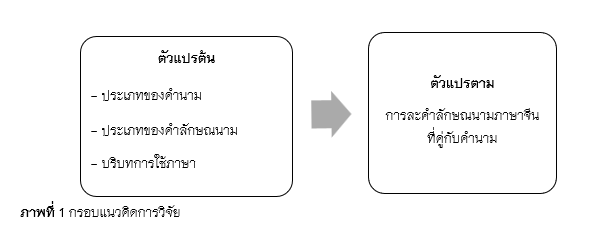
This qualitative research aimed to: 1) study the rules of classifier omission collocated with noun in Chinese, and 2) compare the similarities and differences with its equivalent in Thai by using secondary data and Chinese sentences recording form as tools for data revision and collection. The findings of this study had shown that there were 3 cases that classifier in Chinese could be omitted: 1) in the context of news writing, especially the headline; 2) for referring the person or things mentioned before; 3) for telling the amount or elements of 2 or more things. There were 4 types of classifiers those couldn’t be omitted: 1) quantifier measure word; 2) classifier that told the number of pairs or groups; 3) classifier for approximation; and 4) classifier for telling the time. When it was compared with its equivalents in Thai, it showed that there were 2 similar cases including 1) the context of news writing; 2) when telling the amount or elements of 2 or more things, and there was 1 different case, which was when the person or things mentioned before were referred. For the classifiers those couldn’t be omitted, there were 3 similar cases including 1) quantifier measure word; 2) classifier that told the number of pairs or groups; 3) classifier for telling the time; 4) classifier for approximation.
Downloads
Article Details

This work is licensed under a Creative Commons Attribution-NonCommercial-NoDerivatives 4.0 International License.
The articles published are copyrighted by the Graduate School, Chiang Mai Rajabhat University.
The opinions expressed in each article of this academic journal are solely those of the individual authors and do not reflect the views of Chiang Mai Rajabhat University or its faculty members. The responsibility for the content of each article rests entirely with the respective authors. In the event of any errors, the authors alone are responsible for their own articles.
References
Catford, J. C. (1968). Contrastive analysis and language teaching. In James E. Alatis, Monograph Series on Languages and Linguistics 19th Annual Round Table Contrastive Linguistics and Its Pedagogical Implications. School of Languages and Linguistics, Georgetown University.
Chaisathaphol, S. (2000). A comparative study of classifiers in mandarin and Thai. (Master’s thesis, Chinese Language, Chulalongkorn University). [In Thai]
Chalainanont, S. (2019). A comparison of Chinese and Thai classifiers and new nouns collocations. Journal of Translation and interpretation, 01(2), 88-122.
Huang, J. (2003). Shenglue “yi” he Shenglue Liangci. Qinghai Jiaoyu, 11. [In Chinese]
Jongsirichoke, C. (1987). Evolution of classifiers in the Rattanakosin period. (Master’s thesis, Thai Language, Thammasat University). [In Thai]
Liu, R., & Xu, J. (2022). Biaotizhong de Liangci Shenglue ji qi Lilun Jieshi. Huawen Jiaoxue yu Yanjiu (TCSOL Studies), 02, 86. [In Chinese]
Liu, Y. (2001). Shiyong Xiandai Hanyu Yufa [Practical Modern Chinese Grammar]. Beijing: The Commercial Press. [In Chinese]
Permkesorn, N. (2002). Characteristics of language use in Thai newspapers. Vannavidas Journal, 02(2), 126-136. [In Thai]
Phudhichareonrat, K. (2003). The omission of Thai classifiers. (Master’s thesis, Thai Language, Kasetsart University). [In Thai]
Sun, J. (2016). “Mei+Yi+Liangci+Mingci” Jiegouzhong “Yi” he “Liangci” de Yinxian Guilu Yanjiu. Xiandai Yuwen, 57-58. [In Chinese]
Wongpinunwatana, W. (2021). Language and mass communication. Khon Kaen: Faculty of Humanities and Social Sciences, Khon Kaen University. [In Thai]
Xu, H. (2020). Shilun “shuci+Liangci+Mingci” Jiegouzhong Liangci de Shenglue Qingkuang. Hanzi yu Wenhua, 9, 255. [In Chinese]
Xu, J. (2015). Yuyan Tequ de Xingzhi yu Leixing. Dangdai Xiucixue, 04, 190. [In Chinese]
Yuan, S. (2011). Ying-Han Suolueyu de Yuyi ji Yuyong Bijiao. Journal of Zhengzhou University of Light Industry (Social Science), 01, 12. [In Chinese]
