
The Analysis of Folklore in Textbooks for the Basic Thai Language Anliterature Appreciation Course. Secondary School Year 1 According to the Basic Education Core Curriculum, B.E. 2008
Article Sidebar
Main Article Content
Abstract
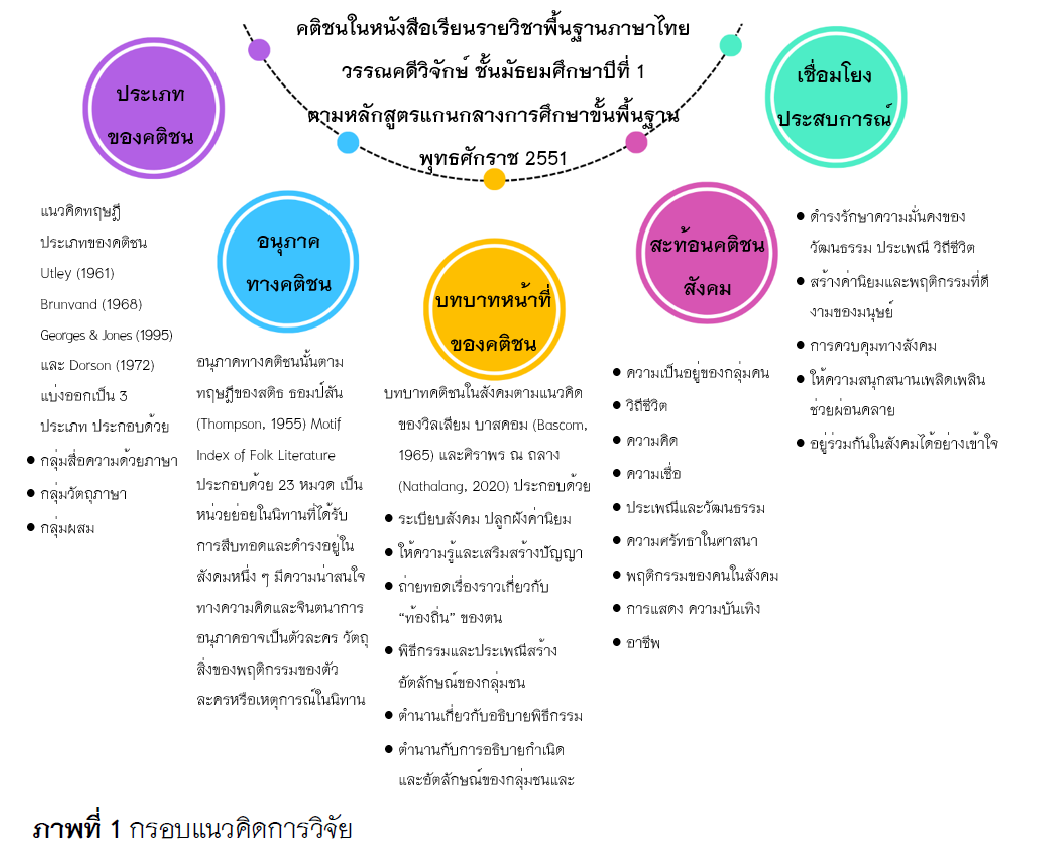
This research aimed to: 1. analyze the types of folklore, 2. analyze folklore particles, 3. analyze the role of folklore in society, 4. analyze reflections of folklore on society way of life and connections to real life experiences. The data source for the research was textbooks for the basic Thai language course, Literary appreciation Mathayom 1 level according to the Basic Education Core Curriculum, B.E. 2008. The research instrument was a folklore analysis recording form in the basic Thai language textbook. Literary appreciation Mathayom 1 students. Analyze. Data was analyzed by basic statistics, such as frequency, percentage, content analysis, and analytical induction, the written in the form of an essay.
The results of the research found that: 1. types of folklore found included: language communication group accounting for 58.47 percent, linguistic object group accounting for 31.70 percent and mixed folklore accounting for 9.83 percent, respectively. 2. Folklore particle data found included Category F: Strange and Wonderful accounts for 64.29 percent, Category D: Magic accounts for 17.86 percent, Category V: Religion accounts for 7.14 percent, Category B: Animals, Category G: Giants, and Category T: Sexuality accounts for 3.57 percent, respectively. 3. Information on the role and duties of folklore in society consisted of role of folklore in education training in social regulations and maintaining social standards of behavior in the dimension of the role of folklore in cultivating social order Cultivate values and maintain behavioral norms for society accounting for 49.53 percent, the role of folklore in providing knowledge and enhancing wisdom. accounted for 22.43 percent and the role of folklore in conveying stories about their "locality" accounted for 17.76 percent and also found a relationship between the role of folklore in society and the role of folklore in explaining the origins and identity of Ethnic groups and rituals in the dimensions of rituals and traditions create the identity of the racial or ethnic group Accounting for 6.54 percent, legends explain rituals. accounting for 2.80 percent and legends and explanations of the origin and identity of ethnic groups and the status of people in society Accounting for 0.94 percent, respectively. 4. Reflects stories related to folklore information such as idioms, proverbs, legends, ways of life, beliefs, rituals, settlements, livelihoods, religion, cultural traditions, civilization, social values and ways of life. historical value to promote awareness and appreciation of the wisdom of civilization that our ancestors have accumulated and transmitted. Be proud of being a Thai nation. In addition, there is folklore information in the textbooks for basic Thai language courses. Literary appreciation Mathayom 1 students can connect real life experiences to develop guidelines for how to behave in order to develop themselves. So that practitioners can live together in society with understanding and happiness.
Downloads
Article Details

This work is licensed under a Creative Commons Attribution-NonCommercial-NoDerivatives 4.0 International License.
The articles published are copyrighted by the Graduate School, Chiang Mai Rajabhat University.
The opinions expressed in each article of this academic journal are solely those of the individual authors and do not reflect the views of Chiang Mai Rajabhat University or its faculty members. The responsibility for the content of each article rests entirely with the respective authors. In the event of any errors, the authors alone are responsible for their own articles.
References
Attagara, K. (1977). Folklore. Bangkok: Teachers Council. [In Thai]
Bascom, W. (1965). Four functions of folklore. In Alan Dundes (ed.), The study of folklore, (pp. 279-298). New Jersey: Prentice-Hall.
BoonIntr, S. (2018). Location and home décor that reflect lifestyle and beliefs of Huathakae old Market waterfront Community. Patanasilpa, 2(Special), 289-302. [In Thai]
Brunvand, J. H. (1968). The study of American folklore: An introduction. (2nd ed.). New York: W.W. Norton and Co.
Dorson, R. M. 1972). Folklore and folklife an introduction. Chicago: University of Chicago Press.
Georges, R. A. and Jones, M. O. (1995). Folkloristics: An introduction. Indiana: Indiana University Press.
Homfung, C. and Ruamsuk, S. (2016). Folklore teaching with development 21st century skills of learner and enhancement pride in Thai wisdom. Veridian, 9(2), 1549-1563. [In Thai]
Jun, F. (2014). Chinese chess playing in Thai society: Background and development. (Master’s thesis, Huachiew Chalermprakiet University). [In Thai]
Leach, M. (1984). Standard dictionary of folklore, mythology, and legend. New York: Funk & Wagnalls.
Luangluang, P. and Buahom, K. (2020). Benefits of folklore mentioned in “WannakhadiLamnam”, a set of secondary school book toward Thai literature. Sakon Nakhon: Kasetsart University, Chaloem Phrakiat Campus Sakon Nakhon Province. [In Thai]
Marknuan, P. (2013). The role and transmission of magic and ritual in folk healers at Ban Nong Khao Changwat Kanchanaburi. (Master’s thesis, Chulalongkorn University). [In Thai]
Nathalang, S. (2020). Folklore theory: Methodology for analyzing legends and folktales. (4th ed.). Bangkok: Chulalongkorn University. [In Thai]
Nimmanhaemin, P. (2000). Folktale studies. Bangkok: Faculty of Arts Textbook Project Chulalongkorn University.
Office of The Basic Education Commission. (2021). Basic course book, Thai language, literary appreciation. Mathayom 1 level. (15th ed.). Bangkok: SKSC Printing House, Lat Phrao. [In Thai]
Petcharoen, S. (1994). An analytical study of folklore in Thai language related skill series textbook one for Mathayonsuksa one revised edition 2533. (Master’s thesis, Kasetsart University). [In Thai]
Sripachai, L. (2018). Luang Prabang spirits: Beliefs rituals and social roles in world heritage city. (Doctorate’ Dissertation, Khon Kaen University). In Thai]
Thompson, S. (1955). Motif-Index of folk literature. (6th ed.). Bloomington: Indiana University Press.
Utley, F. L. (1961). Folk literature: An operational definition. The Journal of American Folklore, 74(293), 193-206.
Wannakit, N. (2012). Motifs of supernatural birth in Jataka, Thai myths and folktales. Manutsayasat Wichakan, 19(2), 60-86. [In Thai]
Winithasathitkul, P. and Jiramethi, J. L. (2015). Folklore: beliefs and Thai society. MCU Humanities Review, 1(1), 31-44. [In Thai]
