
Living Museum Design Guidance for Cultural Tourism: Inthakhin Community, Mae Taeng, Chiang Mai
Article Sidebar
Main Article Content
Abstract
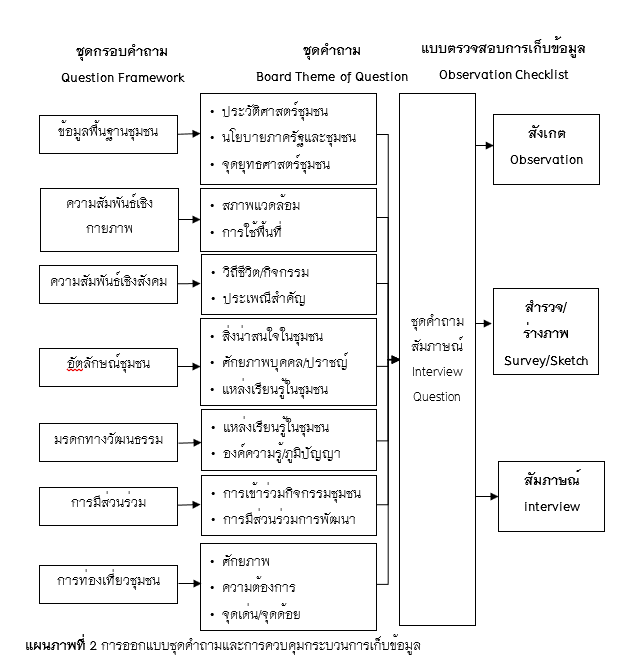
Inthakhin Community is a community on the edge of the Muangkaen plain basin. It has a history more than 700 years since 1801 B.E. It has the cultural wisdom of ancient ceramic kilns and is an important cultural heritage source. The lack of management of community museums has resulted in the near disappearance of wisdom and cultural heritage. This research aimed to be a database of cultural heritage and tourist attractions of the Inthakhin Community in order to create guidelines for managing a living museum by using the community's identity in the design, using a multi-theoretical framework in environment, local identity, community tourism, conservation, participation, and living museum. The research sample consisted of 34 community residents, 5 local philosophers, and 3 representatives of relevant local agencies. The research method used a qualitative survey using in-depth interviews and community inquiries to analyze community characteristics, problems, and needs, using a community participation approach to verify the accuracy of the information. The results of the study found that the identity of the Inthakhin Community consisted of 5 elements: 1) the physicality of the three-river basin area, 2) the evolution of the community history, 3) elements of a rural Lanna village, 4) a learning area for lifestyles and culture, and 5) traditions and rural culture. The study results of the Inthakhin Community Living Museum design were as follows: 1) synthesizing historical data and linking it to the community's potential area, 2) disseminating information on the identity of the potential area for community review, 3) designing and improving the community exhibition space by participating, 4) participating in activities in the cultural area, and 5) evaluating and summarizing project. In sustainable community development, every operational step should emphasize community participation.
Downloads
Article Details

This work is licensed under a Creative Commons Attribution-NonCommercial-NoDerivatives 4.0 International License.
The articles published are copyrighted by the Graduate School, Chiang Mai Rajabhat University.
The opinions expressed in each article of this academic journal are solely those of the individual authors and do not reflect the views of Chiang Mai Rajabhat University or its faculty members. The responsibility for the content of each article rests entirely with the respective authors. In the event of any errors, the authors alone are responsible for their own articles.
References
Bhattarabhatwong, P. (2021). Management evaluation of Inthakin Kiln Site Museum, Mae Tang, Chiang Mai. (Master thesis, Arts Cultural Management, College of Innovation, Thammasat University). [In Thai]
Chaleyjunya, P. and Boonyasurat, W. (2014). Museum Management of Inthakin Potteries Site (Muang Kaen) Mat Tang District, Chiang Mai Province with community participation. The Golden Teak: Humanity and Social Science Journal, 20(2.4), 137-142. [In Thai]
Cohen, J.M. and Uphoff, N. (1981). Rural development participation: Concept and measures for project design implementation and evaluation. Rural Development Committee Center for International Studies. New York: Cornell University.
Faculty of Engineering, Chiang Mai University, Faculty of Economics, Chiang Mai University, Faculty of Architecture, Chiang Mai University, Faculty of Art and Architecture, Rajamangala University of Technology Lanna, & Faculty of Engineering, Rajamangala University of Technology Lanna. (2010). Conceptual design and feasibility for the living museum for Mae Hong Son City. Bangkok: The Thailand Research Fund (TRF). [In Thai]
Hamsupho, S. (2000). Population and development of quality of life. Bangkok: O.S. Printing House. [In Thai]
Kanokmongkol, N. (2011, January - March). Life has a museum Living museum of the Japanese people. Muang Boran Journal, (1), 124-133. [In Thai]
Musigakama, N., Chanphosi, K., & Toumcharoen, M. (1978). Museum studies. Bangkok: Thai Watana Panich. [In Thai]
Office of the Education Council. (2010). Integrating intellectual power to develop community learning centers. Bangkok: Foundation for the Development of Thai Education. [In Thai]
Oranratmanee, R. (2009). Vernacular architecture: architectural education, research and practice. Journal of The Faculty of Architecture King Mongkut's Institute of Technology Ladkrabang, (8), 56-66. [In Thai]
Pongnak, I. & Disatapunahu, S. (2015). The Communityidentity of The Ancient Town of U-Thong Suphanburi Province. Veridian E-Journal Slipakorn University, 8(3), 511-523. [In Thai]
Rattanachuchok, P. and Maneelert, C. (2022). Development of learning application on Intakhil kiln and earthenware production. Rajamangala University of Technology Srivijaya Research Journal, 14(3), 843-857. [In Thai]
Sitthithanyakij, P. (1994, June). Local Museum of Community Life. Art and Culture Magazine, (8), 81. [In Thai]
Tanupol, N., Peng-ont, D., Tanupol, S., Charungkhon, C., Poonoi, S., & Supalak, M. (2000). Development of ecotourism business in Bangpong Community, Sansai District, Chiang Mai. Thailand: Maejo University. [In Thai]
Thongpoon, S., Thongpoon, K., & Thongpoon, Kh. (2020). The community identity study for promoting tourism in Lanka Community, Suphanburi Province. In The 11th Hatyai National and International Conference, (pp. 948-953). 17 July 2020. Songkhla: Hatyai University. [In Thai]
Wattanakit, S. and Noisangiam, N. (2022). A study of community identity as a guideline for architectural design at Palian River Basin, Trang province. Parichart Journal, 35(1), 187-202. [In Thai]
