
The Development of Imaginary Story Writing Ability of Prathomsuksa 6 Students Using Synectics and Graphic Organizer
Article Sidebar
Main Article Content
Abstract
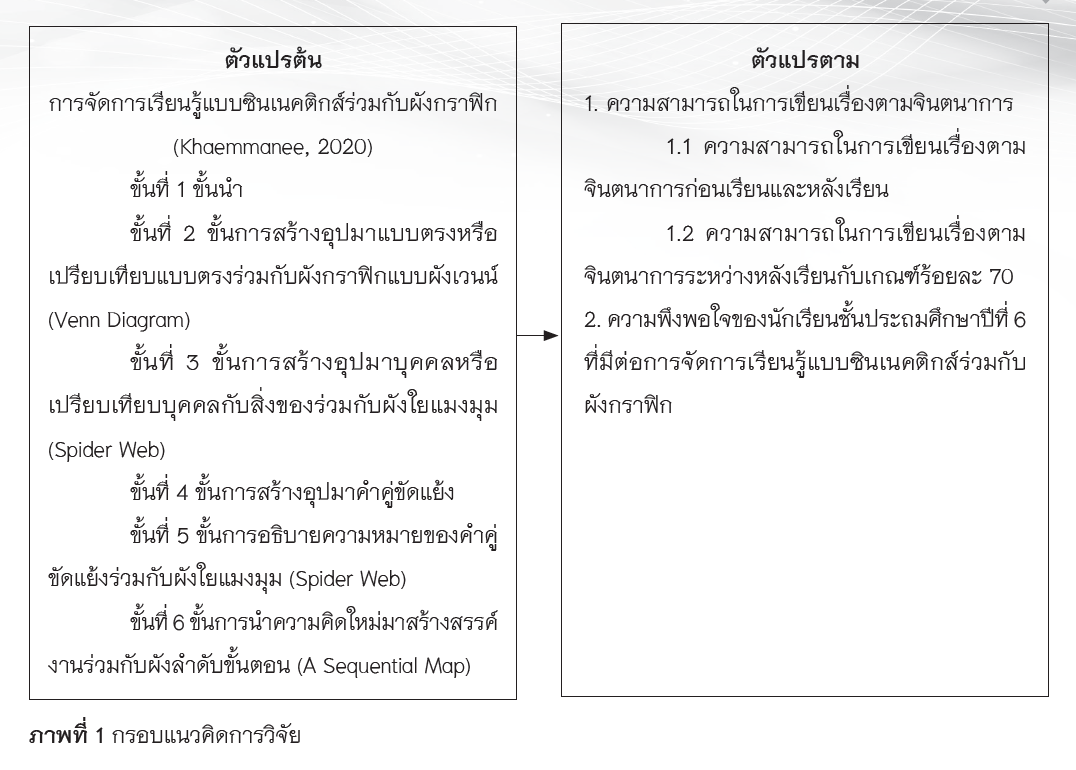
The purpose of this research were to 1) compare the ability to write imaginative stories of grade 6 students before and after the Synectics learning management combined with graphic organizers, 2) compare the ability to write imaginative stories of grade 6 students by organizing Synectics learning together with graphic organizers during the post-class and the criteria of 70 percent, and 3) study the satisfaction of grade 6 students with synectics learning management combined with graphic organizers. The population included students in grade 6, semester 2 in academic year 2023, the Taphanhin Coordination Center School Group 02, a total of 111 students. The sample group was 16 students in grade 6 at WatSattawanaram School, semester 2, academic year 2023 by cluster random sampling. The tools used in the research consisted of: 1) Lesson plans for writing imaginary stories for grade 6 students using Synectics learning combined with graphic organizers, 2) a test to measure ability in the aspect of writing imaginative stories, and 3) a questionnaire on satisfaction with the learning management plan using Synectics learning management together with graphic organizers of grade 6 students. The data were analyzed by mean, standard deviation, Dependent t-test, and One-Sample t-test.
The results of the research found that 1) the ability to write imaginative stories of grade 6 students after studying was significantly higher than before studying at the .05 level. 2) The ability to write imaginative stories of grade 6 students' scores after learning were higher than the t criteria of 70 percent with statistical significance at the .05 level. 3) Students’ satisfaction with the Synectics learning management combined with graphic organizers was at the highest level.
Downloads
Article Details

This work is licensed under a Creative Commons Attribution-NonCommercial-NoDerivatives 4.0 International License.
The articles published are copyrighted by the Graduate School, Chiang Mai Rajabhat University.
The opinions expressed in each article of this academic journal are solely those of the individual authors and do not reflect the views of Chiang Mai Rajabhat University or its faculty members. The responsibility for the content of each article rests entirely with the respective authors. In the event of any errors, the authors alone are responsible for their own articles.
References
Chansuksri, P. (2008). Thai language teaching manual think and write creatively: Essay and summary. Bangkok: OTEP Printing House. [In Thai]
Chitchayavanich, K. (2020). Learning management. Bangkok: Chulalongkorn University. [In Thai]
Chiwapan, A. (2018). Creative writing activities in primary school. Bangkok: Publisher of Chulalongkorn University. [In Thai]
Cronbach, L. J. (1990). Essentials of psychological testing. (5th ed.). New York: Harper Collins Publishers
Khaemmanee, T. (2020). Teaching science: Knowledge for organizing effective learning processes. Bangkok: Chulalongkorn University. [In Thai]
Laoriandee. W. (2012). Learning management formats and strategies to develop thinking skills. (9th ed.). Nakhon Pathom: Faculty of Education. Silpakorn University Sanam Chandra Palace Campus. [In Thai]
Ministry of Education. (2008). Basic Education Curriculum 2008. Bangkok: Teachers Council of Ladprao. [In Thai]
Mongkolmuang, M. (2018). The compare ability of creative writing of Prathom Suksa 3 students Bangkhuntiensuksa School by using a synectics and traditional teaching methods. (Master's thesis, Teaching Thai Ramkhamhaeng University). [In Thai]
Munkham, S. and Munkham, O. (2008). 21 learning management methods: To develop thinking processes.
Nantasena, A. (2017). A study of creative writing ability for Matthayomsuksa 1 students using Synectics model. (Master's thesis, Curriculum and Instruction Nakhon Ratchasima Rajabhat University). [In Thai]
Niyomsap, N. (2017), Basic knowledge in teaching and learning. Nakhon Pathom: Rajabhat University Nakhon Pathom. [In Thai]
Pimpalab, P. (2022). Learning management for synectics instruction model to promote creative writing ability of grade 5 students. (Master's thesis, Curriculum and Instruction Mahasarakham University). [In Thai]
Phetnadi, K. (2022). The development of learning achievement on creative writing by using the Synectics pattern with the worksheet of Frist year vocational certificate students. (M.Ed. Independent Study, Thai Language Naresuan University). [In Thai]
Saengyaruk, P. (2021). Learning management of synectics instruction model for developing creative writing skills of Matthayomsuksa 1. (M.Ed. Independent Study, Thai Language Naresuan University). [In Thai]
Sinthaphanon, S., Sukying, F., Veerakiatsunthorn, J., & Naparat, P. (2019). Various teaching methods to develop the quality of Thai youth. Bangkok: 9119 Printing Techniques Ltd. [In Thai]
Sreponpa, S. (2014). The development of Thai language creative writing ability for Prathomsuksa 4 students through synectics activities. (Master's thesis, Curriculum and Instruction Rajabhat Rajanagarindra University). [In Thai]
Wajanasatian, C. (2016). The development of creative writing ability for grade 3 student taught by using Synectics model. (Master's thesis, Curriculum and Instruction Silpakorn University). [In Thai]
Walliyamethi, S. (2017). Synectics learning activity model to develop writing skills created for students in grades 4-6 at Ban Hat Song Kwae School, Tron District. (Master's thesis, Curriculum and Instruction Uttaradit Rajabhat University). [In Thai]
Wat Satta Wanaram School. (2021). Self-assessment report: SAR, 2021. Phichit: Wat Satta Wanaram School. [In Thai]
