Dear Esteemed Readers,
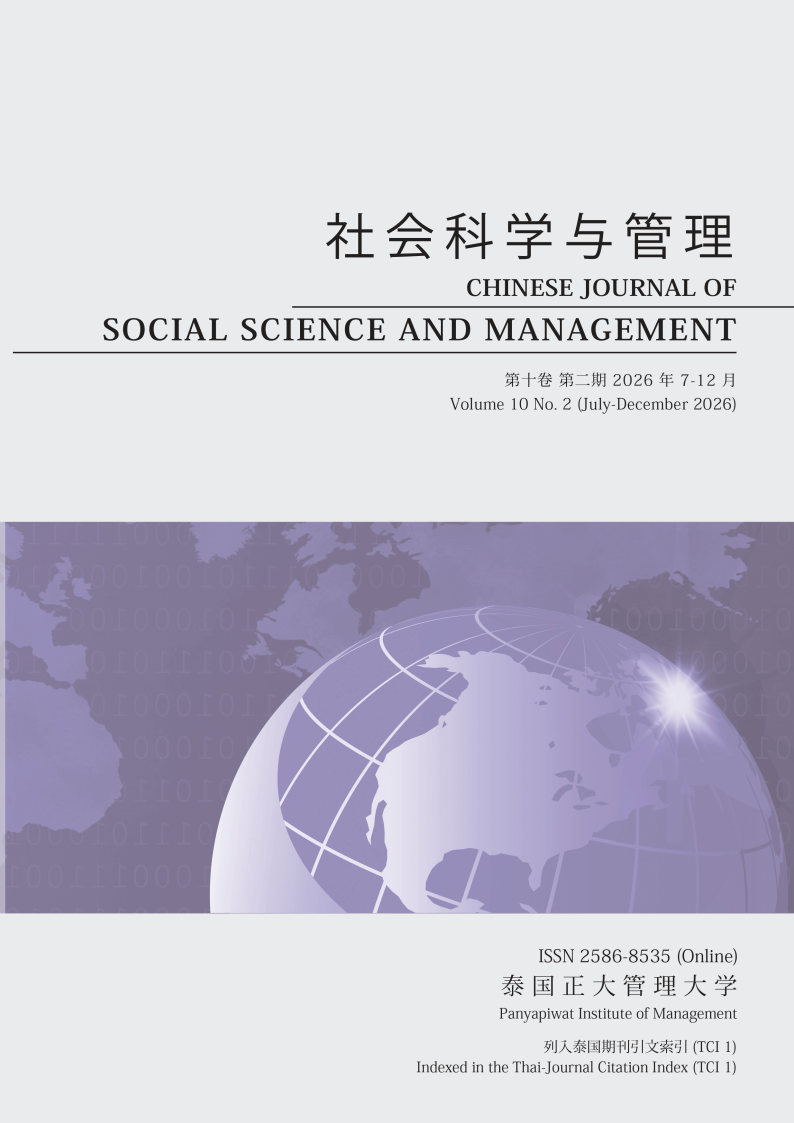
It is with great pleasure that we present Volume 10, Issue 2 (July-December 2026) of the Chinese Journal of Social Science and Management (CJSSM). This issue continues the journal’s commitment to advancing high-quality interdisciplinary scholarship and strengthening academic exchange across disciplines, institutions, and national boundaries.
As a Tier 1 journal (TCI 1), CJSSM remains dedicated to providing a scholarly platform that connects theoretical inquiry with practical relevance while bringing together regional perspectives and broader international academic discourse. Building on the journal’s growing international engagement and inclusion of both Chinese- and English-language scholarship, this issue further reflects the diversity and evolving scope of research in the social sciences and management.
This issue features twenty peer-reviewed articles contributed by scholars affiliated with universities and academic institutions in Thailand and China. The collection encompasses a broad range of contemporary research themes, including:
• Digital Transformation, Technology, and Education: digital adaptation pathways among university faculty, UX/UI requirements for online English learning platforms, acceptance and use of digital Chinese learning applications, and artificial intelligence technology use among university teachers;
• Business, Management, and Organizational Studies: digital leadership, innovative self-efficacy, employee performance, emotional labor, work engagement, inclusive leadership, proactive behavior, improvisation, and task performance;
• Consumer Behavior, Marketing, and Tourism: social capital and destination attributes in tourism, Generation Y’s revisit intentions, rejuvenation strategies for time-honored brands from a Generation Z perspective, and continuance intention in Douyin live-streaming e-commerce;
• Sustainability, Governance, and Investment: ESG investment, corporate governance, organizational culture, and sustainable corporate growth;
• Higher Education and International Student Mobility: factors influencing Chinese university students’ intentions to study in Thailand and the pathways and group differences among Chinese students pursuing doctoral studies in Southeast Asia;
• Language, Media, Literature, and the Arts: Content and Language Integrated Learning (CLIL), translation errors in scholarly publications, film and television adaptations of Chinese novels, Tang Dynasty female poets, the transformation of television news anchors in converged media, and the relationship between punk culture and contemporary artistic movements.
Taken together, the studies in this issue demonstrate the increasingly interdisciplinary nature of contemporary social science and management research. Several contributions draw upon established theoretical perspectives—including Actor–Network Theory, social capital theory, UTAUT and UTAUT2, Conservation of Resources Theory, the Theory of Planned Behavior, Social Cognitive Theory, and academic capital—to examine emerging phenomena across educational, organizational, technological, cultural, and social contexts.
The geographical and institutional diversity represented in this issue also reflects CJSSM’s continuing role as a platform for academic exchange between Thailand and China. Through studies addressing both locally grounded issues and broader regional developments, the contributions provide insights that may be valuable to researchers, educators, organizational leaders, policymakers, and practitioners confronting rapid technological, economic, and social change.
Looking ahead, we are pleased to announce an important development in the journal’s publication schedule. Beginning in 2027, CJSSM will increase its publication frequency from two to three issues per year. This change reflects the journal’s continued growth and our commitment to providing authors with more opportunities to disseminate their research while enabling readers to access new scholarly contributions more frequently. We believe this development represents another important step in strengthening CJSSM’s role as a platform for high-quality academic exchange and expanding its contribution to the international scholarly community.
As CJSSM continues to strengthen its academic quality and international engagement, we remain committed to the principles of academic integrity, rigorous peer review, ethical publishing, and interdisciplinary dialogue. We hope that the studies presented in this issue will stimulate further scholarly discussion, encourage new avenues of inquiry, and contribute meaningfully to the advancement of knowledge across the social sciences and management.
We extend our sincere appreciation to all authors for entrusting their research to CJSSM, to our reviewers for their expertise and dedication, and to our readers for their continued interest and support.
With warm regards,
Asst. Prof. Dr. Pak Thaldumrong
Editor-in-Chief
Chinese Journal of Social Science and Management (CJSSM)
Published: July-December 2026
Published: 2026-11-13