
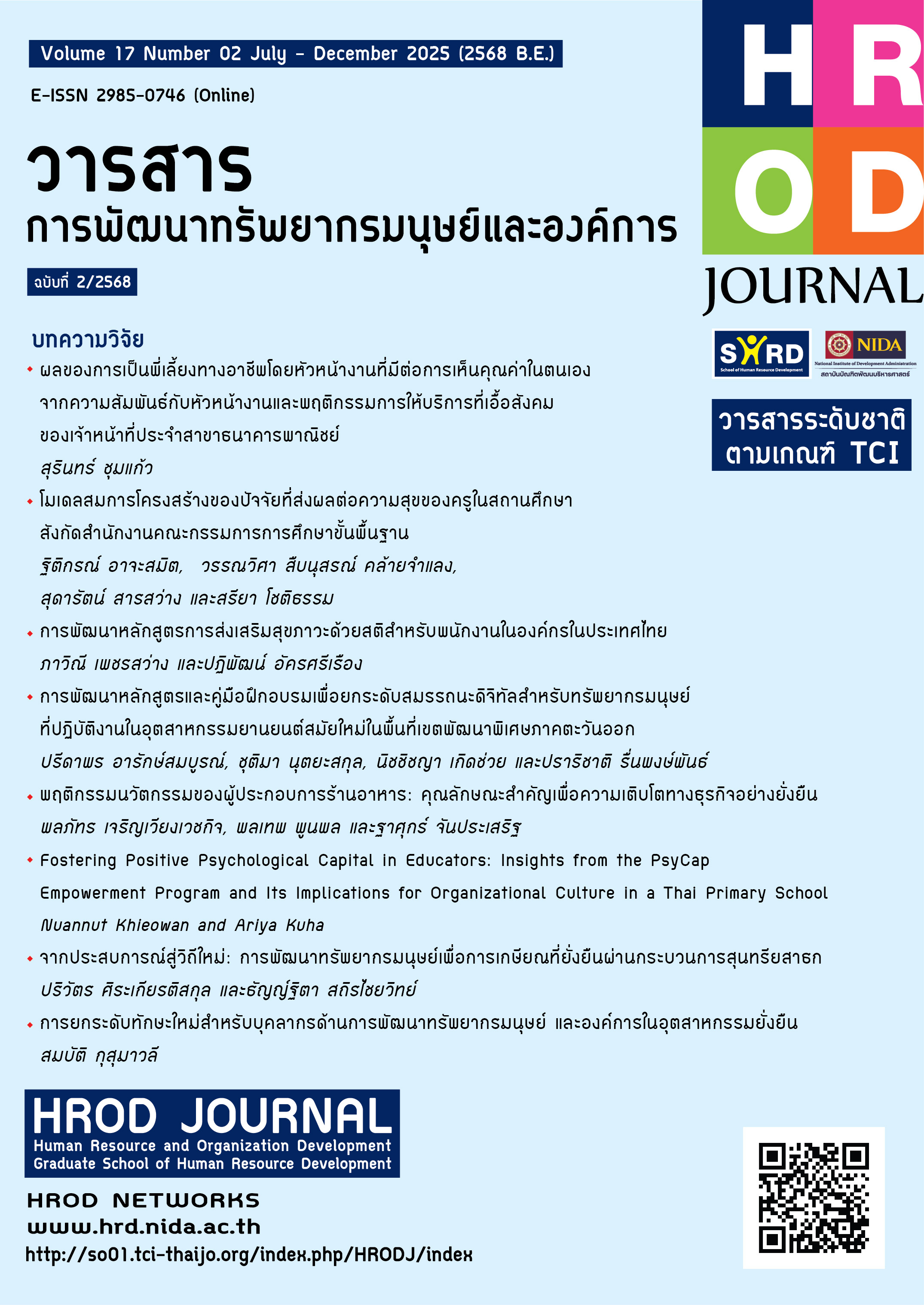
The Restaurant Entrepreneurial Innovative Behavior: Key Attributes for Sustainable Business Growth
Article Sidebar
Main Article Content
Abstract
The main objectives of the qualitative research were to demonstrate the innovative behavior of restaurant entrepreneurs in Thailand by exploring its meaning and critical components and examining how it aligns with or differs from innovative behavior according to theoretical concepts. The study utilizes the definition and components of innovation behavior proposed by Matthews and Brueggemann (2015) as the fundamental framework, which consists of two elements: discovery skill and delivery skill. The research data was collected through interviews with 13 restaurant and beverage entrepreneurs from 10 establishments. These entrepreneurs have demonstrated at least one innovative business practice in the past 5 years.
The study findings reveal that the definition and components of innovation behavior differ partially from Matthews and Brueggemann's concept. Notably, "networking" which is a sub-component of discovery skills, was not observed. Additionally, the definitions of each component differ from the theoretical concepts used in the study.
The research provides foundational insights for developing restaurant and beverage entrepreneurs in Thailand to foster innovative behavior that can contribute to sustainable business growth and national economic development.
Article Details

This work is licensed under a Creative Commons Attribution-NonCommercial-NoDerivatives 4.0 International License.
1) The content of article in HROD journal is the author’s wholly responsibility to research, analyze, summarize, compile, and reference data. The editorial department will not be responsible in anyway.
2) The submitted articles in HROD journal must be unpublished before and must not be currently under consideration for publication elsewhere. If it is detected for its repetition, the author must be responsible for infringement of copyright.
3) Authors will be asked to transfer copyright of the article to the Publisher. The article is prohibited to reproduce all or part of the text, unless allowed.
References
เชียงใหม่นิวส์. (2565, 27 กันยายน). ผุดนวัตกรรมลาบดิบพร้อมรับประทาน เอาใจนักเลงลาบแดนไกล. https://www.chiangmainews.co.th/social/2257500/
ประชาชาติธุรกิจ. (2563, 1 พฤศจิกายน). ธุรกิจอาหาร 4 แสนล้านอ่วม ปิดตัว 5 หมื่นรายเซ่นพิษโควิด. https://www.prachachat.net/economy/news-490041
ตรีทิพย์ บุญแย้ม. (2554). ปัจจัยเชิงสาเหตุพหุระดับที่มีอิทธิพลต่อพฤติกรรมการสร้างนวัตกรรมระดับบุคคลและระดับกลุ่มงานเพื่อสร้างนวัตกรรมผลิตภัณฑ์ในบริษัทเอกชนไทย [วิทยานิพนธ์ดุษฎีบัณฑิต, มหาวิทยาลัยศรีนครินทรวิโรฒ].
พรกนก วิภูษณวรรณ. (2560). คลื่นนวัตกรรมอุตสาหกรรมอาหาร. TMA Magazine, 7(27), 12–17.
สมนึก เอื้อจิระพงษ์พันธ์, พักตร์ผจง วัฒนสินธุ์, อัจฉรา จันทร์ฉาย และ ประกอบ คุปรัตน์. (2553). นวัตกรรม: ความหมาย ประเภท และความสำคัญต่อการเป็น ผู้ประกอบการ, วารสารบริหารธุรกิจ คณะพาณิชยศาสตร์และการบัญชีมหาวิทยาลัยธรรมศาสตร์, 33(128) 49-65
สำนักงานส่งเสริมวิสาหกิจขนาดกลางและขนาดย่อม. (2567). รายงานสถานการณ์ MSME ปี 2566. สำนักงานส่งเสริมวิสาหกิจขนาดกลางและขนาดย่อม.
สำนักงานส่งเสริมวิสาหกิจขนาดกลางและขนาดย่อม. (2566). รายงานสถานการณ์วิสาหกิจขนาดกลางและขนาดย่อม ปี 2566. https://bds.sme.go.th/Knowledge/Detail/16
สำนักงานส่งเสริมวิสาหกิจขนาดกลางและขนาดย่อม. (2568, 11 มกราคม). รายงานสถานการณ์วิสาหกิจขนาดกลางและขนาดย่อม ไตรมาสที่ 3/2567. สืบค้นจาก https://www.sme.go.th/uploads/file/20240930-133636_SME_Q3-2024_Final_ForWeb.pdf
สำนักงานสภาพัฒนาการเศรษฐกิจและสังคมแห่งชาติ กองยุทธศาสตร์และการวางแผนเศรษฐกิจมหภาค. (2566). ภาวะเศรษฐกิจไทยไตรมาสที่สี่ ทั้งปี 2565 และแนวโน้มปี 2566. 27 กันยายน 2567, จาก https://www.nesdc.go.th/ewt_dl_link.php?nid=13445.
Brown, E. (2015). Innovative thinking: Fixed vs. growth mindsets. Business in Greater Gainesville. https://www.businessmagazinegainesville.com/innovative-thinking-fixed-vs-growth-mindsets/
Derler, A. (2019). Growth mindset culture. NeuroLeadership Institute.
Dyer, J. H., Gregersen, H. B., & Christensen, C. M. (2008). Entrepreneur behaviors, opportunity recognition, and the origins of innovative ventures. Strategic Entrepreneurship Journal, 2(4), 317–338. https://doi.org/10.1002/sej.59
Guan, H., Zhang, Z., Zhao, A., Jia, J., & Guan, S. (2019). Research on innovation behavior and performance of new generation entrepreneurs based on grounded theory. Sustainability, 11(10), 2883. https://doi.org/10.3390/su11102883
De Jong, J., & Den Hartog, D. (2010). Innovative work behavior: Measurement and validation. Creativity and Innovation Management, 19(1), 23–36. https://doi.org/10.1111/j.1467-8691.2010.00547.x
Kleysen, R. F., & Street, C. T. (2001). Toward a multi-dimensional measure of individual innovative behavior. Journal of Intellectual Capital, 2(3), 284–296.
Matthews, C. H., & Brueggemann, R. F. (2015). Innovation and entrepreneurship. Routledge.
Nastasi, B. K., & Schensul, S. L. (2005). Contributions of qualitative research to the validity of intervention research. Journal of School Psychology, 43(3), 177–195. https://doi.org/10.1016/j.jsp.2005.04.003
Putri, M. K. (2023). Creative and innovative as an entrepreneur mindset. Jurnal Manajemen dan Bisnis, 11(2), 344–351.
Scott, S. G., & Bruce, R. A. (1994). Determinants of innovative behavior: A path model of individual innovation in the workplace. Academy of Management Journal, 37(3), 580–607. https://doi.org/10.2307/256701
Ward, T. B. (2004). Cognition, creativity, and entrepreneurship. Journal of Business Venturing, 19(2), 173–188. https://doi.org/10.1016/S0883-9026(03)00005-3
Zastempowski, M. (2023). Discovery skill of microentrepreneurs: Diagnosis in the context of innovation. Scientific Papers of Silesian University of Technology: Organization and Management Series, 185, 639–656.
