
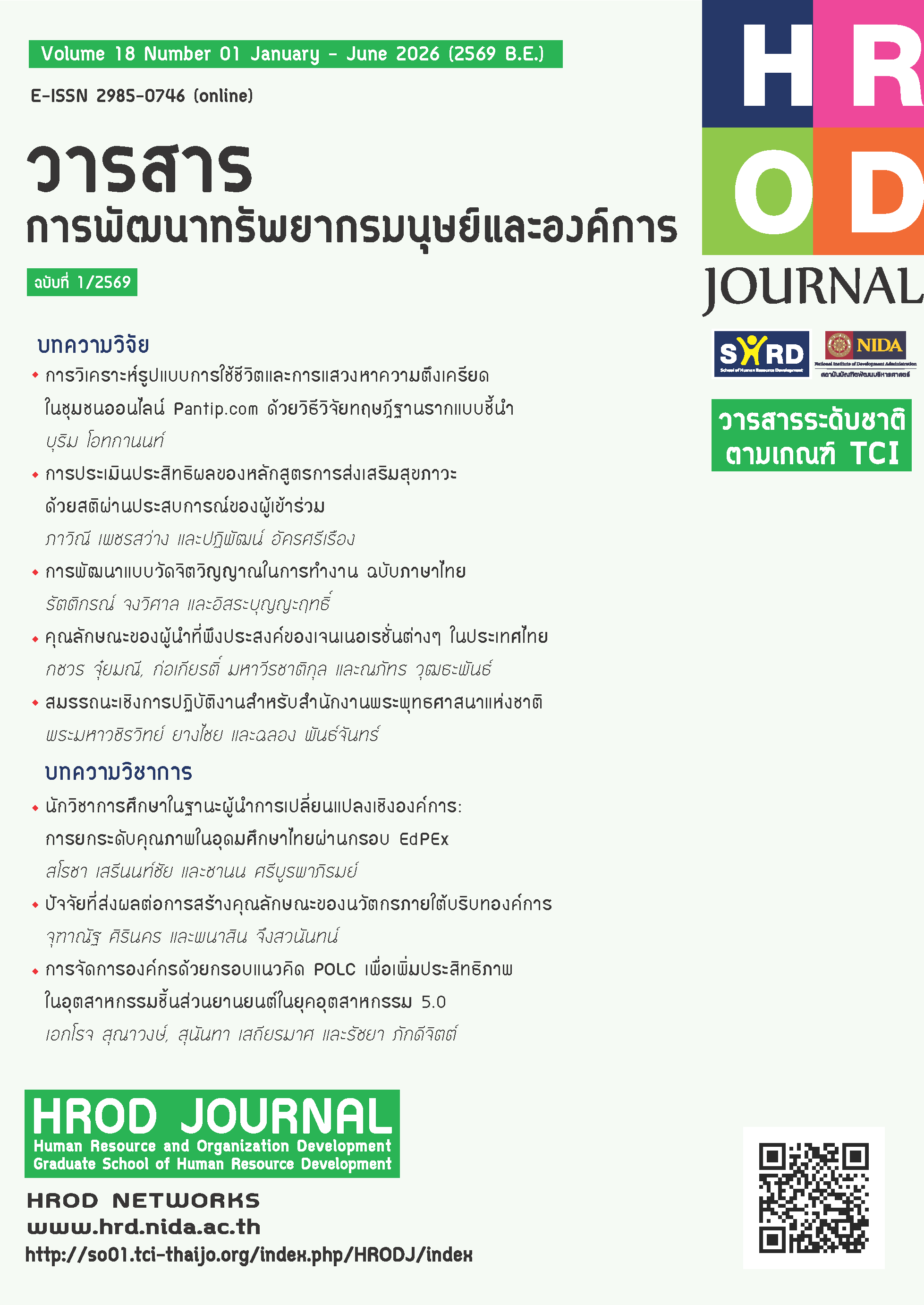
คุณลักษณะของผู้นำที่พึงประสงค์ของเจนเนอเรชั่นต่างๆ ในประเทศไทย
Article Sidebar
Main Article Content
บทคัดย่อ
ความสำเร็จขององค์การต้องอาศัยผู้นำที่พร้อมเผชิญกับการบริหารจัดการองค์การที่ท้าทายและสนับสนุนพนักงานทั้งเจนเนอเรชั่น X, Y และ Z ซึ่งมีค่านิยมและพฤติกรรมที่ต่างกันให้ทำงานร่วมกันได้อย่างเต็มความสามารถ ทั้งนี้มีการศึกษาที่ระบุว่าเจนเนอเรชั่นที่ต่างกันต้องการคุณลักษณะผู้นำที่ต่างกันอย่างชัดเจน แต่ก็มีผลงานวิจัยอีกส่วนหนึ่งระบุว่าในแต่ละเจนเนอเรชั่นต้องการคุณลักษณะผู้นำที่ไม่แตกต่างกัน งานวิจัยนี้มีวัตถุประสงค์เพื่อตรวจสอบคุณภาพแบบสำรวจคุณลักษณะผู้นำที่พึงประสงค์และเปรียบเทียบคุณลักษณะผู้นำที่พึงประสงค์ของพนักงานในแต่ละเจนเนอเรชั่นโดยกลุ่มตัวอย่างคือ คนไทยที่มีอายุระหว่าง 18-60 ปี ซึ่งมีประสบการณ์ทำงานและได้รับค่าจ้าง จำนวน 404 คน ผลการศึกษาพบว่าแบบสำรวจภาวะผู้นำที่พึงประสงค์มีค่าความตรงเชิงเนื้อหา ความตรงเชิงโครงสร้าง ความตรงสู่สมบูรณ์ และความเที่ยงเชิงความสอดคล้องภายในอยู่ในเกณฑ์มาตรฐาน นอกจากนี้ยังพบว่ากลุ่มเจนเนอเรชั่น X มีความพึงประสงค์ในภาวะผู้นำการเปลี่ยนแปลงสูงกว่าภาวะผู้นำที่แท้จริง ภาวะผู้นำแบบผู้รับใช้ และภาวะผู้นำแบบหลอมรวม อย่างมีนัยสำคัญทางสถิติ ในขณะที่กลุ่มเจนเนอเรชั่น Y และ Z มีความพึงประสงค์ในภาวะผู้นำทั้งสี่แบบไม่แตกต่างกันอย่างมีนัยสำคัญทางสถิติ ข้อค้นพบนี้จะเป็นประโยชน์ต่อผู้บริหารในการปรับรูปแบบการนำทีมให้เหมาะสมกับผู้ตามในแต่ละเจนเนอเรชั่น นอกจากนี้ฝ่ายทรัพยากรมนุษย์ยังสามารถออกแบบโปรแกรมพัฒนาภาวะผู้นำได้ตอบโจทย์ความต้องการของพนักงานในเจนเนอเรชั่นต่างๆ ได้อย่างมีประสิทธิผล
Article Details

อนุญาตภายใต้เงื่อนไข Creative Commons Attribution-NonCommercial-NoDerivatives 4.0 International License.
1) เนื้อหาทั้งหมดของบทความที่ลงตีพิมพ์ในวารสารการพัฒนาทรัพยากรมนุษย์และองค์การ เจ้าของผลงานมีการคิด ค้นคว้า ทบทวนวิเคราะห์ สรุป เรียบเรียงและอ้างอิงข้อมูลโดยผู้แต่งเอง กองบรรณาธิการไม่มีส่วนร่วมรับผิดชอบ
2) บทความที่ตีพิมพ์ในวารสารนี้ ต้องไม่เคยได้รับการตีพิมพ์เผยแพร่ที่ใดมาก่อน และไม่อยู่ระหว่างการเสนอเพื่อพิจารณาตีพิมพ์ในวารสารฉบับอื่น หากตรวจพบว่า มีการตีพิมพ์ซ้ำซ้อน ถือเป็นความรับผิดชอบของผู้แต่งแต่เพียงผู้เดียวในการละเมิดลิขสิทธิ์
3) ผลงานที่ได้รับการตีพิมพ์ในวารสารวิชาการ ถือเป็นกรรมสิทธิ์ของวารสารห้ามนำข้อความทั้งหมดหรือบางส่วนไปพิมพ์ซ้ำ เว้นเสียแต่ว่าจะได้รับอนุญาตจากทางกองบรรณาธิการวารสารฯ
เอกสารอ้างอิง
กรมสุขภาพจิต. (2563, 24 กันยายน). Gen Y/Gen Me ประชากรกลุ่มใหญ่ของโลกยุคดิจิตอล ผู้กุมชะตาโลกในอนาคต. https://dmh.go.th/news/view.asp?id=1251
กิตติกวินท์ เอี่ยมวิริยาวัฒน์. (2565). ภาวะผู้นำแบบ Inclusive Leadership ต่อความสำเร็จในการประกอบธุรกิจช่วงสถานการณ์ COVID-19: กรณีศึกษาผู้ประกอบการวิสาหกิจขนาดกลางและขนาดย่อม จังหวัดบุรีรัมย์. วารสารศิลปศาสตร์และวิทยาการจัดการ, 6(2), 1–14. https://so02.tci-thaijo.org/index.php/journalfms-thaijo/article/view/259784
ชวิน ศิลาพันธ์ และ รัตติกรณ์ จงวิศาล. (2564). อิทธิพลของทุนทางจิตวิทยา ภาวะผู้นำที่แท้จริง และจิตวิญญาณในสถานที่ทำงานที่มีต่อความร่วมมือของข้าราชการกรมราชทัณฑ์ในเรือนจำพิเศษในเขตกรุงเทพมหานคร. มนุษยศาสตร์สาร, 22(2), 95–114. https://so03.tci-thaijo.org/index.php/JHUMANS/article/view/246919
เดชา เดชะวัฒนไพศาล, กฤษยา นุ่มพยา, จีราภา นวลลักษณ์ และ ชนพัฒน์ ปลื้มบุญ. (2557). การศึกษาเจนเนอเรชั่นเอ็กซ์และเจนเนอเรชั่นวายในมุมมองต่อคุณลักษณะของตนเองและความคาดหวังต่อคุณลักษณะของเจนเนอเรชั่นอื่น. จุฬาลงกรณ์ธุรกิจปริทัศน์, 36(141), 1–17. https://so01.tci-thaijo.org/index.php/CBSReview/article/view/22362
ทศพล กระต่ายน้อย. (2555). ภาวะผู้นำของนักศึกษาสายสังคมศาสตร์ มหาวิทยาลัยเชียงใหม่ [การค้นคว้าแบบอิสระปริญญามหาบัณฑิต, มหาวิทยาลัยเชียงใหม่]. บัณฑิตวิทยาลัย มหาวิทยาลัยเชียงใหม่. https://cmudc.library.cmu.ac.th/frontend/Info/item/dc:117472
ธมลวรรณ มีเหมย, รัตติกรณ์ จงวิศาล, และ ไฉไล ศักดิวรพงศ์. (2554). ภาวะผู้นำแบบผู้รับใช้ จิตวิญญาณในองค์การ ที่ส่งผลต่อผลการปฏิบัติงานของผู้บริหารระดับต้น ธุรกิจอุตสาหกรรมอาหารแห่งหนึ่งในเขตกรุงเทพมหานคร. วารสารวิชาการพระจอมเกล้าพระนครเหนือ, 21(2). https://ph01.tci-thaijo.org/index.php/kmutnb-journal/article/view/3751
นุช สัทธาฉัตรมงคล และ อรรถพล ธรรมไพบูลย์. (2559). ผู้นำการเปลี่ยนแปลงในยุคโลกาภิวัตน์สู่การพัฒนาอย่างยั่งยืน. วารสารธุรกิจปริทัศน์, 8(1), 167–182.
พนิดา ไชยแก้ว. (2559). อิทธิพลภาวะผู้นำของ Generation Y ต่อความสำเร็จทางธุรกิจ: กรณีศึกษาผู้ประกอบการกลุ่ม Generation Y ในประเทศไทย [วิทยานิพนธ์ปริญญาบริหารธุรกิจมหาบัณฑิต]. มหาวิทยาลัยธรรมศาสตร์.
มนัสวี ศรีนนท์. (2561). ทฤษฎีเจเนอเรชันกับกรอบวิธีคิด. จุลสารนวัตกรรม สถาบันนวัตกรรมการเรียนรู้ มหาวิทยาลัยมหิดล, 12(46), 2–3.
ไฮไลท์ประชาชาติ. (2568, 7 มีนาคม). แบ่งกลุ่ม 63 ล้านประชากรไทย แต่ละเจนต่างกันยังไง คนรุ่นไหนใหม่-เก่า? ประชาชาติธุรกิจออนไลน์. https://www.prachachat.net/hilight-prachachat/news-1768310
Ackerman, C. E. (2019, April 8). Positive leadership: 30 must-have traits and skills. PositivePsychology.com. https://positivepsychology.com/positive-leadership/
Amornpipat, I., & Sorod, B. (2017). Development of Thai authentic leadership measure: An application in a military context. Journal of Community Development Research (Humanities and Social Sciences), 10(2), 11–24. https://www.journal.nu.ac.th/JCDR/article/view/1816
Andi, H. K. (2018). Leadership styles preference among millennials workforce. Malaysian Journal of Youth Studies, 19, 114–134.
Avolio, B. J., & Bass, B. M. (1995). Individual consideration viewed at multiple levels of analysis: A multi-level framework for examining the diffusion of transformational leadership. The Leadership Quarterly, 6(2), 199–218. https://doi.org/10.1016/1048-9843(95)90035-7
Bass, B. M., & Avolio, B. J. (1993). Transformational leadership and organizational culture. Public Administration Quarterly, 17(1), 112–121
Bourke, J. (2016, April 14). The six signature traits of inclusive leadership: Thriving in a diverse new world. Deloitte Insights. https://www.deloitte.com/us/en/insights/topics/talent/six-signature-traits-of-inclusive-leadership.html
Ceballos, S. D. (2017). A study of the differences in GLOBE leadership preferences between Baby Boomers, Generation X, and Millennials [Doctoral dissertation, Our Lady of the Lake University].
Clapp-Smith, R., Vogelgesang, G. R., & Avey, J. B. (2009). Authentic leadership and positive psychological capital: The mediating role of trust at the group level of analysis. Journal of Leadership & Organizational Studies, 15(3), 227–240. https://doi.org/10.1177/1548051808326596
De Meuse, K. P., & Mlodzik, K. J. (2010). A second look at generational differences in the workforce: Implications for HR and talent management. People & Strategy, 33(2), 50–58.
Giallonardo, L. M., Wong, C. A., & Iwasiw, C. L. (2010). Authentic leadership of preceptors: Predictor of new graduate nurses' work engagement and job satisfaction. Journal of Nursing Management, 18(8), 993–1003. https://doi.org/10.1111/j.1365-2834.2010.01126.x
Glass, A. (2007). Understanding generational differences for competitive success. Industrial and Commercial Training, 39(2), 98–103. https://doi.org/10.1108/00197850710732424
Greenleaf, R. K. (2002). Servant leadership: A journey into the nature of legitimate power and greatness (25th anniversary ed.). Paulist Press.
Hair, J. F., Black, W. C., Babin, B. J., & Anderson, R. E. (2010). Multivariate data analysis (7th ed.). Pearson.
Hall, T. L. (2012). Leadership style predilection of Baby Boomers, Generation X'ers, and Generation Y'ers [Doctoral dissertation, University of Maryland University College]. ProQuest Dissertations and Theses Global. https://www.proquest.com/openview/7ace18afcbaafdf18f8b27e8e2383e3a/1?pq-origsite=gscholar&cbl=18750
Huyler, D., Gomez, L., Rocco, T. S., & Plakhotnik, M. S. (2025). Leading different generational cohorts in the workplace: Focus on situational and inclusive leadership. New Horizons in Adult Education and Human Resource Development, 37(1), 6–19. https://doi.org/10.1177/19394225241297230
Lhuglham, W., & Pruetipibultham, O. (2024). Leadership preferences of Generation Z toward performance and retention in electronic manufacturing company. International Journal of Human Resource and Organization Development, 1(1), 1–21. https://so13.tci-thaijo.org/index.php/IJHROD/article/view/610
Liden, R. C., Wang, X., & Wang, Y. (2025). The evolution of leadership: Past insights, present trends, and future directions. Journal of Business Research, 186, 115036. https://doi.org/10.1016/j.jbusres.2024.115036
Lin, C. (2020). The effect of inclusive leadership on employee well-being: A case of XYZ bank in Yunnan, China. ABAC ODI Journal Vision. Action. Outcome, 7(2), 39–61.
Lussier, R. N., & Achua, C. F. (2015). Leadership: Theory, application, & skill development (6th ed.). Cengage Learning.
McGaha, K. K. (2018). An interpretive phenomenological study of America’s emerging workforce: Exploring Generation Z’s leadership preferences [Doctoral dissertation, University of Phoenix]. ProQuest Dissertations and Theses Global.
Nembhard, I. M., & Edmondson, A. C. (2006). Making it safe: The effects of leader inclusiveness and professional status on psychological safety and improvement efforts in health care teams. Journal of Organizational Behavior, 27(7), 941–966. https://doi.org/10.1002/job.413
Ramírez-Herrero, V., Ortiz-de-Urbina-Criado, M., & Medina-Merodio, J. A. (2024). Intergenerational leadership: A leadership style proposal for managing diversity and new technologies. Systems, 12(2), 50. https://doi.org/10.3390/systems12020050
Reisenwitz, T. H., & Iyer, R. (2009). Differences in Generation X and Generation Y: Implications for the organization and marketers. Marketing Management Journal, 19(2), 91–103.
Seemiller, C., & Grace, M. (2016). Generation Z goes to college. Jossey-Bass.
Seneechai, N. (2014). Preference leadership styles of Generation Y [Master’s thesis, Mahidol University]. CMMU Digital Archive. https://archive.cm.mahidol.ac.th/handle/123456789/621
Spears, L. C., & Lawrence, M. (2016). Practicing servant-leadership: Succeeding through trust, bravery, and forgiveness. John Wiley & Sons.
Tenney, M. (n.d.). The 4 positive leadership styles in business. https://businessleadershiptoday.com/what-are-the-4-leadership-styles-in-business/
University of Southern California Libraries. (2025, August 28). Business demography: Age. https://libguides.usc.edu/busdem/age
Walumbwa, F. O., Avolio, B. J., Gardner, W. L., Wernsing, T. S., & Peterson, S. J. (2008). Authentic leadership: Development and validation of a theory-based measure. Journal of Management, 34(1), 89–126. https://doi.org/10.1177/0149206307308913
Wuttaphan, N. (2023). Gamification mechanism and elements affecting gamification dynamics: A case of Generation Z in Thailand. Journal of Humanities and Social Sciences Nakhon Phanom University, 13(3), 35–48. https://so03.tci-thaijo.org/index.php/npuj/article/view/272737
Yasar, R. (2024). The relationship between leadership styles and employees’ motivation of Generation Z [Independent study, Master of Business Administration, Siam University]. https://e-research.siam.edu/kb/the-relationship-between-leadership-styles
