
Social Media and New Form of Protest: A Case of the Thailand’s 2020 Political Movements
Keywords:
Social Media, Social Movements, Thailand’s Political MovementsAbstract
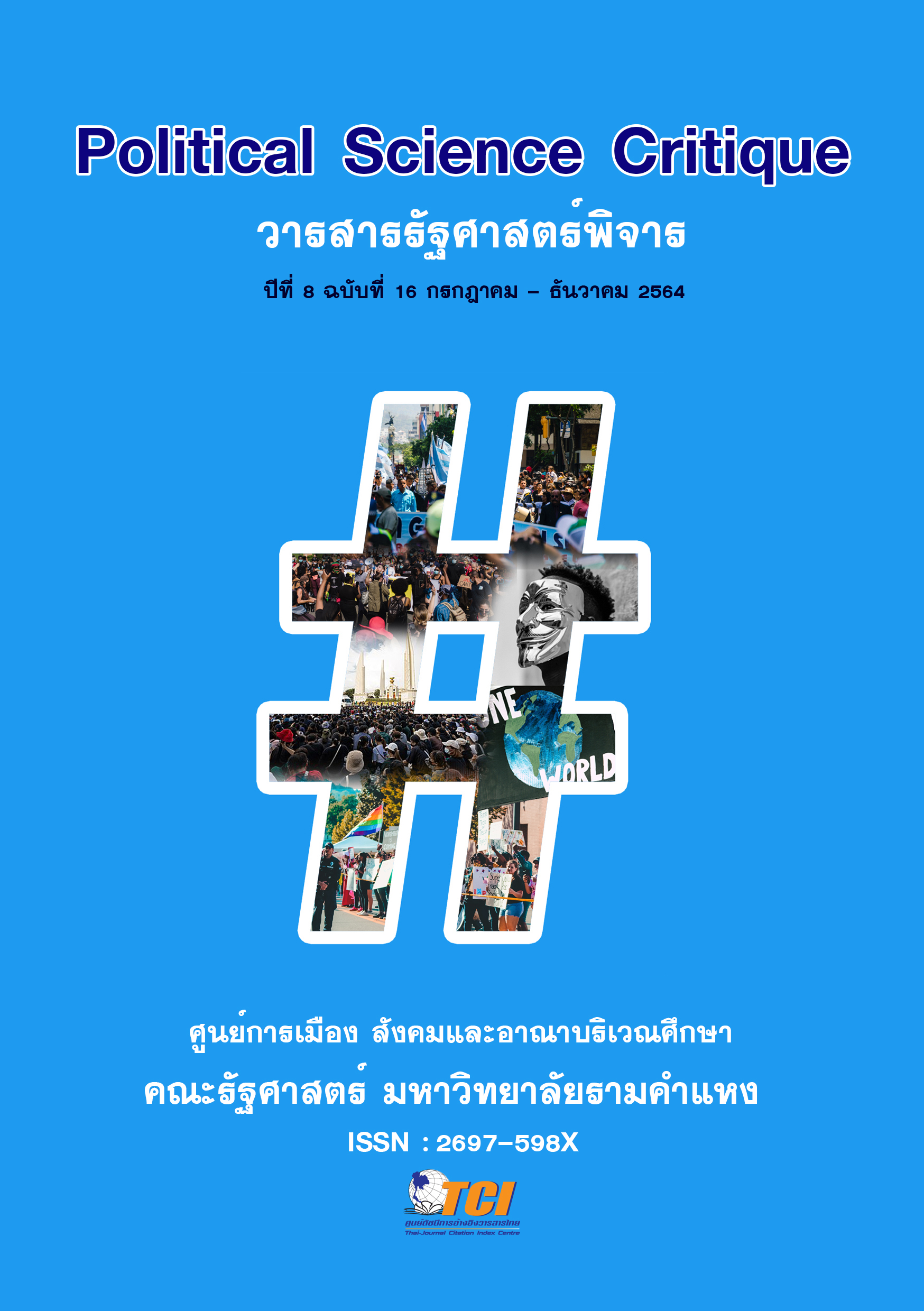
This article presents the changes in Thai political protest movements in 2020, especially the use of social media in protest movements. It was found that social media is a form of communication developed from the Internet. And as an alternative to creating change in the political protest movement in Thailand during that period as well, such as expressing opinions, interactive communication, the mobilization of people and activities in parallel with the normal activities of the protest movement. It has become a new area of political protest for people online. However, the adoption of social media also faces problems that may not be successful when used as a form of the political protest movement. For example, it is seen as a tool by individuals who are separated from society. The use of language can change society and politics and mismanagement of movement strategies, etc.
References
นันทนา นันทวโรภาส. (2558). สื่อสารการเมือง: ทฤษฎีและการประยุกต์ใช้ .พิมพ์ครั้งที่ 2. กรุงเทพฯ: สถาพรบุ๊คส์.
บีบีซีไทย. (2563). แฟลชม็อบนักศึกษา ถึง ชุมนุมใหญ่ของ "คณะราษฎร 2563" ลำดับเหตุการณ์ชุมนุมทางการเมืองปี 2563. ค้นเมื่อ 10 กรกฎาคม 2564 จาก https://www.bbc.com/thai/thailand-54741254.
บีบีซีไทย. (2563). เยาวชนปลดแอก: ใครเป็นใครในแกนนำ-ผู้ชุมนุมที่ถูกดำเนินคดี. ค้นเมื่อ 18 กรกฎาคม 2564 จาก https://www.bbc.com/thai/thailand-53846800
บีบีซีไทย. (2563). เยาวชนปลดแอก: กลุ่ม FreeYOUTH ลั่น "มันจะไม่จบแค่นี้" แกนนำพร้อมถูกดำเนินคดีหากมีหมายเรียก. ค้นเมื่อ 19 กรกฎาคม 2564 จาก https://www.bbc.com/thai/thailand-53846800
บีบีซีไทย. (2563). ประท้วงฮ่องกง : เทเลแกรม แอปพลิเคชันขับเคลื่อน "การประท้วงไร้ผู้นำ" ของชาวฮ่องกงได้อย่างไร. ค้นเมื่อ 25 กรกฎาคม 2564 จาก https://www.bbc.com/thai/international-48822097
ไทยพีบีเอส. (2563). รู้จัก Telegram ช่องทางนัดชุมนุมยุคใหม่. ค้นเมื่อ 25 กรกฎาคม 2564 จาก https://news.thaipbs.or.th/content/297497
ไทยรัฐออนไลน์. (18 ตุลาคม 2563). "เทเลแกรม" อีกช่องทางสื่อสาร ม็อบดาวกระจายคณะราษฎร รูปแบบ "ฮ่องกงโมเดล". ค้นจาก https://www.thairath.co.th/news/politic/1955760
ธนศักดิ์ สายจำปา. (2559). “การเคลื่อนไหวทางสังคมออนไลน์: ประเด็นท้าทายทฤษฎีการเคลื่อนไหวทางสังคม.” วารสารรัฐศาสตร์ มสธ. 1,1: 77-96.
พิจิตรา สึคาโมโต้. (2564). สื่อไทยในวิกฤต การเมืองเปลี่ยนผ่าน เทคโนโลยีปั่นป่วน. โครงการตำราคณะนิเทศศาสตร์ จุฬาลงกรณ์มหาวิทยาลัย. กรุงเทพฯ: จุฬาลงกรณ์มหาวิทยาลัย.
ประชาชาติธุรกิจ. (23 กันยายน 2563). “ดีอีเอส” เตรียมแจ้งความ 10 ราย ผิด พ.ร.บ. คอมพิวเตอร์ ระหว่างชุมนุม. ค้นจาก https://www.prachachat.net/politics/news-526422
มติชนออนไลน์. (21 กุมภาพันธ์ 2563). โลกออนไลน์ทวิต #Saveอนาคตใหม่ ขึ้นอันดับหนึ่ง หลังศาลวินิจฉัยยุบพรรค ตัดสิทธิ 10 ปี. ค้นจาก https://www.matichon.co.th/politics/news_1993057
เดอะแมทเทอร์. (2019). โซเชียลมีเดียสร้างการเคลื่อนไหวทางสังคมได้ แต่ก็ทำให้ล้มเหลวได้เช่นกัน?. ค้นเมื่อ 28 กันยายน 2564 จาก https://thematter.co/thinkers/success-and-failure-of-social-media/88989
เดอะวันโอวันดอทเวิร์ล. (2020). #WhatsHappeninginThailand: เมื่อการเมืองออนไลน์ลงสู่ท้องถนน. ค้นเมื่อ 11 กรกฎาคม 2564 จาก https://www.the101.world/surachanee-sriyai-interview/
ไอลอว์. (2020). บันทึกข้อมูลการชุมนุมของนักเรียน นิสิต นักศึกษาและประชาชน ตั้งแต่วันที่ 22 กุมภาพันธ์ 2563. ค้นเมื่อ 15 กรกฎาคม 2564 จาก https://freedom.ilaw.or.th/en/node/825
เวิร์คพ้อยท์ทูเดย์. (2020). ม็อบดิจิตัล: ความป๊อปในโลกออนไลน์ ที่ผลักดันให้การชุมนุมเข้าถึงคนมากขึ้น. ค้นเมื่อ 11 กรกฎาคม 2564 จาก https://workpointtoday.com/thailand-protest-2020-digital-movement/
ว้อยซทีวี. (2020). #แท็กเพื่อนไปม็อบ ทะยานอันดับ 1 เทรนด์ทวิตเตอร์ไทย. ค้นเมื่อ 1 ตุลาคม 2564 จาก https://www.voicetv.co.th/read/XFF5rnaCn
Castells, M. (2015). Networks of Outrage and Hope: Social Movements in the Internet Age. Second Edition. Cambridge: Polity Press.
Earl, J. (2016). Protest Online. In Bosi, L., G and Uba K (Eds). The Consequences of Social Movements. Cambridge:Cambridge University Press.
Gamson, W. A., and Wolfsfeld, G. (1993). “Movements and Media as Interacting Systems.”Annals of the American Academy of Political and Social Science 528: 114-125.
Gurak, L. J. and Logie, J. (2003). Internet Protests, from Text to Web. In Caughey, M. M. and Ayers, M. D. (Eds.) Cyberactivism: online activism in theory and practice. New York: Routledge.
Hara, N., and Huang B. Y. (2011). “Online Social Movements.” Annual Review of Information Science and Technology 45,1: 489-522.
Jacobin Magazine. (2020). The Problem With Hashtag Activism. Retrieved on 2 September 2021 From https://jacobinmag.com/ 2020/12/ hashtag-activism-review-twitter-social-justice.
Laer, J. V., and Aelst, P. V. (2010). “Internet and Social Movement Action Repertoires:Opportunities and Limitations.”Information, Communication & Society 8: 1146-1171.
Madison, N. and Klang, M. (2020). “The Case for Digital Activism: Refuting The Fallacies of Slacktivism.” Journal of Digital Social Research 2,2: 29-47.
Poell, T. and Dijck J. V. (2018). Social Media and New Protest Movements. In Burgess, J., Marwick, A. and Poell T. (Eds.) The SAGE Handbook of Social Media. London: SAGE Publications.
Sinpeng, Aim. (2021). “Hashtag activism: social media and the #FreeYouth protests in Thailand.” Critical Asian Studies 53,1: 1-14.
Sriyai, S. (2018). Weaving the Web: Internet, Mobilization, and Contentious Political Movements.(Doctoral Dissertation). Texas: Texas Tech University.
The Conversation. (2018). #Revolution: how the humble hashtag changed world politics. Retrieved on 2 September 2021 From https://theconversation.com/revolution-how-the-humble-hashtag-changed-world-politics-105483.
Tufekci, Z. (2014). “Social Movements and Governments in the Digital Age.” Journal of International Affairs 68,1: 1-18.
Turner, E. (2013). “New Movements, Digital Revolution, and Social Movement Theory.” Peace Review: A Journal of Social Justice 25,3: 376-383.
Downloads
Published
How to Cite
Issue
Section
License
All contents and information in the manuscripts published by Journal of Political Science Critique are the authors’ opinions; thus, the authors take sole responsibility for any contents. The editorial board does not agree with or accept responsibility for the manuscripts.
All published articles, information, contents, pictures, or other things in Journal of Political Science Critique are Copyright by the Journal. All Rights Reserved. All contents may not be copied or duplicated in whole or part by any means without the prior written permission of Journal of Political Science Critique.

